10 Best Montessori Toys for 1 Year Old India: Under ₹2500
Looking for best Montessori toys for 1 year old? Discover top 10 picks under ₹2500 in India, plus a pediatrician-vetted safety checklist for your toddler.
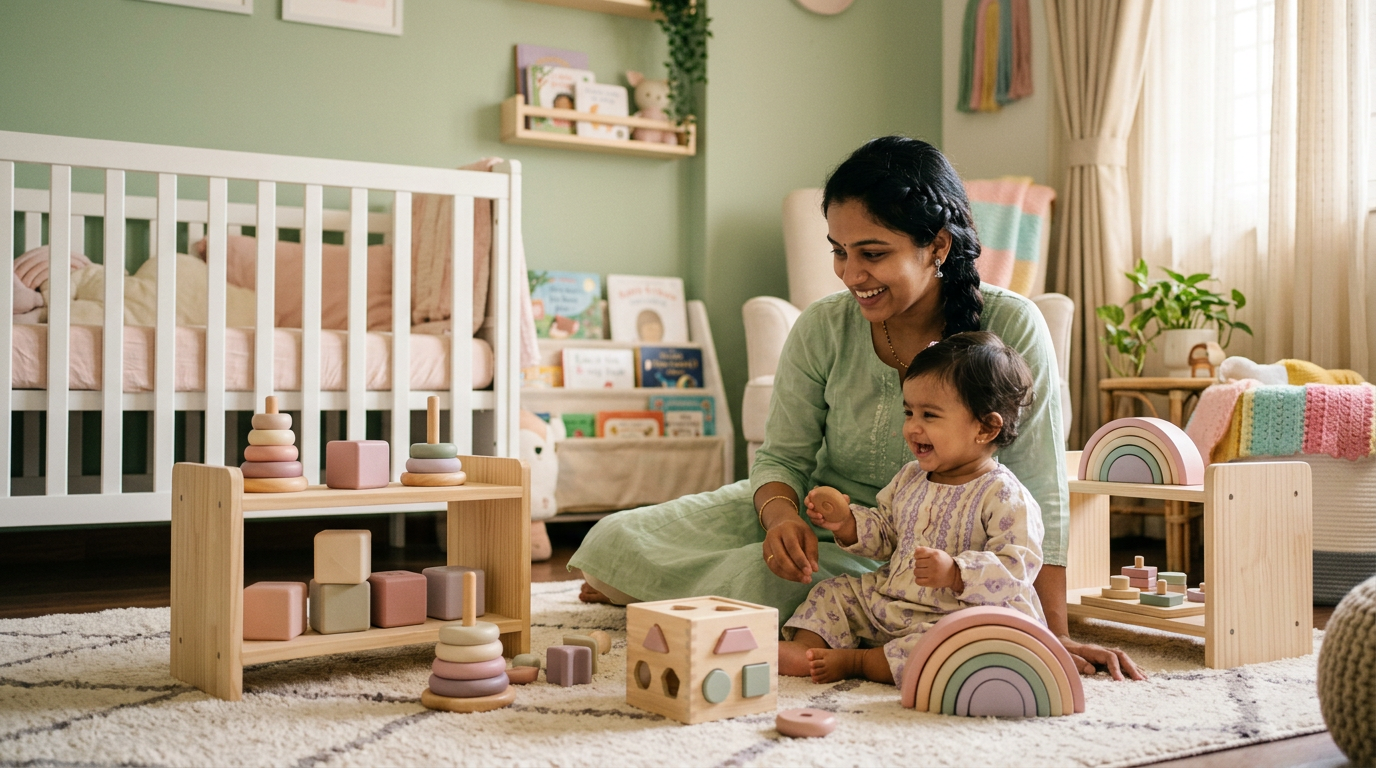
At 14 months, my daughter spent forty-five minutes trying to put a single steel katori inside a larger one, oblivious to the expensive, noisy plastic "learning station" blinking in the corner. That was my wake-up call. For a 1-year-old in India, the best Montessori toys aren't just about "wooden aesthetics"; they are tools that satisfy a child’s intense biological drive to master their hands and understand how the world works.
If you are looking for the "best Montessori toys for 1 year old" in India, the goal is simple: fewer toys, higher quality, and zero batteries. You don't need a ₹5,000 imported set. You need 5-10 purposeful items that encourage "Independent Play" while you finally drink your chai hot.
What actually makes a toy "Montessori" for a 1-year-old?
In our Indian homes, we often confuse "educational" with "loud and colourful." But Maria Montessori’s philosophy at this age (the "toddler" phase) focuses on Practical Life and Sensorimotor development.
A Montessori toy should:
* Isolate one skill: If it’s a shape sorter, it shouldn't also play music.
* Be made of natural materials: Wood, metal, cotton, or silicone feel different to the touch (unlike uniform plastic).
* Promote "Functional Independence": It should allow the child to do something "real."
* Be open-ended: It encourages the child to think, not just react to a button.
Top 10 Montessori Toys Under ₹2500 (India Picks)
Here are the best picks currently available on Indian marketplaces like Amazon, FirstCry, or niche brands like Shumee and Ariro, all keeping your budget in mind.
1. The Object Permanence Box (₹800 - ₹1200)
This is the "OG" Montessori toy. It’s a wooden box with a hole and a tray. The baby drops the ball, it disappears, then rolls back out.
* Why it works: Around 10-12 months, babies grasp that things exist even when they can't see them. This reduces separation anxiety!
Where to find: Brands like Shumee or Lark India*.
2. Wooden Stacking Rings (₹400 - ₹700)
Forget the plastic ones. A wooden set provides weight and resistance.
* Pro-tip: Start with only 2 or 3 rings of very different sizes so they don't get frustrated.
Local pick: Skola Toys or Maya Organic* (Channapatna toys are naturally dyed and safe).
3. Horizontal & Vertical Precision Stackers (₹600 - ₹900)
Unlike simple rings, these require the child to turn their wrist horizontally or vertically to fit a disc onto a peg.
* The Skill: Hand-eye coordination and wrist rotation (essential for future spoon-feeding and writing).
4. Hammer Box / Pound-a-Peg (₹700 - ₹1100)
Toddlers have a lot of "maximum effort" energy. They want to hit things.
Mama-to-mama: Instead of them hitting the sasu maa's* coffee table, give them a wooden hammer and pegs. It’s a great outlet for "big feelings."
5. Standard Puzzles with Large Knobs (₹300 - ₹500 per board)
Choose puzzles with only 3-5 pieces (fruits, transport, or animals). The large wooden knob helps develop the pincer grasp (using the thumb and index finger).
Look for: Webby or Skillofun* wooden puzzles.
6. The "Cleaning" Set (₹500 - ₹1500)
At 1 year, your toddler wants to be just like you.
The Indian Hack: Don't buy a toy set. Go to a local store and buy a small hand-broom (jhadu), a small steel balti*, and a cotton cloth. Giving them a damp cloth to "wipe" the bookshelf is the ultimate Montessori activity.
7. Coin Box / Piggy Bank (₹900 - ₹1400)
This involves slotting large wooden "coins" into a thin slit.
* Why it’s great: It builds incredible focus. You will see that "tongue-out" look of pure concentration.
8. Stainless Steel Nesting Bowls (₹500 - ₹800)
You likely already have these in your kitchen!
The Activity: Buy a set of 5 stainless steel topes* or bowls from a local Bartan shop. They are durable, make a satisfying sound, and teach size discrimination better than any plastic toy.
9. Rainbow Nesting Grimms-style Arches (Replica) (₹1200 - ₹1800)
While the German originals are ₹4000+, Indian brands like Ariro or Simple Days make beautiful neem-wood or pine-wood versions.
* The Play: They can be bridges, tunnels, or fences for their wooden cows.
10. Scooping and Pouring Station (₹200 - ₹500)
Use a tray, two small stainless steel cups, and some dried chana or mung dal.
* The Goal: Transferring the grain from one cup to another using a small spoon.
* Safety Note: Always supervise this to prevent choking hazards.
> Real talk: The "Instagram" trap
> You’ll see reels of "Montessori Playrooms" looking like perfectly beige museums. Let’s be real—your Indian home will have colourful curtains, a jhoola, and maybe some scattered baingan from the morning vegetable shop. Montessori is a mindset, not a colour palette. If a ₹100 plastic bucket from the local market allows your child to practice pouring water in the bathroom, that is Montessori. Don't go into debt for wooden toys.
Safety Checklist: Is it Toddler-Safe?
Before you click 'Buy' or hand over that velan (rolling pin) from the kitchen, screen it through this BIS-inspired checklist:
Real talk from Indian moms
"I spent ₹2000 on a fancy 'Geometric Stacker'. My son ignored it for weeks until I put it on a low, open shelf instead of in a crowded toy box. Suddenly, it was his favourite thing. Sometimes it's not the toy; it's how you present it."
— Ananya, Bengaluru mom of a 15-month-old
"We stopped buying battery-operated cars because my daughter would just sit and watch them move. We switched to a simple wooden push-cart (the gaadi). Now she's the one moving, walking, and 'delivery-ing' her blocks across the 2BHK. Better for her, quieter for me!"
— Pooja, Delhi mom of a 1-year-old
When to call your paediatrician
While play is mostly fun, certain "behaviours" during play can be red flags for developmental delays:
* No eye contact: If your child doesn't look at you to share their "success" (e.g., after finishing a puzzle).
Persistent Pica: If they are only* interested in eating the wood/paint rather than playing with the toy after 14-15 months.
* Losing skills: If they could stack blocks at 12 months but suddenly "forget" how to at 14 months.
* No Pointing: If they cannot point with one finger to show you an object they want.
FAQ: Picking the best Montessori toys for 1 year old
Isn't "Montessori" just a fancy word for expensive wooden toys?
No. Montessori is about "following the child." Giving your child a safe drawer in the kitchen filled with plastic dabbas and steel spoons to sort is 100% Montessori and costs ₹0. The wooden toys are just durable, sensory-rich tools to help that process.
My child still puts everything in their mouth. Are wooden toys safe?
Yes, provided they are made of solid wood (like Neem, Rubberwood, or Beech) and water-based paints. Avoid "MDF" or "Engineered wood" as these contain glues/formaldehydes that shouldn't be chewed.
How many toys should I give them at once?
Try Toy Rotation. Only put out 6 to 8 toys on a low shelf. Keep the rest in a cupboard. When they get bored (usually every 2 weeks), swap them. This prevents "overstimulation" where a child just throws toys instead of playing with them.
Where can I buy authentic Indian Montessori toys?
Look for brands like Ariro (specialise in Neem wood), Shumee (great for skill-based toys), Skola, and Maya Organic. Even IKEA India has some great basic wooden blocks and trackers that fit the philosophy.
Can I use plastic toys in a Montessori home?
Absolutely. Montessori isn't "anti-plastic"; it's "pro-reality." A set of plastic animals for a sensory bin or a high-quality Tupperware for nesting is perfectly fine. Avoid toys that "do the work" for the child (flashing lights, singing alphabets).
Choosing the right toys isn't about the price tag—it’s about observing your child's "Current Obsession." If they are obsessed with opening drawers, get them a lock-and-latch board. If they are obsessed with throwing, give them a soft ball and a basket.
Your child's brain is a sponge; you don't need to force-feed it, just give it the right environment to soak.",excerpt:
Sources & further reading
- IAP — Growth and Development Milestones
- BIS — Safety of Toys (IS 9873) Guidelines
- WHO — Improving Early Childhood Development Guideline
- NIN Hyderabad — Role of Play in Child Nutrition and Growth
Written by Dr. Anjali Mehta, MBBS, DCH (Paediatrics)
Reviewed by TheMamaCircle Editorial Team
Last updated: 18 May 2026
This article is for general information only and is not a substitute for personalised medical advice. Always consult your paediatrician or obstetrician for your specific situation.