12 Month Baby Milestones India: First Steps & Words Guide
Your 12 month baby milestones guide: from first steps to first words. Learn when Indian babies walk, eat family food & signs to see a doctor. Watch them grow!
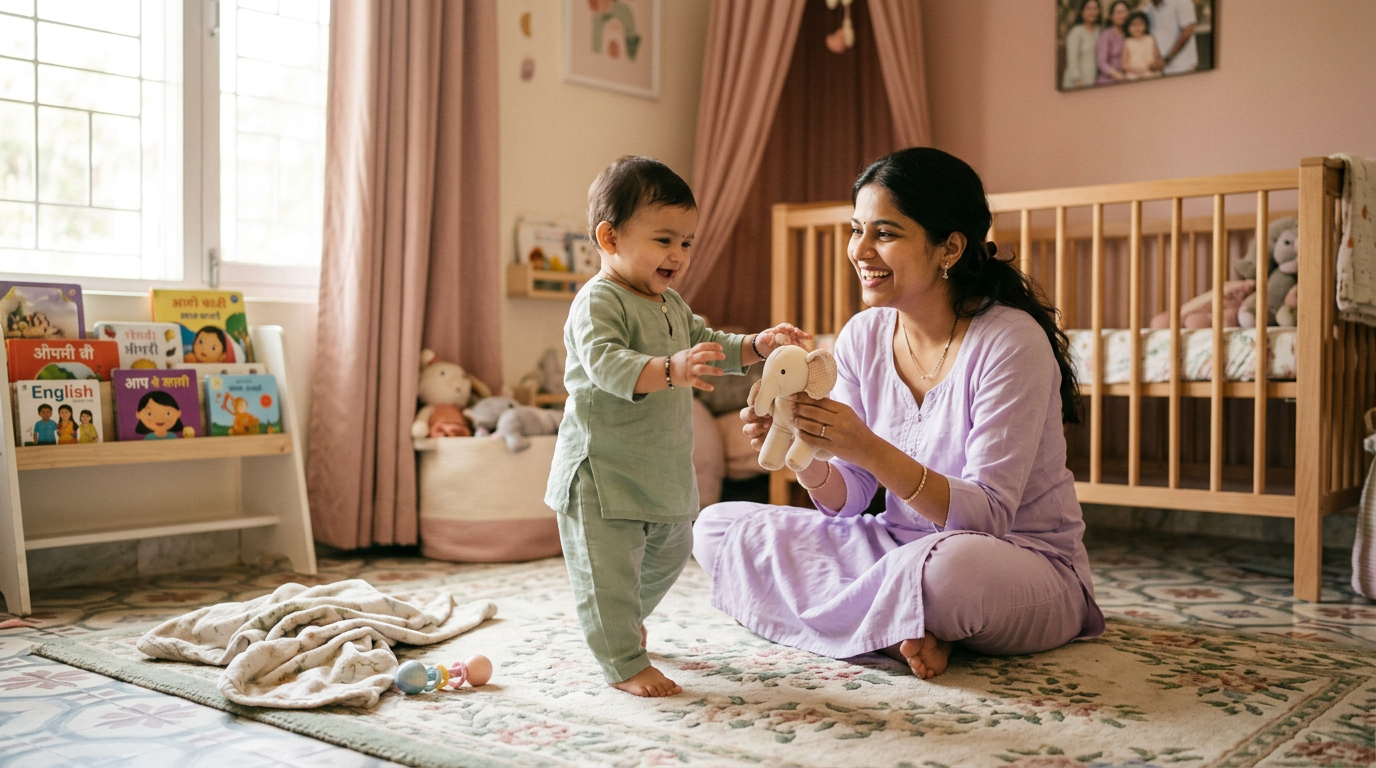
At 12 months, your baby is officially transitioning from an infant to a toddler—a milestone marked by the magical (and sometimes messy) trifecta of first steps, first words, and that first birthday cake smash. In short: by one year, most Indian babies are pulling to stand, using 1-2 functional words like "Mama" or "Dada," and beginning to show a distinct personality through "no" or pointing. While the range for "normal" is wide, this is the age where active exploration takes centre stage, and your role shifts from caregiver to "safety officer."
I remember my own son’s first birthday in Delhi. Between the relatives arguing over whether he should have suji halwa or chocolate cake and the frantic search for his favourite rattle, he decided that exact moment was the time to let go of the sofa and take two shaky steps toward his nani. That’s the 12-month mark in a nutshell: unpredictable, exhausting, and utterly wonderful.
12 Month Baby Milestones: The Big Moves
Physical development at one year is all about verticality. Your baby is tired of the view from the floor and wants to see what’s on the dining table.
Gross Motor Skills (The "First Steps" Watch)
Cruising like a pro: Most 12-month-olds move around the room by holding onto furniture (sofas, beds, or the heavy diwan*).
* Standing alone: They might stand unsupported for a few seconds, looking surprised at their own bravery.
* The first steps: While the average age for walking in India is around 12 to 13 months, many babies start as early as 9 months or as late as 16 months. Both are healthy.
* Sitting from standing: They can now lower themselves from a standing position to a sit without just "plopping" down hard.
Fine Motor Skills
The Pincer Grasp: Your baby can pick up a single grain of cooked rice or a small piece of soft carrots* using their thumb and forefinger.
* Turning pages: They can help turn the pages of a board book, though they might turn three at once.
* Poking and Prodding: Expect them to use their index finger to poke everything—including your eyes and the electrical sockets (time for those ₹200 socket covers from Amazon!).
> Real talk: The "Walker" Myth.
> In many Indian households, the daadi or nani might insist on buying a circular baby walker. As a paediatrician, I’m the "bad guy" here: please skip the walker. The IAP (Indian Academy of Pediatrics) discourages them because they jump-start walking before the muscles are ready and are a major cause of tip-over injuries near kitchen steps or balconies. Push-toys (like a sturdy wooden trolley) are a much safer alternative.
Does My 12-Month-Old Understand Me? (Communication)
By now, "talking" isn't just babbling; it’s communication.
* First Words: Most babies have 1 to 3 "real" words. Usually, it’s "Mama," "Papa," or "Baba." In Indian homes, we also see "Dada," "Didi," or even "Tatta" (for water/thanni) or "Jai" (at the mandir).
Following Commands: If you say, "Give the ball to Mamma," or "Beta, idhar aao*" (come here), they should understand and often comply.
* Geral Gestures: Waving "Tata/Bye-bye" and shaking their head for "No" are huge milestones.
* Joint Attention: If they see a dog out the window, they will point to it and then look at you to make sure you see it too. This is a vital social milestone.
What Should a 12-Month-Old Be Eating?
At one year, your baby can officially join the family table. The WHO and IAP recommend transitioning to "family pot" food—minus the heavy chilli and excessive salt.
* Cow’s Milk Transition: You can now introduce whole cow’s milk (up to 400-500ml a day). However, if you are breastfeeding, please continue! The WHO recommends breastfeeding up to 2 years and beyond.
* The Menu: A typical Indian 12-month-old’s day looks like:
Breakfast: Ragi porridge with mashed banana or a soft idli* with a drops of ghee.
Lunch: Well-mashed khichdi with seasonal veggies like lauki or kaddu*.
Snack: Grated apple or a few pieces of soft paneer*.
Dinner: A small, soft phulka soaked in dal* or curd rice.
Self-Feeding: Let them play with their food. Yes, the dal* will be in their hair. Yes, the floor will be a disaster. But using a spoon (even if it’s upside down) builds hand-eye coordination.
Preparing for the First Birthday: Survival Tips
The first birthday is often more for the parents and the extended family than the baby. Here is how to keep it "milestone friendly":
Real Talk from Indian Moms
"My mother-in-law was convinced my daughter was 'slow' because she wasn't walking at 12 months. She finally took her first steps at 14 months while trying to reach for a Marie biscuit. Every baby has their own 'biscuit' motivation!" — Ananya R., Bengaluru, Mom to 15-month-old.
"The 12-month sleep regression is real. Just when I thought we were done with night wakes, he started standing up in his crib at 3 a.m. crying because he forgot how to sit back down. We had to literally teach him how to plop back on his bum." — Meher V., Mumbai, Mom to 13-month-old.
When to Call Your Paediatrician
While every child is different, some signs warrant a chat with your doctor at the 12-month check-up:
* Movement: Not crawling or dragging one side of the body while crawling.
* Weight/Growth: If they haven't tripled their birth weight (a general guideline).
* Social: No pointing at objects or no "Tata/Bye-bye" waving.
* Language: Doesn't search for things they see you hide, or doesn't say "Mama/Dada" (even if non-specifically).
* Standing: Cannot stand even with support or seems to have very "stiff" or very "floppy" legs.
Frequently Asked Questions
Does my baby need shoes now that they are walking?
Inside the house, barefoot is best! It helps their foot arches develop and allows them to "grip" the floor. Buy soft-soled shoes only for outside trips to protect them from heat or sharp objects.
Can I stop sterilising bottles and bowls?
By 12 months, if your water source is clean and you are washing with hot soapy water, you can stop the rigorous boiling/sterilising of every spoon. However, continue to ensure the drinking water itself is boiled or RO-filtered.
My baby only wants to eat curd rice. Is that okay?
Food "jags" are common. One week it’s only curd rice, the next it’s only bananas. Keep offering variety without forcing it. As long as they are energetic and gaining weight, it’s usually a phase.
How much sleep does a 12-month-old need?
Usually 11-14 hours in a 24-hour cycle. This typically looks like 10-11 hours at night and two naps (one morning, one afternoon), though some babies drop to one nap early.
Why is my baby suddenly so clingy?
This is the peak of separation anxiety. They now understand that when you leave the room, you are "gone," but they don't quite get that you’re coming back. This is actually a sign of healthy emotional attachment!
A final thought: At one year, your baby is a little scientist, testing gravity with every dropped spoon and testing boundaries with every "no." Pack away the "infant" mindset and get ready for the toddler years. It’s loud, it’s fast, but oh boy, it’s fun.
Your mantra for this month: They aren't being difficult; they are being curious.
Sources & further reading
- Indian Academy of Pediatrics (IAP) — Growth and Development Charts
- WHO — Infant and Young Child Feeding Guidelines
- AIIMS Delhi — Paediatrics Department Health Education
- National Health Portal (NHP) India — Child Health Milestones
Written by Dr. Anjali Mehta, MBBS, DCH (Paediatrics)
Reviewed by TheMamaCircle Editorial Team
Last updated: 21 April 2026
This article is for general information only and is not a substitute for personalised medical advice. Always consult your paediatrician or obstetrician for your specific situation.