12 Month Baby Milestones: Indian Guide to Walking & Talking
Worried about 12 month baby milestones? From first steps to first words, here is what is actually normal for Indian toddlers. Read our expert-led guide now.
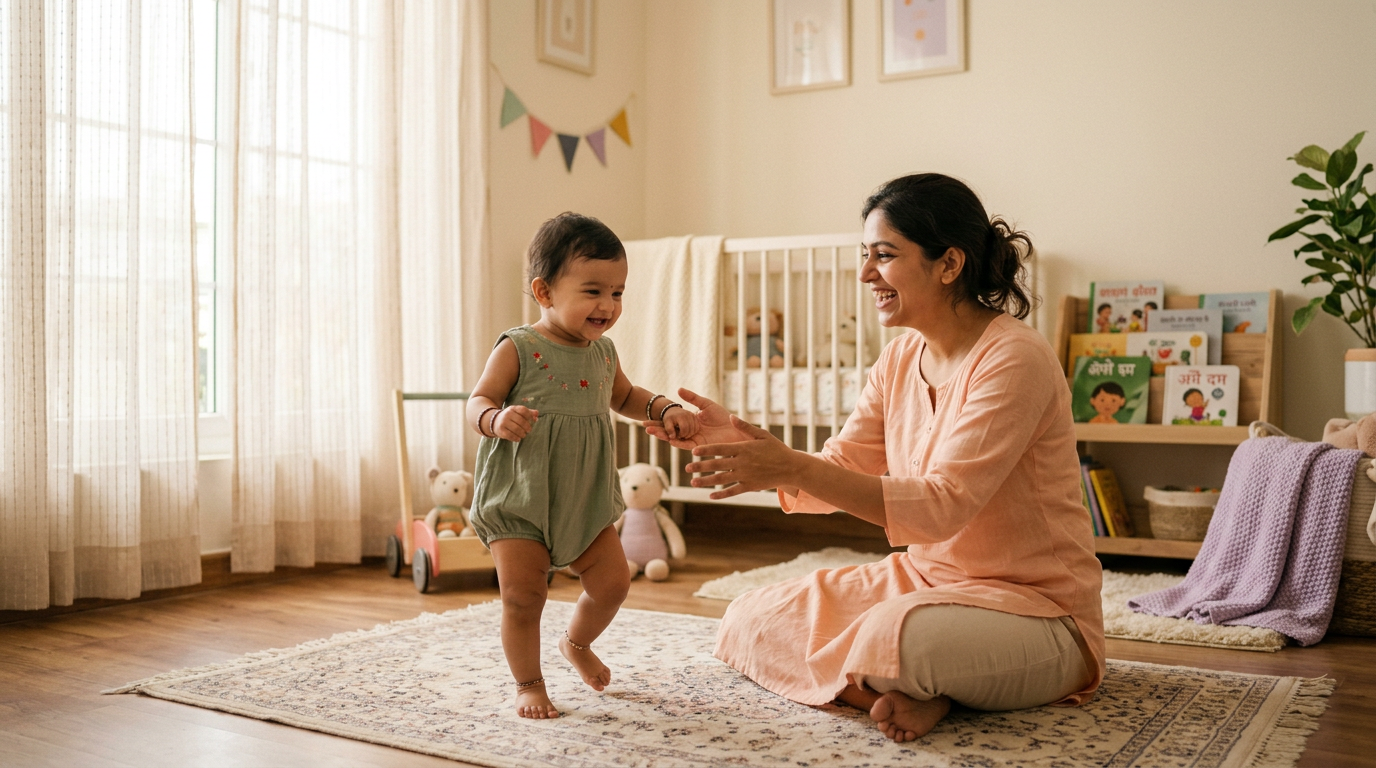
By the time your baby hits the 12-month mark, they are officially trading their 'infant' status for 'toddler' energy. Most Indian parents expect their baby to walk and talk clearly by their first birthday, but the reality is a wide range: some are running at 11 months, while others continue happily crawling until 15 months. Both are normal. This month is less about one big event and more about the transition from being a baby who watches the world to a toddler who demands to be part of it.
12 Month Milestones: What is actually happening?
At one year, your baby’s brain is like a sponge soaked in ghee—it’s rich, developing fast, and slightly slippery to keep up with. We divide these milestones into four main buckets: gross motor (big movements), fine motor (small movements), communication, and social-emotional.
Gross Motor: The Physics of the First Step
While the 'first step' is the holy grail of milestones, don't panic if your baby is still 'cruising' (walking while holding onto the sofa or the divan).
* Pulling to stand: Your baby can now use furniture to haul themselves up.
* Cruising: Shuffling sideways while holding onto the edge of the bed.
* Standing alone: They might let go for 2-3 seconds, look surprised, and then plop onto their diaper.
* The Walk: Some may take 2-3 shaky steps. If they aren't walking by 12 months, it is not a delay. The Indian Academy of Pediatrics (IAP) notes that walking can emerge anywhere between 9 and 16 months.
Fine Motor: The Pincer Grasp Mastery
Your 12-month-old is now a professional at picking up tiny things you didn't know were on the floor.
Pincer Grasp: Using the thumb and forefinger to pick up a single grain of cooked rajma or a piece of roti*.
* Giving objects: They might hand you a toy, though they might not always want to let go of it!
* Turning pages: They can help turn the thick pages of a board book, though they might try to turn three at once.
Communication: More than just "Ma-ma"
By now, "Mama" and "Papa" (or "Dada") usually have meaning. They aren't just sounds; they are labels for their favourite people.
One or two words: Besides Mama/Papa, they might have a word for milk (doodh) or water (paani*), even if it sounds like "doo" or "paa".
* Understanding "No": They know what it means, even if they choose to ignore it.
Gestures: Waving 'bye-bye', blowing a kiss, or shaking their head to refuse khichdi* are all major communication milestones.
> Mama-to-mama Real Talk:
> I remember my son’s first birthday. Everyone was hovering, waiting for him to walk. He refused. He spent the whole party crawling at high speed between people’s legs because it was faster. I felt like a failure because my neighbor’s 10-month-old was already running. I wish someone had told me: "Relax, his personal timetable isn't a reflection of your parenting." He walked two weeks later when no one was watching.
How do I encourage my 12-month-old's development?
You don't need expensive Montessori toys from Instagram to help your baby hit these marks. High-quality interaction is free.
Language Development at Home
The Narration Game: Talk through your day in your mother tongue. "Now Mummy is putting rai in the tadka," or "Let's put on your blue kurta*." This builds their internal vocabulary.
Singing: Traditional loris* or simple rhymes like 'Lakdi ki Kathi' help them understand rhythm and phonetics.
* Read Aloud: Even 5 minutes of looking at a book together makes a massive difference in brain wiring.
Physical Strength and Safety
* Barefoot is Best: In India, we love our fancy baby shoes, but for a 12-month-old learning to walk, being barefoot is superior. It helps their toes grip the floor and develops the arches in their feet. Save the shoes for when you go to the park.
* The "Yes" Space: Create a corner of the living room where everything is safe. If you are constantly saying "No, don't touch the vase," or "No, keep away from the TV unit," they lose the confidence to explore.
* Ditch the Walker: The IAP and most global paediatric bodies strongly advise against wheeled baby walkers. They don't help babies walk faster; they actually strengthen the wrong muscles and are a major cause of preventable head injuries.
Real talk from Indian moms
"My daughter didn't say a single word until 13 months. Then suddenly, she started saying 'Nani' every time the phone rang. I realized she was observing everything, just waiting for her moment."
— Priya, Bengaluru, mom to 14-month-old Ishani
"We were so worried about walking, but our paediatrician told us to look at her 'commando crawl.' She was so strong and fast. Eventually, at 15 months, she just stood up and walked to the kitchen. No drama, just ready."
— Meher, Mumbai, mom to 2-year-old Kabir
Transitioning to the Family Table: 12-month Nutrition
At 12 months, the biggest milestone isn't just physical—it's nutritional. This is the age where "solid food" becomes the primary source of nutrition, and milk becomes the supplement.
When to call your paediatrician
While every baby is different, there are a few "red flags" that warrant a check-in with your doctor at the 12-month mark:
* No crawling: If the baby isn't mobile at all (crawling, scooting, or shuffling).
* Low muscle tone: If the baby feels 'floppy' in your arms or cannot support their own weight when held in a standing position.
* No gestures: Doesn't wave, point to objects, or shake their head.
* No babbles: If they aren't making consonant sounds like "ba, ba" or "da, da".
* Loss of skills: If they used to be able to sit or say a word and now they cannot.
* No eye contact: If they don't look at you when you call their name.
Frequently Asked Questions
My baby is 12 months and doesn't have teeth yet. Is this a delay?
Not necessarily. While many babies get their first tooth around 6 months, some don't sprout one until 14 or 15 months. As long as their bone growth and other milestones are fine, the teeth will come. Ensure they have enough Vitamin D, as per IAP guidelines.
Should I stop breastfeeding at the first birthday?
The WHO and IAP recommend breastfeeding for up to 2 years and beyond. If you and your baby are happy, there is no medical reason to stop just because they turned one. However, ensure they are eating 3-4 solid meals a day.
Is it okay if my baby still prefers crawling over walking?
Absolutely. Crawling is actually excellent for bilateral brain development (using both sides of the brain together). Some babies crawl until 16 months and then skip the 'wobbly' phase and go straight to stable walking.
My baby screams when I leave the room. Is this normal?
Yes, this is 'separation anxiety,' and it often peaks around 12 months. They now understand that you exist even when you aren't in sight, and they want you back! A quick, firm goodbye and a promise to return (which you keep) helps build trust.
How many words should a 1-year-old know?
Most 12-month-olds have 1-3 'meaningful' words. However, their receptive language (what they understand) is much higher. If you say "Where is the ball?" and they look for it, they are hitting their language milestones perfectly.
Your baby’s first birthday is a celebration of your survival as much as it is their growth. Don't let a checklist of milestones rob you of the joy of watching your little human become their own person. Whether they walk across the room or crawl to their cake, they are exactly where they need to be.
Remember: You are the best expert on your baby—trust your gut as much as the charts.
Sources & further reading
- Indian Academy of Pediatrics (IAP) — Growth and Development Charts
- World Health Organization (WHO) — Infant and Young Child Feeding Guidelines
- AIIMS Delhi — Paediatrics Developmental Milestones Caregiver Guide
- National Health Portal (NHP) India — Child Health and Immunization
Written by Dr. Anjali Mehta, MBBS, DCH (Paediatrics)
Reviewed by TheMamaCircle Editorial Team
Last updated: 26 April 2026
This article is for general information only and is not a substitute for personalised medical advice. Always consult your paediatrician or obstetrician for your specific situation.