15+ Fun Activities for Babies: Indian Home Guide
Discover 15+ easy activities for babies using everyday Indian household items. From sensory play to tummy time, boost your baby's brain development today!
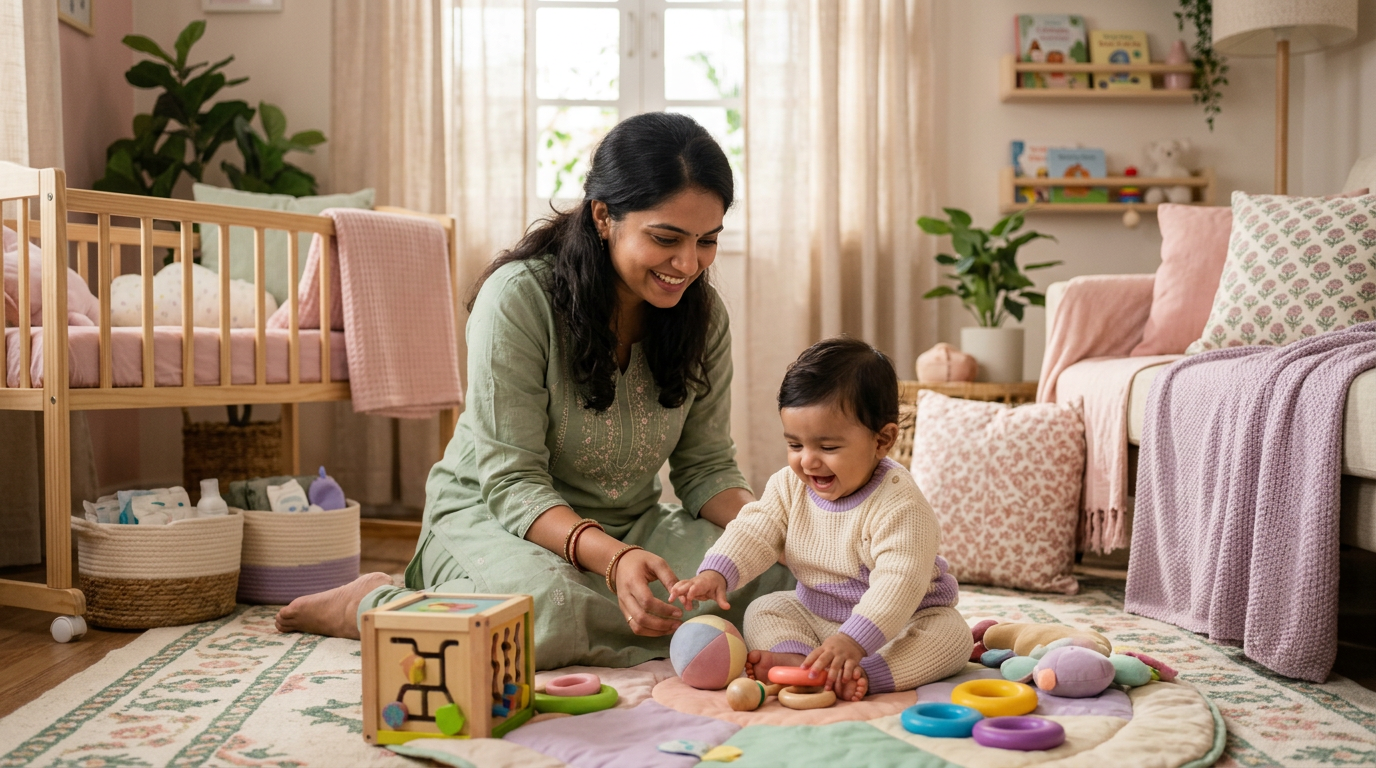
Finding engaging activities for babies doesn't require a Montessori-certified nursery or expensive imported toy kits. In fact, your Indian kitchen and the average 2BHK apartment are goldmines for developmental play. At this stage, your baby’s 'work' is simply exploring textures, sounds, and movements. By using everyday items like steel katoris, soft dupattas, and even atta dough, you can stimulate their growing brain while managing your household chores.
Why early play matters for your baby's brain
From the moment you bring your little one home, their brain is forming millions of neural connections every second. While you might be focused on postnatal recovery (also called postnatal), your baby is focused on the world around them. Simple activities for babies act as the building blocks for motor skills, language acquisition, and emotional bonding.
In India, we have a long tradition of sensory stimulation—from the daily maalish (massage) that provides deep pressure input to the bright torans hanging on doors that catch a newborn’s gaze. These aren't just 'time-pass' routines; they are foundational brain development activities for babies that set the stage for future learning.
Activities for babies: Age-appropriate play ideas
0 to 3 Months: The sensory awakening
At this stage, your baby is getting used to life outside the garbh (womb). Their vision is still developing, and they love high-contrast patterns and familiar voices.
* Black and White Cards: Use simple DIY cards with bold black patterns on white paper. Hold them 8-10 inches from their face. You can also use our baby vision simulator to see exactly how your little one perceives these shapes.
The 'Dupatta' Peek-a-Boo: Use a light, breathable cotton dupatta* or a soft muslin swaddle. Gently drape it over your face and then reveal yourself with a "Peek-a-boo!" or "Kahaan gaya baby?" The sheer fabric allows them to see light and shadow before you fully appear.
* High-Contrast Tracking: Slowly move a bright red rattle or a black-and-white toy from left to right to encourage visual tracking.
3 to 6 Months: Reaching and rolling
This is the golden age of tummy time activities. As their neck muscles strengthen, their world expands.
The Steel Utensil Concert: Give your baby a small steel katori* and a silicone spoon. The reflection on the shiny steel is fascinating, and the 'clink' sound provides immediate auditory feedback.
Water Play in a Thali: Place a shallow thali with a tiny bit of water in front of them during tummy time. Let them splash their hands. Warning: Never leave a baby unattended with water, even for a second.*
Texture Touching: Let them feel the difference between a rough coconut shell (narial), a soft silk sari*, and a cool steel glass.
6 to 12 Months: The explorer stage
Once they start sitting up and crawling, activities for babies become much more dynamic. They are now learning 'cause and effect'.
Atta Dough Sensory Play: Make a salt-free, edible dough using whole wheat flour (atta*) and water. Let them squish it. This is excellent sensory play for babies as it strengthens finger muscles needed for self-feeding later.
* The Laundry Basket Tunnel: A simple plastic laundry basket turned sideways makes a great 'cave' to crawl through.
Rice Bins (Supervised): Fill a small tub with uncooked basmati* rice and hide large wooden blocks inside. Let them dig to find the 'treasure'. Ensure the grains are large enough and your supervision is 100% to avoid choking risks.
How to set up indoor activities for toddlers and older babies
As your baby transitions into toddlerhood, they need more space to move. If you live in a typical urban apartment, you might feel limited, but you can maximize vertical space.
For more structured ideas, you can also look into indoor activities for toddlers that involve sorting pulses or matching lids to containers.
Real talk from Indian moms
> "I spent ₹2,000 on a fancy 'activity gym' that my daughter ignored. You know what she loved? My bunch of steel keys and an empty Haldiram’s packet because of the crinkly sound. Now, we just play with kitchen tools!"
> — Ritu V., Mumbai (Mom to 8-month-old Kabir)
> "During the monsoon in Kerala, we couldn't go out. I started 'Sari Swings' where my husband and I hold the ends of a sturdy cotton sari and gently rock him. It’s his favorite way to calm down before a nap."
> — Anjali K., Kochi (Mom to 11-month-old Arjun)
Safety first: Choosing the right toys
The Indian Bureau of Standards (BIS) has strict guidelines (IS 9873) for toy safety. When choosing Montessori baby toys, always look for the ISI mark. Avoid toys with small parts that can fit inside a toilet paper roll, as these are choking hazards.
If you're ever worried about your baby's reaction to a new activity—perhaps they are crying excessively or seem unusually lethargic—you can use an AI cry analyzer to help decode their needs, though it never replaces a mother's intuition or medical advice.
When to call your paediatrician
While every baby develops at their own pace, keep an eye out for these 'red flags' during play:
* Visual issues: The baby does not track moving objects with their eyes by 3-4 months.
* Auditory issues: The baby does not startle at loud noises or turn toward sounds by 6 months.
* Motor delays: The baby is unable to hold their head up by 4 months or cannot sit without support by 9 months.
* Social cues: The baby does not smile back or make eye contact during play by 3 months.
* Persistent Floppiness: The baby feels unusually 'loose' or stiff in your arms during activities.
Frequently Asked Questions
What are the best sensory play for babies under 6 months?
For younger babies, sensory play is all about touch and sound. Tummy time on different textures (a shaggy rug vs. a smooth sheet), listening to bhajans or soft lullabies, and gentle baby massage with coconut or almond oil are the best ways to engage their senses.
How often should we do tummy time activities?
The Indian Academy of Paediatrics (IAP) suggests starting tummy time as soon as you come home from the hospital. Start with 2-3 minutes, 2-3 times a day, and gradually increase it as the baby gets stronger. Always do this while they are awake and supervised.
Are there specific brain development activities for babies that help with speech?
Yes! Narrating your day is the best activity. Talk to your baby in 'Parentese' (high-pitched, melodic speech). Point to objects and say their names in your mother tongue and English. Reading board books with large pictures also significantly boosts language brain centers.
My 10-month-old isn't interested in indoor activities for toddlers. Is this normal?
Totally! At 10 months, many babies are more interested in practicing their new physical skills like pulling to stand or cruising. Don't force a 'seated' activity if they want to move. Follow their lead; if they want to climb the sofa, that is their activity for the day!
What are some low-cost activities for babies at home?
You don't need to spend a lot. An empty plastic bottle filled with colored dal (lentils) makes a great shaker. A cardboard box can become a 'car' or a 'house'. Even a bowl of water with some floating plastic lids provides 20 minutes of solid engagement.
Playing with your baby is not a chore to be checked off a list; it is the language of love. Whether you are singing a folk song during stanpaan (breastfeeding) or letting them splash in a bucket, you are building a secure foundation for their entire life. You are doing a great job, Mumma.
I am enough, and I am exactly what my baby needs today.
Sources & further reading
- Indian Academy of Paediatrics (IAP) Growth Charts and Development
- World Health Organization (WHO) Standards for Child Development
- National Health Portal (NHP) India - Infant and Young Child Care
Written by Dr. Anjali Mehta, MBBS, DCH (Paediatrics)
Reviewed by TheMamaCircle Editorial Team
Last updated: 6 September 2026
This article is for general information only and is not a substitute for personalised medical advice. Always consult your paediatrician or obstetrician for your specific situation.