40 Days Postpartum India Guide: Japa, Maalish & Tradition
The 40 days postpartum India guide covers Japa, Maalish, and Sutak traditions. Learn how to balance ancient wisdom with modern recovery. Get the recovery you deserve.
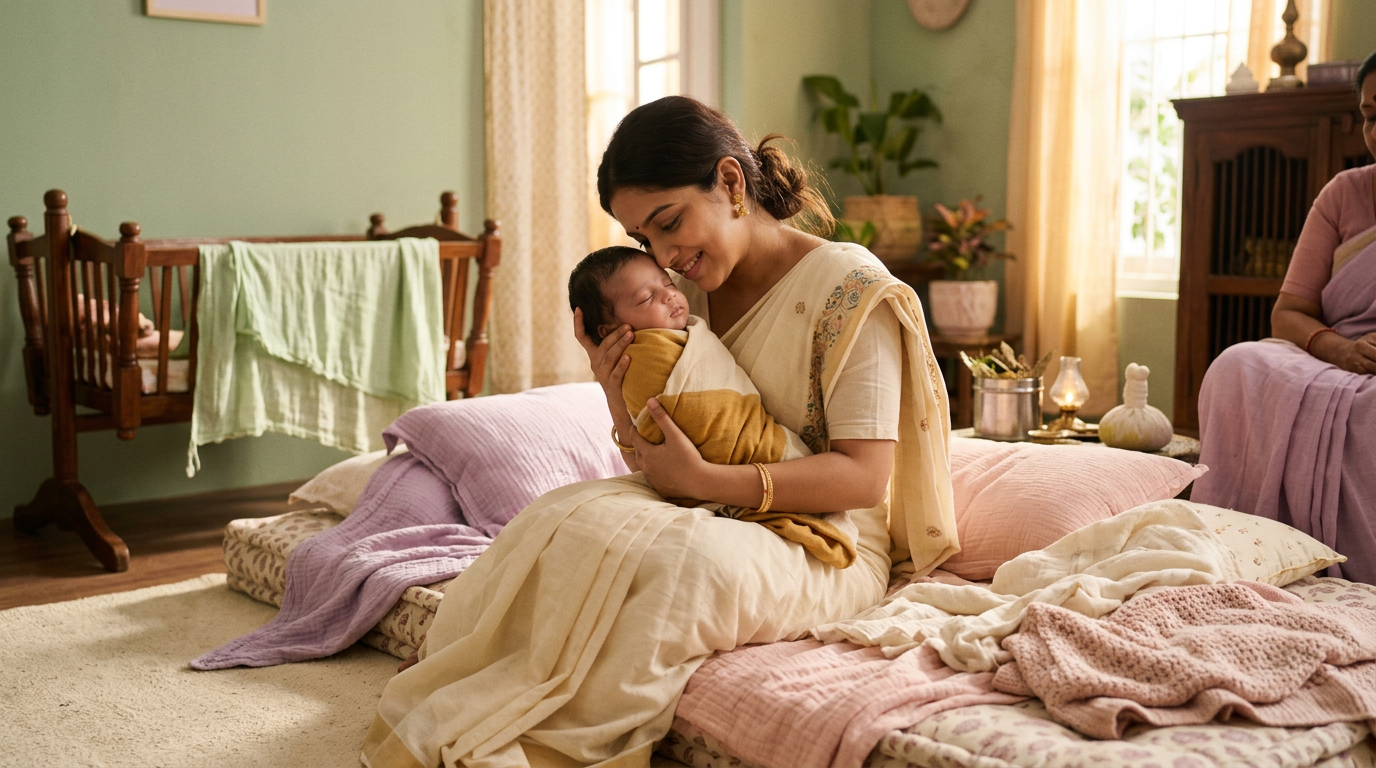
The traditional 40-day postpartum period in India—known as the Sawa Mahina (five weeks) or the Japa period—is a cultural deep-cleansing ritual designed to help a mother heal from childbirth. While modern medicine focuses on the 6-week postnatal checkup, Indian tradition mandates a strict regimen of maalish (massage), specific warming foods, and physical confinement. The core goal is simple: total rest for the mother to prevent long-term aches and a boost in breast milk supply.
My own memories of this period involve the pervasive smell of ajwain and sarson ka tel (mustard oil). On day 10, when I wanted to just walk to the balcony, my sasu maa blocked the door, insisting that "the wind would enter my bones." While some of it sounds like superstition, much of this 2000-year-old wisdom aligns with the biological need for the uterus to involute and the pelvic floor to recover.
What Exactly Happens During the 40-Day Japa Period?
The Japa (or Zapa) period is the North Indian term for the postpartum recovery phase, though every region has its name: Sutak or Vidhi in various communities. It is grounded in the Ayurvedic belief that birth creates a 'void' in the body, increasing Vata (air/wind), which must be countered with heat, oil, and rest.
The Physical Restrictions
Traditionally, the mother stays in one room. You aren't supposed to cook, clean, or move heavy objects. While being "confined" sounds restrictive, in a busy Indian household, this is often the only way a new mother gets out of chores.
Head covering: You’ll likely be told to wear a scarf or dupatta* even indoors to prevent "catching a chill."
Cotton in ears: A classic nani* move to keep the wind out—biologically, it just keeps the environment quiet for the baby.
No cold water: Drinking only lukewarm or ajwain*-infused water to aid digestion and reduce bloating.
The Spiritual & Social Aspect: Sutak
Sutak refers to a period of ritual impurity following birth (and death). For 10 to 40 days, the family may not visit temples or perform pujas. Practically, this served as an ancient form of "social distancing" to protect a newborn’s fragile immune system and a mother’s healing body from infections long before we knew what germs were.
> Mama-to-mama Real Talk: Let’s be honest—the 40 days can feel like a golden cage. You are pampered, but you also lose your autonomy. If the "rules" start making you feel trapped or anxious, it’s okay to step into the hall or take a shower without five people supervising. Your mental health is just as important as your Vata balance.
The Art of Postpartum Maalish (Massage)
If there is one non-negotiable in the Indian 40-day plan, it is the maalish. Usually performed by a professional Dai or Japa maid, this isn't a relaxing spa massage; it’s a vigorous, intentional realignment of the body.
Why it works:
The Oil Choice:
Mustard Oil (Sarson): Used in the North for its warming properties. Often infused with garlic and ajwain*.
* Sesame Oil (Til): Common in the South and West; highly penetrative and nourishing for the skin.
* Coconut Oil: Preferred in coastal regions for its cooling yet antimicrobial properties.
Belly Wrapping (Banding)
After the massage, the Dai will often wrap your abdomen tightly with a long cotton saree or a cloth binder. This provides "back support" and helps the abdominal muscles (rectus abdominis) knit back together. In medical terms, it helps with diastasis recti, though it should never be so tight that it hurts or restricts breathing.
The Japa Diet: Healing from the Inside Out
In India, food is medicine. The postpartum diet is strictly "Sattvic" and warming. You will likely be told to avoid "heavy" foods like rajma, bhindi, or citrus fruits, which are thought to cause colic in the baby.
The "Must-Have" Superfoods:
* Panjiri or Gondh ke Ladoo: Made with edible gum resin, whole wheat flour, ghee, and nuts. These are calorie-dense to support breastfeeding and provide calcium. (Cost: ₹800-₹1200 per kg if ordered from specialty makers).
* Ajwain Ka Paani: Carom seeds boiled in water. It’s a digestive powerhouse for both mom and baby.
* Dalia and Khichdi: Broken wheat and moong dal are the gold standard for easy digestion.
* Haldi Doodh: Turmeric milk acts as a natural anti-inflammatory to heal internal "wounds" from delivery.
Real Talk from Indian Moms
"I fought my mother about the 'no hair wash for 11 days' rule. We settled on day 4 with a very quick warm bath. But honestly? The maalish was the only reason I didn't have back pain after my epidural."
— Ananya, Bengaluru (Mom to a 5-month-old)
"My sasu maa insisted on the room being hot with no AC in July in Delhi. I reached a breaking point. We compromised by keeping the AC at 26 degrees and me wearing full sleeves. You have to negotiate!"
— Priyanka, Delhi (Mom to a 2-year-old)
> Mama-to-mama Real Talk: The "Postpartum Glow" is 90% ghee and 10% sweat. Don't feel pressured to look like a Bollywood star leaving the hospital. If you're in a nighty with oily hair and a crying baby, you're doing it right.
When to Call Your Paediatrician (or OB-GYN)
While traditions are wonderful, they shouldn't mask medical red flags. Call your doctor if:
* Fever: Any temperature over 100.4°F (38°C). This is NOT "milk fever"; it could be an infection.
* Heavy Bleeding: If you are soaking a pad in under an hour or passing clots larger than a lemon.
* Calf Pain: Extreme pain, redness, or swelling in one leg (risk of DVT).
* Severe Mood Swings: If you feel unable to bond with the baby or have thoughts of self-harm (Postpartum Depression).
* Baby's Jaundice: If the baby's skin or eyes look yellow, don't wait for the 40-day mark to go out; see a doctor immediately.
Frequently Asked Questions
Can I take a bath during the 40 days?
Yes. Despite old myths about "water entering the womb," hygiene is vital. Use warm water and avoid sitting in a tub (sitz baths are fine) until your stitches have healed. Most Indian families allow a full bath after the 6th or 10th day ritual (Chhatti).
Is it safe to have a massage after a C-section?
Wait at least 2-3 weeks for the incision to heal before starting a full-body massage. Never let a Dai massage directly over a C-section scar until your doctor clears you at the 6-week checkup. You can, however, have your legs, arms, and head massaged much sooner.
Why am I told not to skip the ghee?
In moderation, ghee provides the healthy fats needed for brain development in the baby (via breast milk) and helps lubricate the joints which are loosened by the hormone relaxin during pregnancy. However, if you have high cholesterol or gestational diabetes, consult your doctor first.
Can I use a modern maternity belt instead of a saree wrap?
Absolutely. Modern abdominal binders (priced ₹500-₹2000) are more breathable and easier to adjust than a traditional saree. They serve the same purpose of providing core support.
When does the Japa period officially end?
Traditionally, it ends on the 40th day with a Puja or a bath (usually called Ghat Puja or Kuan Pujan in some cultures). This marks your return to "normal" life and the kitchen.
The 40-day tradition is ultimately an act of community love. In a world that expects women to "bounce back" in a week, our Indian culture demands that we slow down. Embrace the pampering, eat the ladoos, and let your village take care of you. You did the hard work of growing a human; now, let the Japa heal you.
Repeat after me: My rest is not a luxury; it is a recovery requirement.
Sources & further reading
- Indian Academy of Pediatrics (IAP) — Postnatal Care Guidelines
- WHO — Postpartum care of the mother and newborn
- National Health Portal (NHP) India — Postnatal Care
- Ayush Ministry — Ayurvedic Postnatal Care (Sutika Paricharya)
Written by Dr. Ritu Sharma, MD (Obstetrics & Gynaecology)
Reviewed by TheMamaCircle Editorial Team
Last updated: 29 April 2026
This article is for general information only and is not a substitute for personalised medical advice. Always consult your paediatrician or obstetrician for your specific situation.