6 Month Baby Milestones India: Sitting, Weaning & Growth
Master 6 month baby milestones like sitting, weaning onto solids (ragi/khichdi), and babbling. Learn what's normal for Indian babies. Read the doctor's guide!
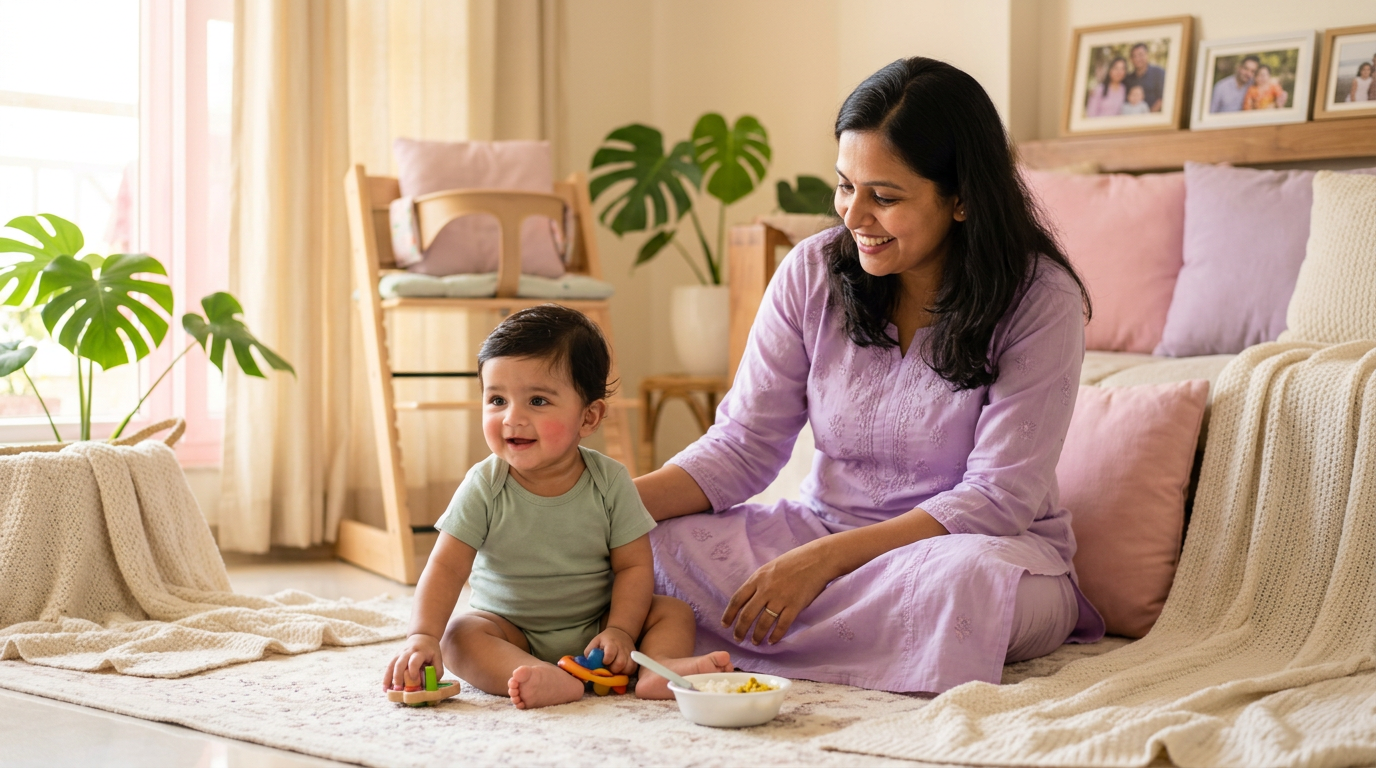
At 6 months, your baby is officially entering the 'Golden Age' of infancy. This is the month when the floppy newborn you brought home transforms into a tiny person who can sit (mostly!), recognise their name, and—most importantly—begin their journey with solid foods. If you’re wondering if your little one is on track, the short answer is: if they are starting to hold their head steady, showing interest in your dinner plate, and babbles 'ba-ba' or 'da-da', you’re doing great.
6 Month Baby Milestones: Physical and Motor Skills
This is the big 'pivot' month. Your baby’s muscles, from their neck down to their lower back, have finally strengthened enough to defy gravity. According to the Indian Academy of Pediatrics (IAP) revised growth charts, we look for specific gross motor developments during the 180-day mark.
Sitting up: With and without support
While some babies sit independently at 6 months, many still need 'tripod' support—leaning forward on their hands.
* The Milestone: Sitting with support (like a nursing pillow or your hand) is the standard.
* The Next Step: Sitting without support for a few seconds. If your baby still slumps over immediately, don't panic; the range for independent sitting goes up to 8 months.
Safety Tip: Put away the fancy 'Bumbo' seats or walkers. Your floor is the best gym. Use a clean dhurrie* or a foam mat and let them spend plenty of time on their tummy to build those back muscles.
Rolling both ways
By now, most babies can roll from tummy to back and back to tummy. This means diaper changes are about to become a wrestling match! Always keep a hand on your baby when they are on a changing table or bed—falls from palangs are the most common reason for ER visits in India at this age.
The Big Transition: Starting Solids (Weaning)
In India, we often celebrate this with an Annaprashan or Mukhe Bhaat ceremony. Physiologically, 6 months (180 days) is the WHO-recommended age because your baby's natural iron stores start to dip, and their digestive system is finally ready for more than just milk.
Signs your baby is ready for 'Dabba' or home food:
What to feed first?
Forget the expensive imported cereals. Start with local, iron-rich, and easily digestible foods:
* Single-grain porridges: Ragi (nachni) is an Indian superfood—high in calcium and iron. Cook it well with water or expressed breast milk.
Stewed Fruits/Veg: Mashed banana, steamed apple puree, or well-cooked kaddu* (pumpkin).
* Dal Paani? No. A common mistake in Indian households is giving only the watery part of the dal. The nutrition is in the thick, mashed dal itself. Start with a thick consistency, not a liquid one.
Real talk: The "First Meal" Reality
The first time you offer a spoonful of moong dal khichdi, your baby might make a face like you’ve offered them lemon juice. They might spit it out. They might even cry. This is not a rejection of your cooking! It’s a sensory shock. It takes 10-15 tries for a baby to accept a new flavour. Don't give up and reach for the bottle immediately.
Communication and Sensory Development
Your 6-month-old is becoming a social butterfly. They aren't just crying for milk anymore; they are communicating for fun.
Language Milestones
* Babbling: You’ll hear strings of vowels (ah, eh, oh) and the beginning of consonants (ba, ma, da).
* Response to Name: If you call "Ishaan!" or "Zoya!", they should turn their head toward you.
* Emotional Range: They start showing clear signs of joy (squealing) and displeasure (grunting or stiffening their body).
Cognitive and Sensory Growth
Object Permanence (The 'Peek-a-boo' phase): They are beginning to understand that if you hide your face behind a dupatta*, you haven't actually disappeared.
* Transferring Objects: Watch if your baby can move a rattle from their right hand to their left hand. This is a huge milestone for brain-crossing coordination.
* The "Mouth" Stage: Everything—everything—will go into the mouth. This is how they learn about textures. Ensure their toys are BPA-free and larger than a cardboard toilet paper roll to avoid choking.
Real talk from Indian moms
Ananya, Bengaluru (Mom to 6-month-old Kabir): "My sasu-maa insisted we start buffalo milk at 5 months because Kabir looked 'thin'. I stood my ground based on my paediatrician’s advice about kidney load. We started Ragi at 6 months instead, and he loves it. It's okay to say 'no' to elders if it’s for the baby's health."
Meher, Lucknow (Mom to 7-month-old Sara): "I was so worried because Sara wasn't sitting at 6 months while my neighbour’s baby was crawling. My doctor reminded me that every baby has a different calendar. Two weeks later, she just popped up into a sit-position on her own!"
When to call your paediatrician
While every baby is unique, certain "red flags" at 6 months warrant a visit to your clinic:
* No head control: Head still flops back when you pull them to a sitting position.
* No sound: Doesn't make any vowel sounds or babbles.
* Lack of engagement: Doesn't follow moving objects with their eyes or doesn't recognise parents.
* No weight bearing: Doesn't try to put any weight on their legs when held upright.
* Extreme stiffness or floppiness: If the baby feels very "rigid" or "like a ragdoll."
Frequently Asked Questions
Can I give my 6-month-old honey or salt?
No. No honey before age 1 (risk of infant botulism). No added salt or sugar before age 1. Their kidneys cannot process salt yet, and sugar sets a preference for sweets that leads to childhood obesity.
How much water should a 6-month-old drink?
Once you start solids, you can offer 30-60ml of boiled and cooled water in a sippy cup or a small katori-spoon after meals. Breast milk or formula remains the primary source of hydration.
Is it normal that my baby hasn't started crawling yet?
Yes! Crawling usually happens between 7 and 10 months. Some babies skip crawling entirely and go straight to cruising.
My baby is 6 months and has no teeth. Is this a delay?
Not at all. The first tooth (usually the bottom front) typically appears between 6-10 months, but some "late bloomers" don't get theirs until 12 months. If they have no teeth by 15 months, see a dentist.
Can I give Cerelac instead of home-cooked food?
While commercial cereals are convenient and fortified, they are often high in hidden sugars. Home-cooked khichdi, ragi, or mashed fruits provide better texture and exposure to family flavours. Use commercial cereal only as a backup.
The 6-month mark is a whirlwind of messy high-chair photos and 'tripod' sitting videos. Enjoy this phase of discovery—you are finally getting a glimpse of the little person your baby is becoming.
Focus on the progress, not the perfection, and remember: your baby’s only benchmark is their own growth from yesterday.
Sources & further reading
- Indian Academy of Pediatrics — Revised Growth Charts and Development Milestones
- WHO — Infant and Young Child Feeding Guidelines
- National Health Portal India — Complementary Feeding (Weaning)
- AIIMS — Paediatrics Department: Child Development Series
Written by Dr. Anjali Mehta, MBBS, DCH (Paediatrics)
Reviewed by TheMamaCircle Editorial Team
Last updated: 27 April 2026
This article is for general information only and is not a substitute for personalised medical advice. Always consult your paediatrician or obstetrician for your specific situation.