9 Months Pregnancy Diet Chart Indian Guide: Week-by-Week
Master your 9 months pregnancy diet chart Indian style. From ragi to ghee, learn week-by-week nutrition tips to fuel your body for labour. Read the guide now.
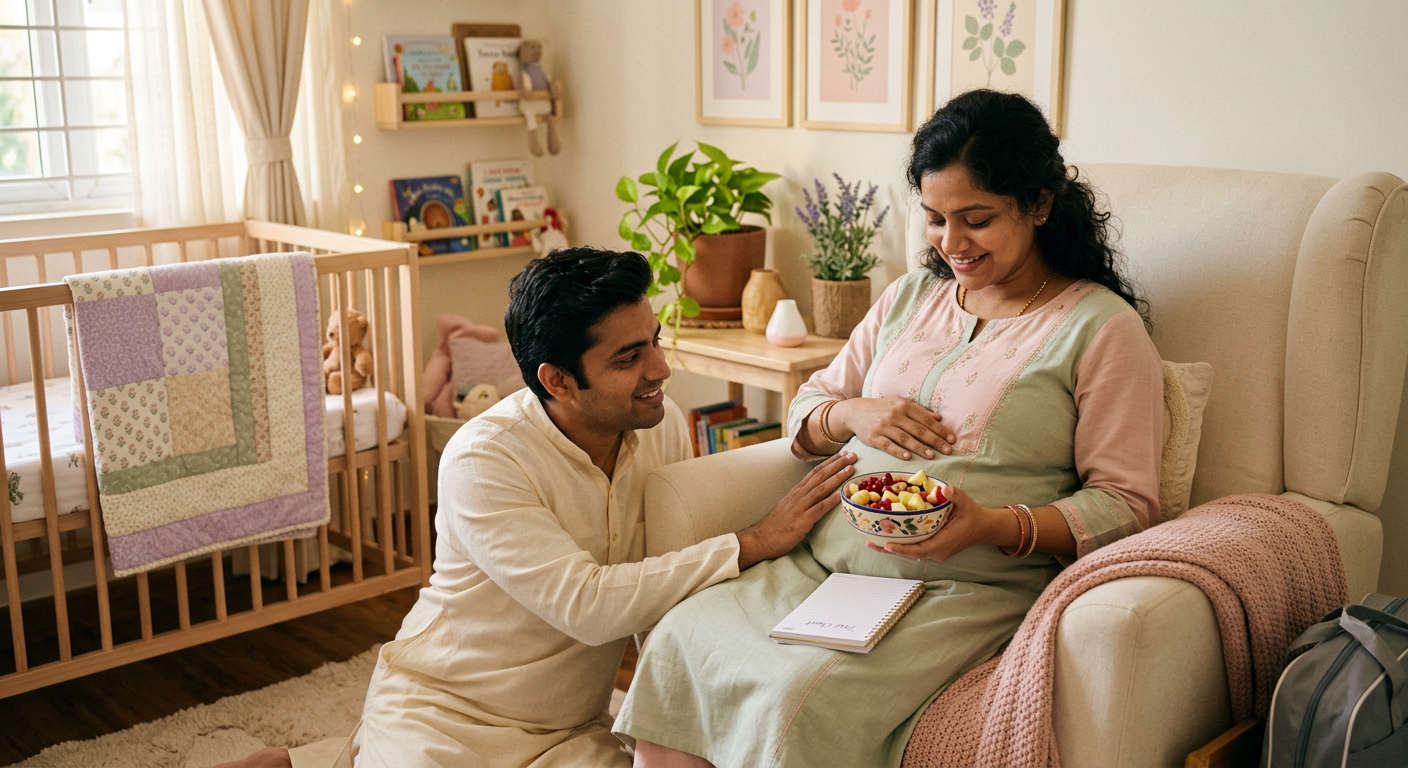
During your 9th month of pregnancy, your diet should focus on high-calorie, nutrient-dense foods that support the baby’s final weight gain (about 200g per week) while keeping your digestion smooth to manage late-term acidity. The goal is "sustenance without stuffing"—focusing on complex carbs like ragi and bajra, healthy fats from ghee and nuts, and high-fibre vegetables to prevent constipation. You aren’t just eating for two; you’re fueling for the marathon of labour.
At 36 weeks, I remember sitting at my dining table in Delhi, staring at a bowl of dal-chawal and feeling like there was absolutely no room left in my stomach. My son was head-down, pushing against my ribs, and the heartburn was real. This is the reality of the ninth month: you are hungrier than ever, but your stomach capacity is at its lowest.
What should a 9-month pregnancy diet chart in India look like?
In the final stretch, your baby is busy practicing breathing and stacking up fat stores. Your body is busy softening pelvic ligaments and preparing for milk production. Here is a week-by-week nutritional breakdown to help you cross the finish line.
Week 36: The Iron and Vitamin C Push
Your blood volume has peaked, and your baby is busy building their own iron stores to last them for the first six months after birth.
* The Goal: Maximise iron absorption.
What to eat: Palak-paneer (iron + protein), poha with lots of lemon juice (Iron + Vitamin C for absorption), and pomegranate* (anar) juice.
Real Talk: Avoid tea or coffee immediately after meals. The tannins in your chai* block iron absorption. Wait at least 45 minutes.
Week 37: Healthy Fats for Brain and Lung Maturity
The baby’s brain is still developing rapidly. Healthy fats also help in the production of surfactants in the baby's lungs.
* The Goal: DHA and Omega-3 fatty acids.
What to eat: Walnuts (akhrot), soaked almonds (badam*), and a teaspoon of A2 cow ghee in every meal. If you eat fish, small varieties of well-cooked fatty fish are great.
* Mama-to-Mama: Don't fear the ghee. While it doesn't "grease the birth canal" (that's a myth!), it provides the essential fatty acids your brain needs to avoid that "pregnancy brain" fog and helps with postpartum recovery.
Week 38: Fibre to Fight the "Final Constipation"
As the baby drops lower into the pelvis (lightening), the pressure on your rectum increases.
* The Goal: 25-30 grams of fibre daily.
What to eat: Isabgol (psyllium husk) in warm milk if recommended by your doctor, oats porridge, daliya* (broken wheat khichdi), and skin-on fruits like apples and pears.
Hydration Tip: Drink at least 2.5 to 3 litres of water. Coconut water (naariyal paani*) is your best friend here to maintain amniotic fluid levels.
Week 39 & 40: Energy for Labour (The Carbohydrate Phase)
You could go into labour any day. You need slow-releasing energy.
* The Goal: Complex carbohydrates and hydration.
What to eat: Ragi ladoos (made with jaggery), banana (the ultimate pre-labour snack), and curd rice* (probiotics to keep the gut calm).
The "Date" Trick: Some studies, including those often cited in clinical circles, suggest that eating 6 dates (khajur*) a day in the final weeks may help with cervical ripening. Even if it doesn't "start" labour, they are a fantastic, iron-rich energy boost.
Sample 9-Month Indian Pregnancy Diet Chart
| Time | Ideal Food Option | Why? |
| :--- | :--- | :--- |
| 7:00 AM | 5 Soaked almonds + 2 Walnuts + 1 Glass warm milk | Brain health and protein kickstart |
| 9:00 AM | 2 Vegetable Parathas (less oil) OR Ragi Idli with Sambar | Complex carbs for sustained energy |
| 11:00 AM | A bowl of Papaya (Ripe) or Watermelon + Coconut Water | Ripe papaya (white latex-free) is safe and helps digestion |
| 1:30 PM | 1 bowl Dal, 1 bowl Sabzi (Ghiya/Tinda/Bhindi), 1 Roti, Salad | Balanced Indian lunch; easy on the stomach |
| 4:30 PM | Roasted Makhana OR a bowl of Sprouted Moong Salad | Low-calorie, high-protein crunch |
| 7:30 PM | Moong Dal Khichdi with Ghee OR Vegetable Dhalia | Light dinner to prevent nighttime reflux |
| 9:30 PM | Half a glass of Turmeric (Haldi) Milk | Anti-inflammatory and promotes sleep |
> Real talk: The "Two People" Myth
> Let’s get one thing straight: you are not eating for two grown adults. You only need about 350-450 extra calories in the third trimester. That’s essentially an extra bowl of dal and an apple, not a second thali. Overeating now can lead to gestational diabetes or a very large baby (macrosomia), making a vaginal delivery more difficult.
Must-have Nutrients in your 9th Month
Real talk from Indian moms
"I was so terrified of having a big baby that I stopped eating rice in my 9th month. My doctor scolded me! She said I needed the energy. I switched to brown rice and hand-pounded rice, and it made a huge difference in my energy levels during those long walking sessions."
— Ananya S., Bengaluru (Mom to a 4-month-old)
"In my family, they insisted I drink a glass of milk with a huge dollop of ghee every night to 'slide the baby out.' Honestly, it just gave me loose motions. I started putting that ghee on my rotis instead, which was much easier to digest."
— Meher P., Mumbai (Mom to a 1-year-old)
When to call your paediatrician (or Obstetrician)
While we are talking about food, certain symptoms related to your intake or digestion need immediate medical attention:
* Sudden swelling (Oedema): If your face or hands puff up suddenly after a salty meal, it could be Preeclampsia.
* Severe Heartburn with Pain: If it’s high up in the "pit" of your stomach and doesn't go away with an antacid.
* Reduced Baby Movement: You should feel at least 10 kicks/movements in 2 hours after a meal. If the baby is quiet after you've eaten, call your doctor.
* Extreme Itching: Itching on palms and soles can indicate Cholestasis (a liver issue).
Frequently Asked Questions
Can I eat spicy food in the 9th month to induce labour?
There is no scientific evidence that spicy food induces labour. However, it can cause severe heartburn and indigestion, which you definitely don't want when you're already uncomfortable. Stick to mildly spiced ghar ka khana.
Is it safe to eat Kesas-Milk (Saffron)?
Yes, in moderation (1-2 strands). While it doesn't make the baby "fair" (that’s a colourist myth), it is known to help with mood swings and muscle relaxation.
Should I stop eating papaya and pineapple?
Ripe papaya is perfectly safe and a great source of Vitamin C. Unripe (green) papaya contains latex which can trigger contractions. Pineapple contains bromelain, but you would have to eat massive quantities (like 7-10 whole pineapples) for it to actually affect the cervix. A few slices are fine.
How much ghee should I actually have?
1-2 teaspoons per meal is healthy. Drinking "cups" of ghee is unnecessary and can lead to excessive weight gain that is very hard to lose postpartum.
Can I drink tea or coffee?
Limit caffeine to under 200mg a day (about 1-2 small cups of Indian chai). Remember that caffeine is a diuretic and can make frequent urination worse.
What if I have no appetite?
This is common as the baby crowds your organs. Switch to 6 small "mini-meals" instead of 3 large ones. A smoothie or a bowl of curd is easier to manage than a full thali.
Ending this journey is both exhausting and exhilarating. Your body has spent 270+ days building a human being from scratch. Feed it with respect, listen to your hunger cues, and remember: every healthy bite of khichdi or badam is a building block for your little one. You’ve got this, Mama. Soon, the only "diet chart" you'll be worried about is your baby's breastfeeding schedule!
Focus on nourishment, not perfection.
Sources & further reading
- IAP — Nutrition in Pregnancy and Lactation
- ICMR-NIN — Dietary Guidelines for Indians
- FOGSI — Good Clinical Practice Recommendations on Iron Deficiency Anemia in Pregnancy
- WHO — Antenatal care for a positive pregnancy experience
Written by Dr. Ritu Sharma, MD (Obstetrics & Gynaecology)
Reviewed by TheMamaCircle Editorial Team
Last updated: 22 May 2026
This article is for general information only and is not a substitute for personalised medical advice. Always consult your paediatrician or obstetrician for your specific situation.