Baby Development Month by Month: India Parent’s Milestone
Learn about baby development month by month with our Indian guide. Track motor, social, and cognitive milestones from 0-12 months. Don't miss these signs!
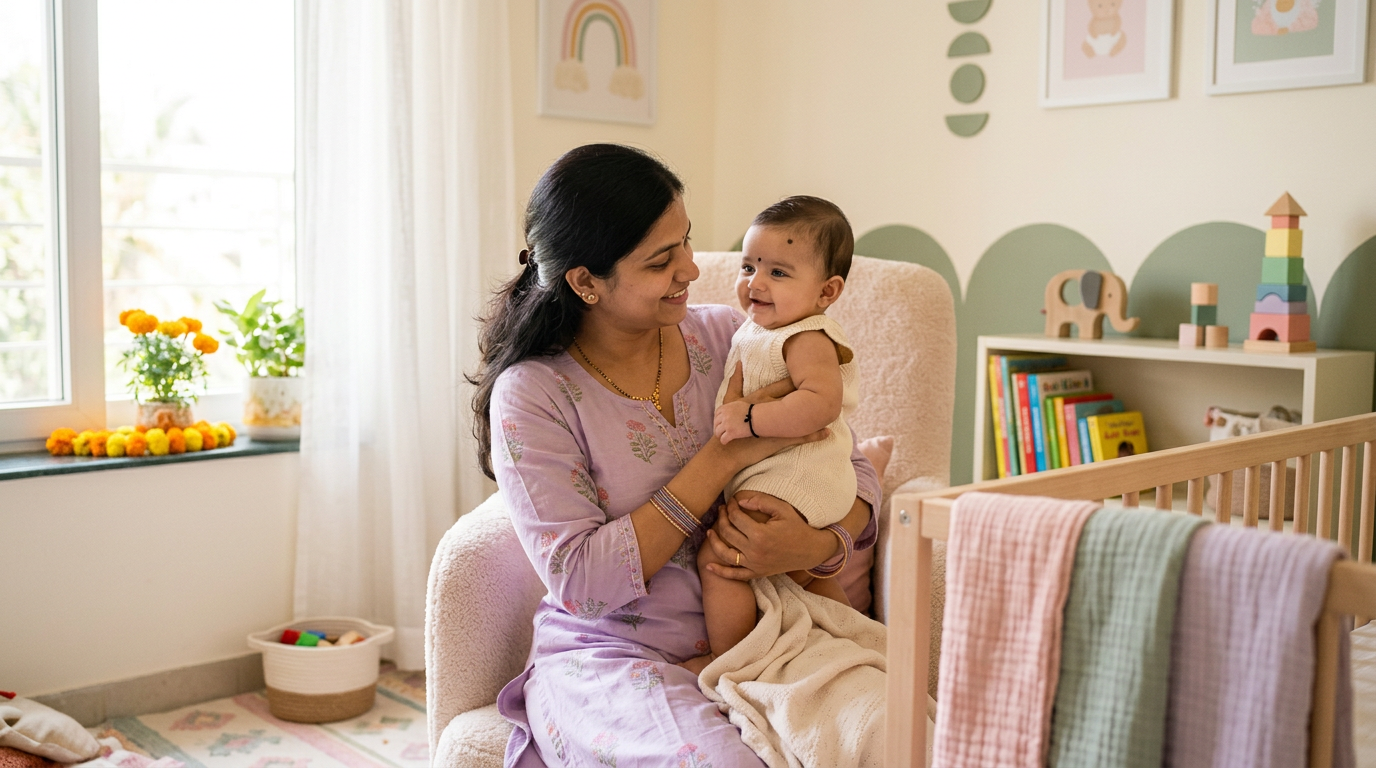
It is 3 a.m. and you are staring at your three-month-old, wondering if that "ga-ga" was a sign of genius or just gas. We have all been there. Most parents want to know exactly what to expect from baby development month by month, but here is the quick truth: babies don’t read development manuals. They grow in spurts, often mastering a physical skill like rolling over while temporarily "forgetting" how to babble. In India, we often have the added pressure of sasu maa or the neighbours comparing our baby’s milestones to every other child in the colony.
This guide breaks down the first 12 months of your baby’s journey, focusing on Indian contexts—from maalish routines to the transition to khichdi.
Months 1 to 3: The "Fourth Trimester" and Discovery
In these first 90 days, your baby is transitioning from the garbh (womb) to the world. Their world is blurry, and their movements are mostly reflexive.
Motor and Physical Milestones
* The Neck Hold: By month 3, most babies can lift their head and chest when lying on their tummy.
* Hands and Grips: They move from keeping fists tightly clenched to starting to open them and batting at colourful toys.
The Visual Range: Initially, they only see about 8-12 inches (the distance to your face during stanpaan* or bottle feeding).
Social and Cognitive Milestones
* The Social Smile: Around 6 to 8 weeks, you get the "real" smile—the one that reaches their eyes and isn’t just a digestive reflex.
* Coos and Oohs: They begin making vowel sounds.
* Focusing: They start following moving objects (like a slow-moving ceiling fan or a handheld rattle) with their eyes.
Real talk: The first six weeks are survival mode. If you are crying because the baby is crying and the maalish wali is thirty minutes late, you are doing fine. Breastfeeding or formula feeding—fed is best. Don't let anyone "shame" you into thinking your stress affects your milk supply; it's a physiological process, not a magic trick.
Months 4 to 6: The Great Transition
This is the stage where your baby’s personality really starts to pop. This is often when Indian families begin the Annaprashan or Mujhoot (first solid food ceremony).
Motor and Physical Milestones
* The Roll: Most babies roll from tummy to back first, then back to tummy.
* Sitting Support: By 6 months, many can sit with support (using a "C" shaped nursing pillow or your lap).
* The Reach: They no longer just bat at toys; they grab them and, inevitably, put them straight into their mouths.
Social and Cognitive Milestones
* Laughter: Full-on belly laughs start here.
* Name Recognition: They may start turning their head when you call their name.
* The "Vocal Play": They start blowing raspberries and experimenting with volume. If they start shrieking in a high-pitched tone, they aren't in pain—they’ve just discovered they have a "volume knob."
H2: Are my baby’s milestones on track?
In our clinics, we see parents terrified because a cousin's baby walked at 9 months while theirs is only crawling at 11. The Indian Academy of Pediatrics (IAP) emphasizes a "window of achievement." For example, walking can start anywhere between 9 and 16 months. If your baby is meeting most milestones within a 2-month grace period, they are usually doing great.
Case Study: Advait from Pune
Sneha, a mom from Pune, was worried because her 7-month-old Advait wasn't sitting steadily. "The dadi was convinced he was 'weak' because we didn't give him enough ghee," Sneha told us. After a check-up, the paediatrician noted Advait had excellent fine motor skills (picking up small bits of thread) and was very vocal. Two weeks later, after some dedicated "floor time" without the jhoola, Advait sat up perfectly. The lesson? Every baby prioritises different skills.
Months 7 to 9: Movement and Exploration
Your baby is no longer a stationary object. This is the "baby-proofing" phase where you realise your house is a deathtrap of sharp corners and low-level plug points.
Motor and Physical Milestones
* Crawling: While some babies skip crawling and go straight to "bottom shufflers," most start some form of movement (commando crawl or classic hands-and-knees) by 9 months.
Pincer Grasp: This is huge! They start using their thumb and forefinger to pick up small things—like a piece of well-cooked moong dal* or a stray bit of lint from the carpet.
Social and Cognitive Milestones
Object Permanence: They now know that if you hide a toy under a dupatta*, it hasn’t disappeared forever. This leads to the joy—and repetitive agony—of Peek-a-boo.
* Stranger Anxiety: This is the phase where they might scream when an over-eager uncle tries to pick them up. It’s a sign of healthy cognitive development; they now know who is "home" and who is "guest."
Mama-to-mama tip: This is the best time to introduce iron-rich Indian foods. Think ragi porridge, mashed papaya, and well-mashed khichdi with a drop of homemade ghee. Avoid salt and sugar until the first birthday—their kidneys aren't ready, and their taste buds don't need the "addiction."
Months 10 to 12: The Toddler Launchpad
By the time the first birthday candle is lit, your baby is a tiny human with distinct opinions (usually "no" and "mine").
Motor and Physical Milestones
* Cruising: Walking while holding onto the sofa or your hand.
* Standing Solo: Standing for 2-3 seconds without holding anything.
Waving and Pointing: They use gestures to communicate what they want (pointing at the dabba* of biscuits) and can wave "Tata/Bye-bye."
Social and Cognitive Milestones
* First Words: "Mama," "Papa," or "Dada" usually emerge, though they might be used indiscriminately at first.
* Functional Play: They start using objects for their intended purpose—putting a toy phone to their ear or trying to use a comb (even if it’s on their chin).
Real Talk from Indian Moms
"Don't buy expensive walkers. The IAP actually discourages them because they can tip over and don't actually help babies walk faster. Give them a sturdy wooden ghoda* or just floor time." — Meera, Chennai, mom of 14-month-old.
"My MIL wanted to put kajal* to make the eyes bigger. I stood my ground because of the lead risk. It was an awkward week, but my baby’s eye health is non-negotiable." — Pooja, Delhi, mom of 5-month-old.
When to call your paediatrician
While every baby is different, certain "red flags" deserve a professional look. Call your doctor if:
* By 3 months: They don't react to loud noises or follow a moving object with their eyes.
* By 6 months: They don't try to reach for toys or seem unusually "floppy" (poor head control).
* By 9 months: They don't sit with help or don't babble (make "ba-ba" or "ma-ma" sounds).
* By 12 months: They don't crawl, don't point to objects, or lose skills they previously had.
* Any age: A sudden loss of previously achieved milestones is always a reason for a check-up.
Frequently Asked Questions
Does maalish (massage) help with milestones?
Yes, but not in the "magic" way some claim. Daily maalish with coconut or olive oil improves circulation, helps with weight gain, and provides essential tactile stimulation. It doesn't "straighten bones," but it does strengthen the bond and helps the baby relax for better sleep.
When should my baby start speaking Hindi/English/Mother tongue?
Most babies say their first meaningful word by 12 months. In multilingual Indian households, babies might take slightly longer to start speaking, but they usually end up with a more robust vocabulary across all languages. Don't worry if they mix words!
My baby is 10 months and has no teeth. Is development delayed?
Teething is not an indicator of cognitive or motor development. Some babies are born with a tooth; others don't get one until 14 months. As long as they are meeting other milestones, "late" teething is perfectly normal.
Is "Tummy Time" really that important?
Yes! In India, we often keep babies in jhoolas or on their backs to avoid "flat head." Tummy time—even 2-5 minutes several times a day—is the "gym" for your baby. It builds the neck, shoulder, and core muscles needed for sitting and crawling.
Should I use a walker to help my baby walk?
The short answer is no. Most paediatric associations, including the IAP, recommend against baby walkers. They can lead to toe-walking and delay the development of the muscles needed for independent walking. Stick to a "push-toy" or simply let them cruise along furniture.
My baby only wants to eat purees at 10 months. Is this okay?
By 9-10 months, babies should be introduced to "finger foods" and textures. If they only eat purees, they aren't practicing the "munching" motion which is vital for the development of jaw muscles used in speech.
You are doing a great job. Some months will feel like a leap, and others will feel like you’re stuck in a loop of diapers and sleep deprivation. Just remember: you are the best expert on your own baby.
Watch the baby, not the calendar.
Sources & further reading
- Indian Academy of Pediatrics (IAP) — Growth and Development Charts
- WHO — Multicentre Growth Reference Study Group (Motor Milestones)
- AIIMS New Delhi — Department of Paediatrics Development Guidelines
- UNICEF India — The First 1000 Days of Life
Written by Dr. Anjali Mehta, MBBS, DCH (Paediatrics)
Reviewed by TheMamaCircle Editorial Team
Last updated: 2 May 2026
This article is for general information only and is not a substitute for personalised medical advice. Always consult your paediatrician or obstetrician for your specific situation.