Baby Weight Chart India 2026: WHO + IAP 0–24 Months Guide
Track your baby's weight month-by-month using WHO and IAP charts for Indian babies (0–24 months) — normal ranges, percentiles & red flags. See the full guide.
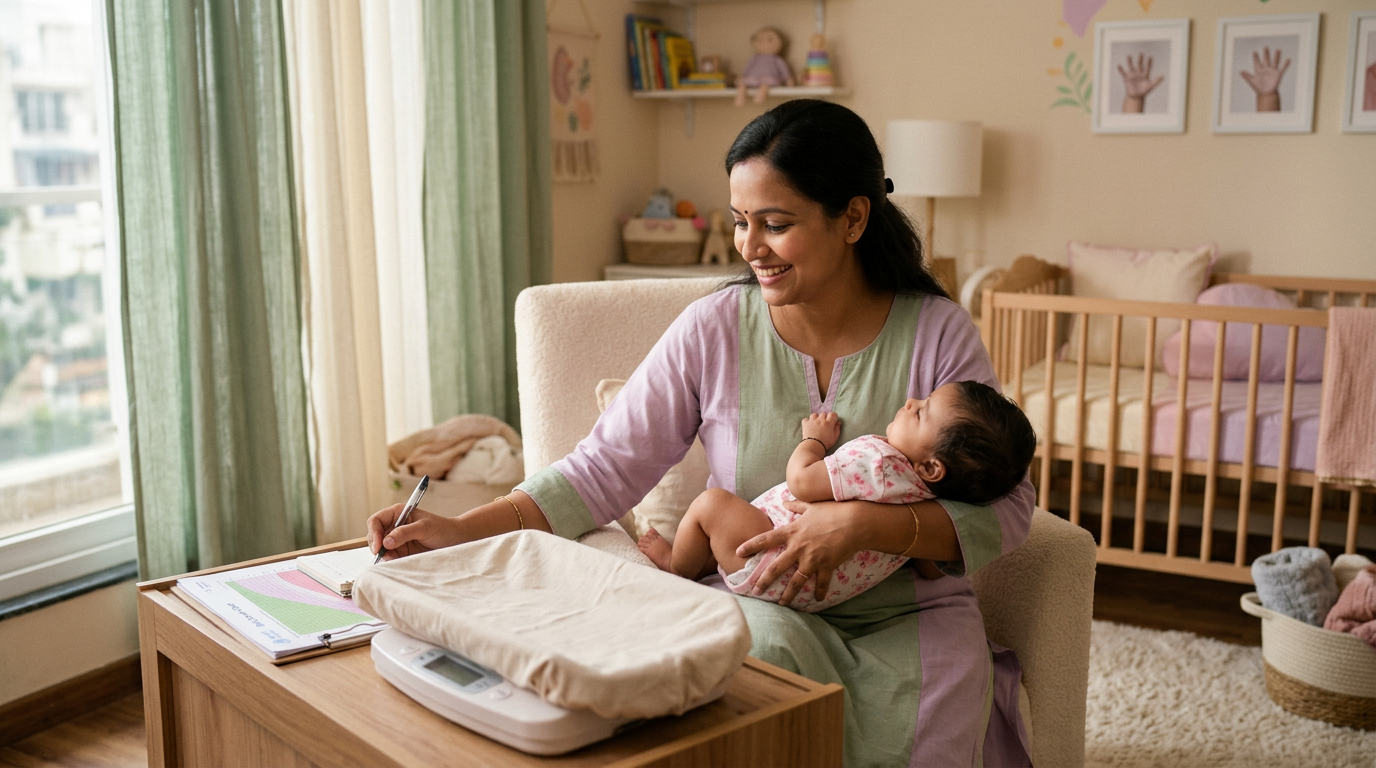
The gold standard for tracking your baby’s growth in India is the WHO Child Growth Standards, which are used by the Indian Academy of Pediatrics (IAP). For a healthy, full-term Indian baby, the average birth weight is approximately 2.8 kg to 3 kg, and we expect most babies to double that weight by 5 months and triple it by their first birthday. If your baby is active, meeting milestones, and wetting 6-8 nappies a day, a minor wiggle in the growth curve is usually nothing to panic about.
Why we use the WHO Growth Chart in India
In India, we transitioned from older charts to the WHO Growth Standards because they are based on how children should grow when given optimum nutrition (specifically breastfeeding) rather than just how they do grow in a specific region.
Whether you are in a humid Kerala monsoon or a dry Delhi winter, these charts help us differentiate between a baby who is naturally "petite" and a baby who is experiencing "growth faltering." In my practice, I see many parents obsessed with the "90th percentile." Let’s be clear: being in the 50th percentile isn't an 'average' grade like in school; it means your baby is exactly in the middle of 100 healthy children.
Understanding the "Growth Curve"
- The Percentiles: If your baby is on the 15th percentile, it just means 85% of babies their age are heavier. It does NOT mean they are weak.
- The Trend: We look for a steady curve. A baby who stays on the 10th percentile for six months is usually perfectly fine. A baby who drops from the 90th to the 50th suddenly? That’s when we investigate.
Indian Baby Weight Chart: Month-by-Month (Average)
While every baby is different, here is a general guide for the average weight (50th percentile) for Indian boys and girls based on WHO data.
| Age | Boys (Avg Weight) | Girls (Avg Weight) | Growth Milestone |
| :--- | :--- | :--- | :--- |
| Birth | 3.3 kg | 3.2 kg | Initial 7-10% weight loss is normal in week 1. |
| 1 Month | 4.5 kg | 4.2 kg | Regains birth weight by day 10-14. |
| 2 Months | 5.6 kg | 5.1 kg | Social smiles begin! |
| 3 Months | 6.4 kg | 5.8 kg | Neck holding becomes steadier. |
| 4 Months | 7.0 kg | 6.4 kg | Weight usually double of birth weight soon. |
| 5 Months | 7.5 kg | 6.9 kg | Rolling over (be careful on the changing mat!). |
| 6 Months | 7.9 kg | 7.3 kg | Start of solids (Annaprashan). |
| 8 Months | 8.6 kg | 8.0 kg | Sitting without support. |
| 10 Months | 9.2 kg | 8.5 kg | Pincer grasp (picking up small grains). |
| 12 Months | 9.6 kg | 8.9 kg | Weight is roughly 3x birth weight. |
Important Note: These are averages. There is a wide "normal" range. For example, at 6 months, anything between 6.4 kg and 9.7 kg can be perfectly healthy for a boy depending on birth weight and genetics.
> Real talk: Indian grandmothers have a built-in "chubby baby" radar. If the baby doesn't have thigh folds, they think we aren't feeding them enough. But remember: A "lean" active baby is often healthier than a "fat" lethargic baby. Don't let the "padosi ki nanad" (neighbour's sister-in-law) make you feel guilty about your milk supply based on a visual check.
Factors that Influence your Baby's Weight in India
Maalish (Massage) and Growth
In India, we swear by maalish. While a massage with coconut or sesame oil won't "make a baby fat," research suggests that tactile stimulation can improve weight gain in preterm infants and improve sleep patterns, which indirectly helps growth. Just be gentle with those tiny limbs!
When "Low Weight" is actually a concern
We get worried when we see "Growth Faltering." This isn't just about being small; it’s about a change in the pattern.
Case Study: Little Aarav from Mumbai
Aarav was born at 3.1 kg. At his 4-month checkup, his mom, Priya, was worried because he looked "thin" compared to his cousin. Looking at his Vaccination card (MCP card), we saw he followed the 50th percentile line perfectly. However, between months 6 and 7, after starting solids, his weight didn't move at all. We realised he was being given mostly watery dal ka paani instead of mashed thick khichdi. Once we increased the calorie density with a teaspoon of ghee, his curve moved back up.
Real talk from Indian moms
"My daughter was always on the 5th percentile. I spent months crying over my breastmilk supply. Then my paediatrician asked me to look at my own childhood photos. I was a tiny baby too! Stop comparing babies to the Amul baby posters."
— Ridhima, Bengaluru, Mom to an 18-month-old
"In our colony, everyone comments on how 'haadi' (bony) my son looks. But he is crawling, mimicking sounds, and has 8 teeth. I’ve learned to say 'My doctor is happy with him' and walk away."
— Sana, Hyderabad, Mom to a 10-month-old
When to call your paediatrician
Weight is just one piece of the puzzle. Watch for these "Red Flags":
* Baby has not regained birth weight by 3 weeks of age.
* Baby crosses two major percentile lines downwards (e.g., drops from 75th to 25th).
* Fewer than 6 wet nappies in 24 hours.
* Baby is lethargic, has a weak cry, or is too tired to suckle.
* Significant weight loss after a bout of illness that doesn't recover within 2 weeks.
* The baby stops hitting developmental milestones (sitting, smiling, grasping).
Frequently Asked Questions
Is there a specific Indian baby weight chart?
The IAP (Indian Academy of Pediatrics) recommends using the WHO Growth Charts for children under 5. While there are IAP-specific growth charts for older children (5–18 years) to account for Indian puberty patterns, for babies, the WHO standard is the global and national benchmark.
Why is my baby losing weight in the first week?
It is 100% normal for babies to lose 7% to 10% of their birth weight in the first few days as they lose excess fluid. They should regain this weight by the time they are 10 to 14 days old.
Does "Dal Paani" help in weight gain?
No. This is a common Indian myth. Dal ka paani (the clear water on top of boiled pulses) is mostly water. If you want your baby to gain weight after 6 months, give them the mashed dal itself, enriched with a little ghee or butter.
My baby is 6 months old and hasn't doubled their birth weight. Is this bad?
Most babies double their weight by 5 months, but if your baby was very heavy at birth (e.g., 4kg+), they might take a little longer to double it. Consult your doctor to check the overall trend.
Can I use Cerelac to increase baby weight?
While commercial cereals are convenient, homemade calorie-dense foods like Ragi porridge, mashed banana, or Khichdi with ghee are excellent for healthy weight gain without the added preservatives or high sugar content.
Is weight gain different for C-section babies?
The mode of delivery doesn't determine long-term weight gain, though C-section moms might face a slight delay in milk "coming in," which can affect very early weight patterns. However, by the one-month mark, their growth potential is the same as vaginally delivered babies.
Every baby has their own pace, like a flower blooming in its own time. Focus on the smile, the energy, and the milestones—not just the number on the scale. Your love is the best nourishment.
Sources & further reading
- Indian Academy of Pediatrics (IAP) — Growth Charts for Indian Children
- WHO — Child Growth Standards
- AIIMS — Nutrition and Growth Guidelines for Infants
- NHP India — Infant and Young Child Feeding
Written by Dr. Anjali Mehta, MBBS, DCH (Paediatrics)
Reviewed by TheMamaCircle Editorial Team
Last updated: 10 May 2026
This article is for general information only and is not a substitute for personalised medical advice. Always consult your paediatrician or obstetrician for your specific situation.