Bilingual Baby Books Hindi English: Pratham & Tulika Guide
Discover the best bilingual baby books in Hindi and English from Pratham, Tulika, and Karadi Tales. Boost your child's 'desi' vocabulary naturally!
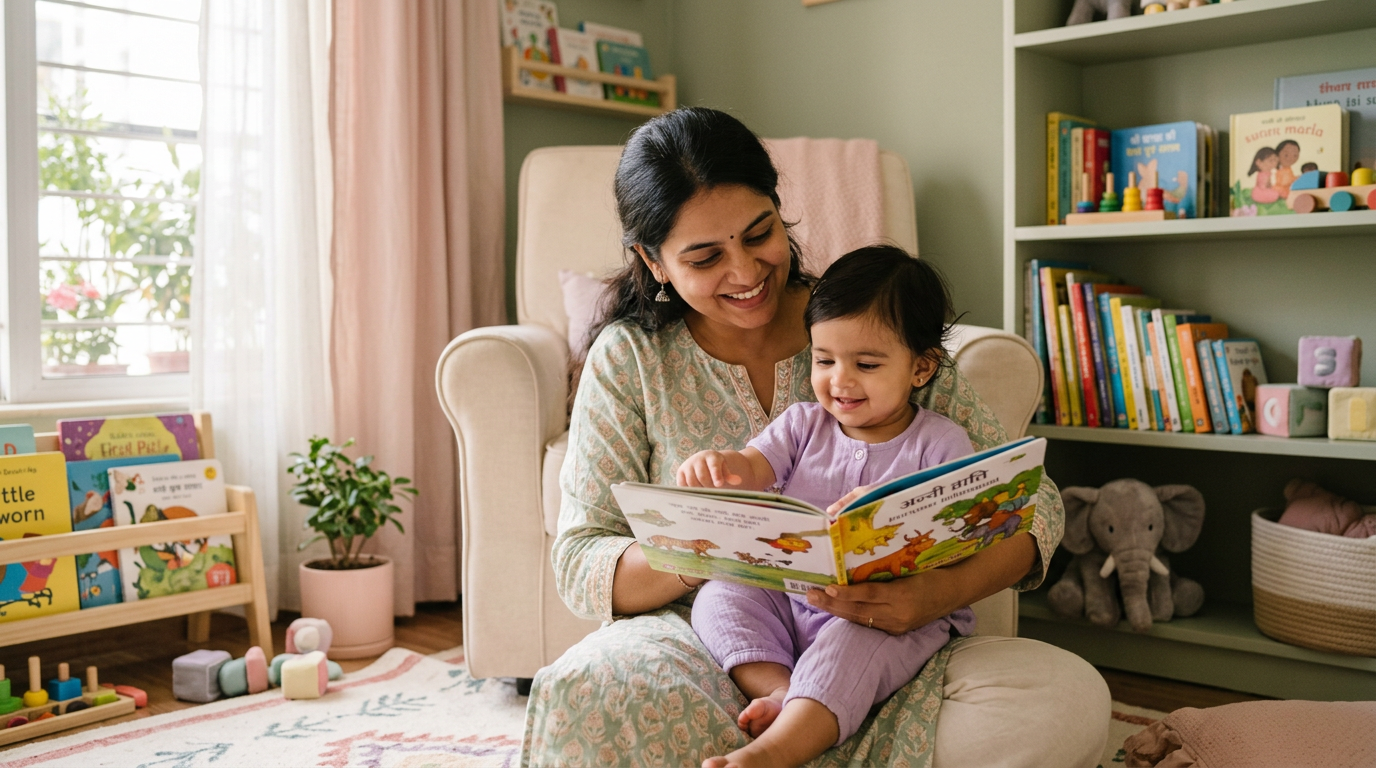
Bilingual baby books in Hindi and English are the most effective way to raise a 'desi' reader without the stress of formal tutoring. If you want your child to speak Hindi fluently but find yourself reaching for English books out of habit, you aren’t alone. By introducing dual-language board books from publishers like Pratham, Tulika, and Karadi Tales between 0 and 3 years, you create a natural bridge between your 'mother tongue' and the global language of school.
Why Bilingual Books are the 'Secret Sauce' for Indian Homes
Growing up in India, most of us are naturally multilingual, yet we often panic about our children’s vocabulary. My daughter, Avni, would stare blankly when my sasu maa asked, "Beta, pani chahiye?" because we had spent months only reading "The Very Hungry Caterpillar" in English. That’s when I pivoted to bilingual books.
Bilingual books work because they don’t treat Hindi as a "translation" but as an equal companion. They help children:
* Map sounds to objects: Seeing the word 'Elephant' and 'Haathi' next to the same picture builds cognitive flexibility.
Cultural Context: Books from Indian publishers feature genda phool, autowallahs, and barish*—things our kids actually see out their window in Mumbai or Delhi, not snowmen and maple leaves.
* Parental Confidence: If your Hindi is a bit "rusty" (no judgment!), having the text right there helps you read with the correct flow.
Is it better to read in Hindi or English first?
The short answer: Do both at once! Research shows that babies are born "citizens of the world" and can distinguish between phonemes of multiple languages. Reading a bilingual book allows you to switch seamlessly. You can read the English sentence, then repeat it in Hindi, or as many Indian moms do, use "Hinglish" to explain the plot.
Real Talk: Don't force the 'Shuddh' Hindi
One mistake we often make is trying to be too perfect. If you don't use the word "Viman" in daily life, don't feel pressured to force it if the book uses "Hawai Jahaz." The goal is communication and connection, not passing a Sahitya Akademi exam. If you are comfortable, your baby will be too.
The 'Big Three' of Indian Children's Publishing
If you are looking to build a home library that feels like India, these three publishers are non-negotiable.
1. Tulika Books: The Gold Standard for Diversity
Tulika is the pioneer of the bilingual format in India. Their books usually feature English on one side and a regional language (Hindi, Tamil, Marathi, etc.) on the other.
Top Pick: Gajapati Kulapati* (available in bilingual editions). This series about a lovable elephant with a cold is a rite of passage for Indian toddlers.
* Price Range: ₹150 – ₹250.
* Why we love them: The illustrations are rooted in Indian folk art styles but feel modern and clean.
2. Pratham Books (StoryWeaver): Making Reading Accessible
Pratham is a non-profit that transformed the Indian reading landscape. Their "Read India" movement ensures high-quality stories at very affordable prices.
Top Pick: Fat King, Thin Dog* or any of their "Level 1" bilingual titles.
* Price Range: ₹40 – ₹100.
* Why we love them: You can actually read many of these for free on their digital platform, StoryWeaver, before buying the physical copies.
3. Karadi Tales: For the Love of Audio and Rhythm
While known for their "audiobooks narrated by Naseeruddin Shah," Karadi Tales has wonderful printed bilingual books.
Top Pick: The Shrewd Turtle or their Junior* series.
* Price Range: ₹200 – ₹500.
* Why we love them: They focus heavily on the "rhythm" of the language. Even their Hindi translations feel poetic rather than clunky.
How to use Bilingual Books: A Step-by-Step Guide
Buying the book is only 20% of the work. The rest is how you present it.
Real talk from Indian moms
> "We live in a nuclear setup in Bengaluru. My son was only hearing English at daycare. Tulika’s bilingual books became my way of making sure he could actually talk to his Nana-Nani during summer holidays without a translator!" — Ananya, mom to 3-year-old Kabir.
> "Initially, I felt guilty that I couldn’t speak 'pure' Hindi. But reading Pratham books aloud helped me relearn words I had forgotten since school. It’s now our favorite part of the bedtime routine." — Megha, mom to 18-month-old Ira.
Is my baby getting confused by two languages?
This is a common concern in Indian households. However, linguistic experts and the IAP (Indian Academy of Pediatrics) agree that bilingualism does NOT cause speech delays. In fact, most Indian children are naturally exposed to 2-3 languages (Home language, State language, English).
Mama-to-mama tip: Your child might "code-switch" (mix languages, like saying "Mujhe water chahiye"). This is not a sign of confusion; it’s a sign of a high-functioning bilingual brain choosing the easiest word available!
When to call your paediatrician
While bilingualism is great, keep an eye on developmental milestones. Consult your doctor if:
* Your 18-month-old doesn't use any words meaningfully (in any language).
* Your child consistently avoids eye contact during storytime.
* They seem to lose language skills they previously had (regression).
* They don't respond to their name or simple commands by 12 months.
Frequently Asked Questions
Which language should I read first on the page?
There is no fixed rule. However, if you want to emphasize Hindi, start with the Hindi sentence, then English, then end with Hindi so the last sound they hear is the target language.
My child only wants to read in English. What do I do?
Don't make Hindi a 'chore.' If they ask for the English version, read it, but pepper in Hindi descriptions of the pictures. "Yes, the sun is shining! Kitni tez dhoop hai na?"
Are these books available for other Indian languages?
Yes! Tulika and Pratham are excellent at providing bilingual options for Marathi-English, Tamil-English, Bengali-English, and more. Generally, the English text remains the same, but the secondary language changes.
Where can I buy these in India?
Amazon and Flipkart carry most titles. However, for the best curation, check out independent bookstores like Full Circle or buy directly from the publisher's websites to support Indian literature.
At what age should I start?
Start at birth! High-contrast bilingual board books are great for newborns. By 6 months, they will enjoy the rhythm, and by 12 months, they will start pointing to objects.
Reading is about more than just words; it’s about passing on your 'Virasa' (heritage). By picking up a bilingual book today, you are giving your child the gift of two worlds.
Your voice is the first book your baby ever reads—make it a soulful one.
Sources & further reading
- Indian Academy of Pediatrics (IAP) — Guidelines on Early Childhood Development
- UNESCO — Importance of Mother Tongue Based Multilingual Education
- National Institute of Nutrition (NIN) Hyderabad — Cognitive Development in Toddlers
- Pratham Books — Research on Reading Habits in India
Written by Neha Kapoor, RD (Registered Dietitian, Maternal & Child Nutrition)
Reviewed by TheMamaCircle Editorial Team
Last updated: 8 May 2026
This article is for general information only and is not a substitute for personalised medical advice. Always consult your paediatrician or obstetrician for your specific situation.