Developmental Red Flags Baby: When to Consult an Indian
Is your baby meeting milestones? Learn the critical developmental red flags for Indian babies and when to book that paediatrician visit. Trust your gut, Mom.
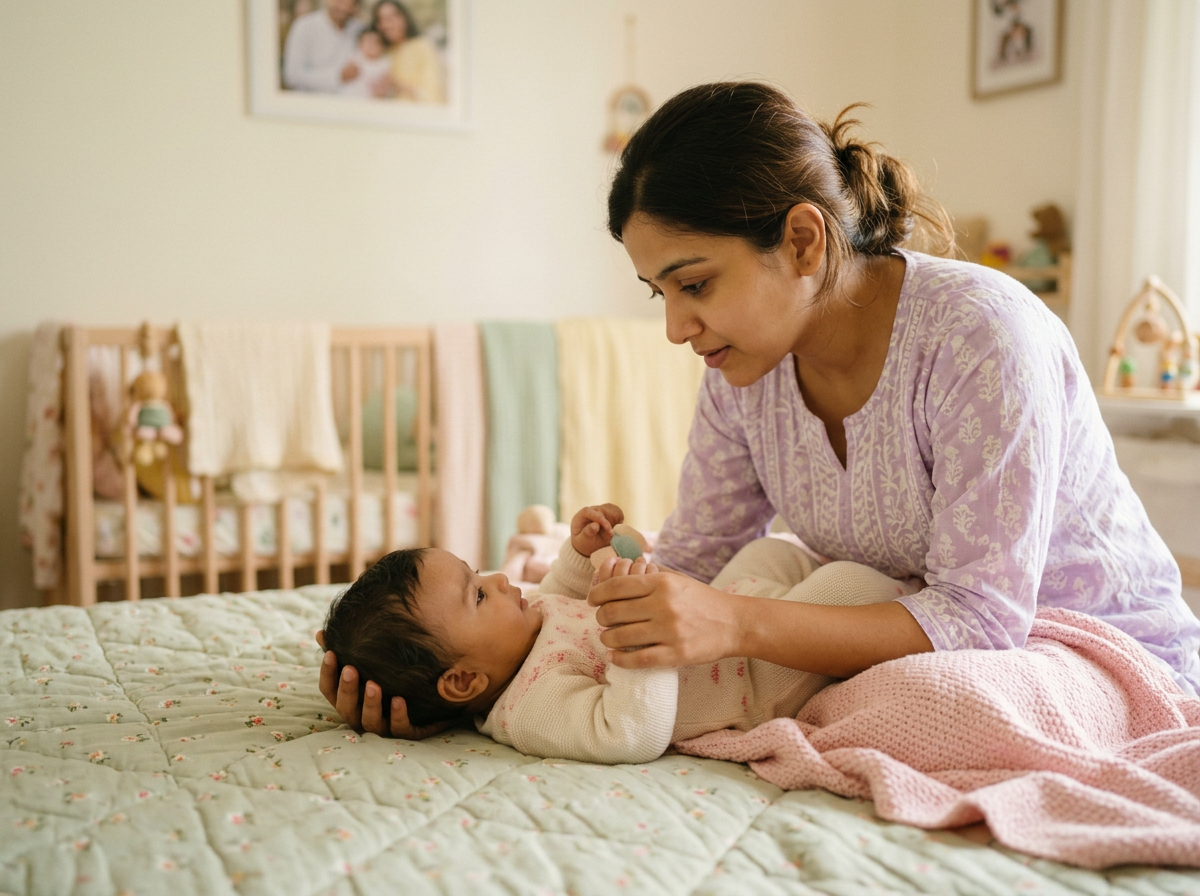
If your baby isn't hitting a milestone exactly when the Google chart says they should, don't panic—milestones are ranges, not deadlines. However, if your 3-month-old isn’t supporting their head, your 9-month-old isn’t sitting, or your 12-month-old isn’t making eye contact or responding to their name, these are developmental red flags that require an immediate visit to your paediatrician. In India, we often hear \"late bloomers\" or \"he’ll talk when he’s ready,\" but early intervention is the most powerful tool we have.
What are Developmental Red Flags?
Development is more than just \"first steps\" and \"first words.\" It is a complex dance of motor skills (physical movement), sensory processing (sight/sound), and social-emotional growth. While it is true that every child is unique, the Indian Academy of Pediatrics (IAP) sets specific benchmarks. If a child misses these "cutoff" ages, it’s no longer a case of being a "slow starter"—it’s a signal to investigate.
The Problem with the "Wait and See" Approach
In many Indian households, grandmothers or well-meaning neighbours might say, "His father didn't speak until he was four, don't worry!" As a doctor, I hear this daily. While genetics play a role, waiting too long can miss the 'plasticity' window of the brain—the time when therapy (like speech or physio) works fastest.
Red Flags in the First 6 Months: Physical & Sensory
The first half-year is all about "finding one's body." We look closely at muscle tone and how the baby interacts with your face.
* By 2-3 Months:
* Does not follow moving objects with their eyes (tracking).
* Does not respond to loud noises (clapping, a door slamming).
* The "Floppy" Sign: If the baby feels unusually limp or like a "rag doll" when you pick them up.
* Does not smile at people (Social smile usually appears by week 6-8).
* By 4-6 Months:
* Poor head control (head still flops back when you pull them to a sitting position).
Does not reach for or grasp objects (like a rattle or your dupatta*).
* Does not bring objects to their mouth.
* Stiffness: Legs are constantly stiff or crossed (scissoring) when you try to change their diaper.
Real talk: The Maalish Myth
We love our maalish (massage) tradition in India, and while it's great for bonding, it cannot "fix" a developmental delay. If your maalish wali says she can massage away a "tight limb" or make a late-sitter sit up by rubbing harder, please stop. Physical delays often have neurological roots that require a doctor, not more mustard oil.
Red Flags from 6 to 12 Months: Social & Motor
This is the stage of "curved" development—sitting, crawling, and babbling.
* By 9 Months:
* Cannot sit with support.
* Does not babble ("ba-ba", "ma-ma", "da-da").
* Does not recognize familiar faces or show "stranger anxiety" (which is actually a healthy sign of brain development!).
* Does not roll over in either direction.
* By 12 Months:
* Does not crawl or "bottom scoot."
* The "Name Call" Test: Does not look at you when you call their name. This is a significant red flag for hearing or social communication issues.
Does not use any gestures (waving "bye-bye" or pointing to the pankha*/fan).
* Cannot stand even with support.
Red Flags in the Second Year (12-24 Months)
This is where speech and social interaction take centre stage. In India, where many of us live in multilingual households (Hindi, English, mother tongue), babies might take a tiny bit longer to sort the sounds, but the intent to communicate should be there.
* Language & Communication:
* No single words by 15-16 months.
* No two-word phrases (e.g., "Mamma doodh" or "Give toy") by 24 months.
Regression: This is the biggest red flag. If your child could* say five words and suddenly stops saying them, or stops waving, consult a specialist immediately.
* Social/Behavioural:
* Lack of "joint attention"—if you point at a dog outside and the baby doesn't look where you are pointing.
* Preference for playing alone or lack of interest in other children.
* Extreme difficulty with transitions or repetitive movements (rocking, hand-flapping) that interfere with play.
Real Talk from Indian Moms
> "My son wasn't pointing at things by 14 months. Everyone said 'he's a boy, they talk late.' But my gut felt off. We went to a developmental paediatrician and found he had a mild hearing blockage from repeated ear infections. Six months of intervention changed everything."
> — Priya, Bengaluru (Mom to 3-year-old Kabir)
> "I spent weeks crying because my daughter wasn't crawling at 10 months. It turns out she was a 'bottom shuffler' and perfectly fine, but having the doctor do the 'Ages and Stages Questionnaire' gave me my sleep back."
> — Meher, Mumbai (Mom to 14-month-old Ira)
Case Study: The "Late Talker" in a Joint Family
Ananya from Delhi noticed her 18-month-old, Ishaan, wasn't speaking any words. Her mother-in-law insisted it was because the house was too noisy with three languages. However, Ananya noticed Ishaan also didn't follow simple commands like "Bring the ball."
We conducted a formal assessment and found Ishaan had a receptive language delay. By starting speech-language therapy early and coaching the family on how to simplify instructions, Ishaan was hitting his targets by age two. The lesson? A loud house doesn't cause a delay, but it can mask one.
When to call your Paediatrician
Don't wait for your next vaccination appointment if you see any of the following:
* Loss of skills: Any loss of speech, babbling, or social skills at any age.
* Asymmetry: If the baby uses only one side of their body to reach or crawl.
* Vision/Hearing: If you suspect they aren't seeing or hearing you properly (e.g., no startle reflex to loud sounds).
* No eye contact: If the baby avoids looking at you during feeding or play.
* Persistent toe-walking: If your toddler walks on their tippy-toes almost exclusively after age two.
Frequently Asked Questions
Is it normal for my baby to skip crawling?
While some babies go straight from sitting to walking, crawling is an important milestone for bilateral coordination (using both sides of the brain/body). If they skip crawling but are pulling to stand and "cruising" along furniture, it's usually fine. If they aren't moving at all, see a doctor.
Does watching TV/Mobile cause developmental delays?
Excessive screen time (the "digital nanny") has been linked to delayed speech and poor social skills in Indian toddlers (WHO recommends ZERO screen time under age 2). It doesn't usually cause a disability, but it robs the brain of the human interaction it needs to grow.
My baby is 15 months and not walking. Should I worry?
The "normal" range for walking is 9 to 18 months. If your baby is pulling to stand, cruising, and active, you can wait until 18 months. If they are 15 months and cannot stand even with your help, book an appointment.
Can a vegetarian diet cause delays?
If a mother's diet (during pregnancy/breastfeeding) or the baby's weaning diet is deficient in Vitamin B12 or Iron, it can absolutely affect brain development and motor skills. Ensure your baby is getting iron-rich foods like ragi, pomegranate, and pulses (dal).
How do I talk to my family about my concerns without a fight?
Instead of saying "I think something is wrong," say, "The paediatrician gave me a checklist at our last visit and suggested we track these specific signs. I want to rule things out so we don't regret it later." Frame it as medical due diligence.
Early intervention is not a label; it is a ladder. If you feel in your "Mamma-gut" that something isn't right, trust yourself. You are your child’s best advocate.
You are doing a great job; asking the question is the first step.
Sources & further reading
- Indian Academy of Pediatrics (IAP) — Growth and Development Guidelines
- WHO — Multi-centre Growth Reference Study (MGRS) Group
- AIIMS Delhi — Department of Pediatrics Developmental Screening
- NHP India — Child Health and Development
Written by Dr. Anjali Mehta, MBBS, DCH (Paediatrics)
Reviewed by TheMamaCircle Editorial Team
Last updated: 9 May 2026
This article is for general information only and is not a substitute for personalised medical advice. Always consult your paediatrician or obstetrician for your specific situation.