Gentle Parenting in India Guide: Scripts for Joint Families
Master gentle parenting in Indian joint families. Practical scripts for Dadi/Nani, handling tantrums without shouting, and breaking generational cycles safely.
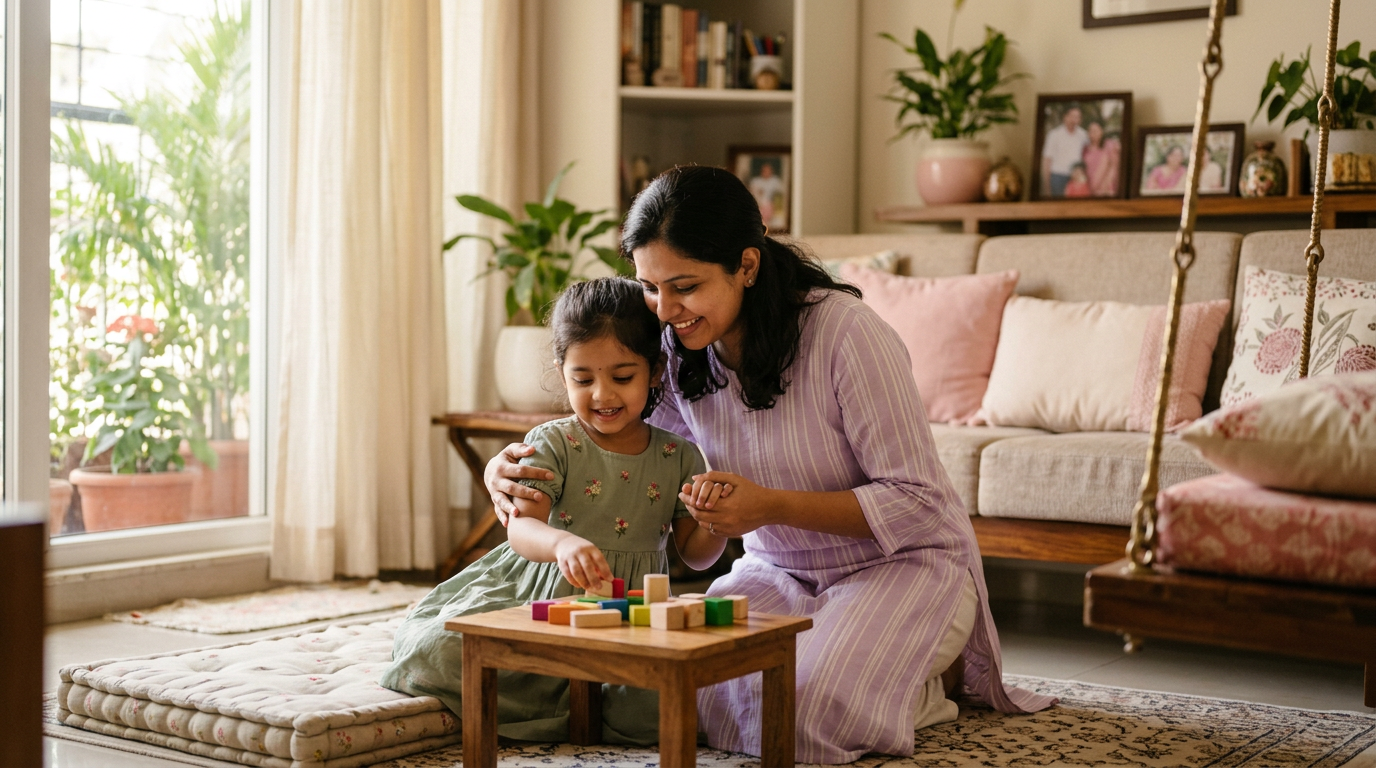
Gentle parenting in Indian homes isn't about letting your child ‘rule the house’; it is about building a relationship based on respect rather than fear, even when three generations are watching you from the dining table. To do this in a joint family, you need two things: a steel spine for boundaries and a soft heart for your child. In our culture, where shame and shouting are often mistaken for discipline, switching to a gentle approach can feel like an uphill battle against Dadi, Nani, and everyone in between.
I remember my first week back at my in-laws' place with my toddler. He threw a tantrum because I wouldn’t give him a second ladoo. Immediately, my mother-in-law said, \"Arre, rone kyun de rahi ho? Ek hi toh maang raha hai.\" (Why are you letting him cry? He’s only asking for one.) I felt the heat rise in my cheeks. I wanted to scream, but instead, I had to find a way to parent my child while 'managing' my elders.
Gentle Parenting is Not "Permissive" Parenting
The biggest misconception in Indian households is that gentle parenting (laglaad) makes children "spoilt." On the contrary, gentle parenting is about High Warmth + High Firmness.
In an Indian context, this means we stop using "Because I said so" or the threat of the thappad (slap) and start using logical consequences. You are still the boss, but you are a kind boss, not a dictator.
The Three Pillars for Indian Homes:
How to Handle the "Log Kya Kahenge" Pressure
When you’re at a family wedding and your 3-year-old is having a meltdown, the aunties start whispering. In India, a child’s behaviour is seen as a direct report card of your parenting.
Real Talk: The "Audience" Anxiety
Let’s be honest: it is 10x harder to be a gentle parent when your Sasu Maa is standing there sighing or your sister-in-law is rolling her eyes. You feel judged. You feel like you should just yell so everyone sees you are "taking action." Don't. Your child’s mental health is more important than your reputation at the kitty party. Take a deep breath, pick up your child, and move to a quiet room. You don't owe the crowd a performance.
Practical Scripts for Joint Family Situations
The biggest hurdle is often the well-meaning but different parenting styles of grandparents. Here is how to handle common scenarios without causing a family feud.
Scenario 1: The "Don't Cry" Trap
Dadi says: "Don’t cry like a girl! Be a brave boy. Look, the crow will come and take you if you cry."
* What you say to the child: "It’s okay to be sad that the toy broke. I’m here. You can cry it out."
What you say to Dadi: "Mummyji, hum ise sikha rahe hain ki emotions ko kaise handle karna hai. Rone se uska mann halka ho jayega.*" (Mummyji, we are teaching him how to handle emotions. Crying will help him feel better.)
Scenario 2: Forced Feeding
Nani says: "He hasn't eaten anything! Just one more spoon for Nani? If you don't eat, I’ll be sad." (Emotional blackmail is our national sport!)
* What you say to the child: "You listen to your tummy. If it's full, you can stop."
* What you say to Nani: "Ma, his stomach is small. If we force him, he will start hating mealtime. Let’s trust him."
Scenario 3: The Threat of the "Police" or "Outdoor Ghost"
The Help/Elder says: "If you don't sleep, I'll call the police/baba."
* What you say to the child: "The police are here to keep us safe, not to take children away. You are safe here."
* What you say to the adult: "Please don't use fear to make him listen. We want him to feel safe at home, not scared of the world."
Case Study: Ananya from Pune
Ananya, a mom to a 4-year-old in a family of eight, shared her "Gentle Parenting Win" with us. Her father-in-law used to mock her for "talking too much" to her son during tantrums instead of just giving him a "light smack."
Ananya stayed consistent. After six months, she noticed her son would come to her when he was angry and say, "Mama, I'm frustrated, I need a hug," instead of hitting. Her father-in-law eventually admitted, "He listens to you more than the kids in our day listened to us."
Mama-to-Mama: It takes time. You are breaking generational cycles of trauma. It won't happen in a week.
When to Call Your Paediatrician
Gentle parenting focuses on emotional regulation, but sometimes "behaviour" is actually a clinical issue. Consult your doctor if:
* Your child has frequent, violent meltdowns that last longer than 20-30 minutes.
* The child is hurting themselves (head banging, biting themselves).
* There is a significant delay in speech or social interaction.
* The child seems unable to make eye contact or follow simple instructions by age 2.
* You feel you are unable to control your own anger and fear you might hurt the child.
Real Talk from Indian Moms
* Megha, Delhi (Baby 2y): "The hardest part isn’t the baby; it’s my mother-in-law saying 'We raised 4 kids without all this drama.' I just smile and say, 'I know, you did great, but the world is different now.'"
* Sumitra, Bengaluru (Baby 5y): "I used to hide in the bathroom to do gentle parenting because I didn't want the lecture. Now, I do it openly. If they think I’m soft, let them. My son tells me everything, and that’s my reward."
Frequently Asked Questions
Isn't gentle parenting just being a "doormat" for your kid?
No. Being a doormat is permissive parenting—where there are no rules. Gentle parenting has very strict rules (e.g., "We do not hit"), but the way we enforce them is through calm guidance, not through fear. If they hit, you take them away from the situation. You don't hit them back to "teach" them.
How do I handle my husband who thinks I'm too soft?
Sit him down away from the kids. Show him the research (IAP and WHO guidelines) on how physical punishment and shouting affect brain development. Frame it as a "team goal": we want a child who talks to us when they're 16, not one who hides things from us.
My child only listens when I shout. What do I do?
This is because they have become "conditioned" to your volume. Their brain ignores you until you hit the "threat level" (shouting). To fix this, you have to "reset." Get down on their eye level, touch their shoulder, and speak in a low, firm voice. It will take a few weeks of "whisper-parenting" to break the shouting cycle.
How can I be gentle when I’m exhausted and living in a joint family?
Self-regulation. You cannot pour from an empty matka. If you’re about to blow, tell your child (and your family), "Mama is feeling very angry right now. I am going to take 5 minutes in my room to calm down." This actually is gentle parenting—you are modelling how to handle big feelings.
What if my child "misbehaves" just to get attention from grandparents?
Grandparents often give in to demands to be "the good guy." Have a private chat with the elders. Tell them, "When you give him the chocolate I said no to, he learns that he can play us against each other. Let's be a team so he grows up disciplined."
Gentle parenting in an Indian home isn't about perfection; it’s about persistence. You are teaching your child that their voice matters and their home is a safe space.
I am my child's safe harbour, even when the sea is choppy.
Sources & further reading
- Indian Academy of Paediatrics (IAP) — Parenting Guidelines on Discipline and Child Mental Health
- WHO — Guidelines on Parenting for Lifelong Health
- AIIMS Department of Paediatrics — Childhood Behavioural Management Strategies
- NHP India — Child Health and Emotional Well-being Portal
Written by Dr. Anjali Mehta, MBBS, DCH (Paediatrics)
Reviewed by TheMamaCircle Editorial Team
Last updated: 23 May 2026
This article is for general information only and is not a substitute for personalised medical advice. Always consult your paediatrician or obstetrician for your specific situation.