Gentle Parenting in Indian Homes: Practical Guide & Scripts
Gentle parenting in Indian joint families: How to hold boundaries without the 'thappad' or 'shame'. Practical scripts for dadi & nani included. Join the circle!
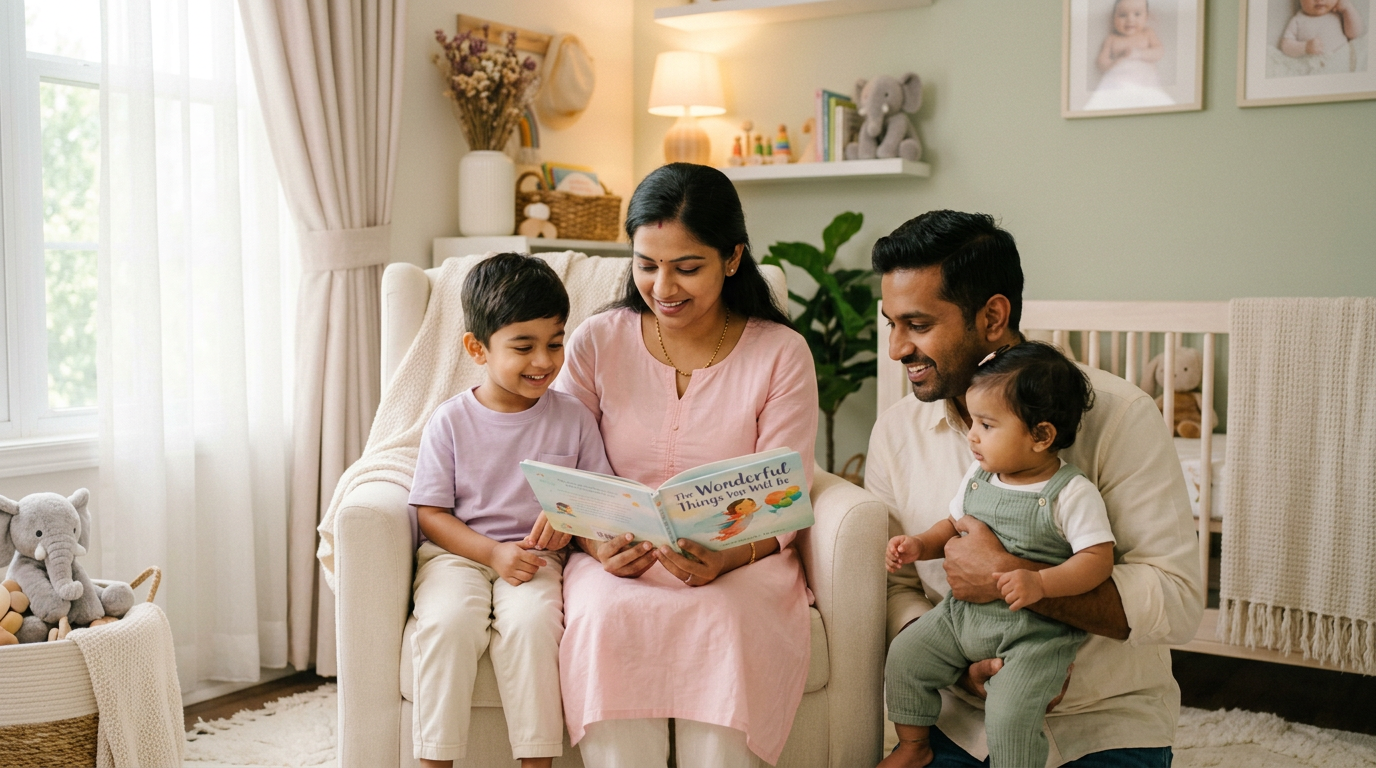
Gentle parenting in Indian homes isn't about letting your child "run wild"—it is about building a relationship based on respect rather than fear, even when the dadi, dadi, and sasu maa are watching with raised eyebrows. At its core, it means treating your child as a tiny human with big feelings, while holding firm, consistent boundaries. In a typical Indian household, this often means bridging the gap between the "because I said so" generation and our desire to raise emotionally resilient kids.
I remember my own 2 AM meltdown when my toddler refused to sleep. My mother-in-law stood at the door, suggesting we just "give him a light slap" or "scare him with the booji (ghost)" so he’d comply. I had to choose: do I follow the old ways to keep peace in the house, or do I stick to my goal of gentle discipline? I chose the latter, but it required a very specific set of Hinglish scripts to manage the adults as much as the child.
What does gentle parenting actually look like in an Indian context?
Gentle parenting (often called Positive Parenting) is built on four pillars: empathy, respect, understanding, and boundaries. In India, we often struggle because our traditional parenting style is authoritarian—the "shame and blame" method.
Understanding the "Why": Instead of punishing a child for throwing a steel ka glass*, we look at why they did it. Are they tired? Hungry? Seeking connection?
Holding the line without hitting: We don't use thappads* or canes. We use logical consequences. If you throw the toy, the toy goes away for ten minutes.
The "No-Shaming" Rule: We avoid phrases like "Gande bachhe aise karte hain" (Bad kids do this) and replace them with "Behaviour bura tha, aap acche ho"* (The behaviour was bad, you are good).
*
Real talk: The struggle is real.
Let’s be honest—gentle parenting is 10x harder when you live in a joint family. It’s easy to stay calm when you’re alone, but when your father-in-law is judging your "softness" or your sister-in-law’s kids are perfectly "obedient" (out of fear), your patience wears thin. You aren’t just parenting your child; you’re re-parenting yourself while managing the egos of five other adults. It’s okay to feel exhausted.
*
Practical Scripts for Joint Family Challenges
The biggest hurdle to gentle parenting in India isn't the child—it's the log kya kahenge (what will people say) factor. Here is how to handle common scenarios with scripts that are respectful to elders but firm on your parenting choices.
Scenario 1: When Dadi tries to "scare" the child into eating
Traditional way: "Kha lo, nahi toh police pakad legi!" (Eat, or the police will catch you!)
The Gentle Script (to the child): "Beta, police doesn't come for kids who don't eat. We eat because our tummy needs energy to play."
The Script (to Dadi): "Mummyji, I want him to love food, not fear the police. Let’s try telling him how strong he’ll get like his Chacha instead."
Scenario 2: When the child has a tantrum in front of guests
Traditional way: A quick pinch or a harsh "Chup ho jao!" (Shut up!) to save face.
The Gentle Script: "I see you’re feeling very overwhelmed because there are so many people here. It’s okay to cry. Let’s go to the other room for a minute."
The Script (to the judgmental relative): "He's just having a hard time with the noise. We'll be back once he's had a moment to breathe. It’s normal for his age."
Scenario 3: When an elder says, "We hit you and you turned out fine."
The Script: "I know you did your best with the tools you had, and I’m grateful for my upbringing. But research now shows that hitting can cause anxiety, and I want to try a different way to build his inner confidence. I’d love your support in this."
How to Handle the "Over-Pampering" (The Dada-Dadi Factor)
In many Indian homes, the struggle isn't just harshness; it's the lack of boundaries from grandparents who give chocolates for breakfast.
*
Mama-to-Mama: Don't aim for 100%.
If you lose your cool and yell, you haven't failed at gentle parenting. You’re human. The beauty of this method is the "Repair." Go to your child, say "I'm sorry I yelled. I was frustrated, but it wasn't your fault. Let's try again." This teaches them more about conflict resolution than being "perfect" ever would.
*
Ananya’s Story: A Win in a Delhi Joint Family
Ananya, a mom of a 3-year-old in Delhi, shared: "My father-in-law used to call my son a 'crybaby' every time he fell down. I started saying, 'It's okay to cry, it hurt,' every single time. After three months, I saw my father-in-law actually sit down on the floor and tell my son, 'Bura laga na? Koi baat nahi.' (It felt bad, right? No problem.) He didn't even realize he was using my script. Change is slow, but it happens by example."
When to call your paediatrician (Behavioural Red Flags)
While gentle parenting handles most tantrums, sometimes "big feelings" are signs of something else. Consult your doctor if:
* The child is consistently hurting themselves or others (biting/hitting) despite firm boundaries for over 6 months.
* The child completely loses touch with reality during a meltdown (no eye contact, cannot be consoled at all).
* There is a sudden, drastic change in behaviour or regression (e.g., a potty-trained 4-year-old starting to bed-wet daily).
* The child shows no interest in social interaction with peers or family members.
* You feel you are unable to control your own anger and fear you might physically harm your child.
Frequently Asked Questions
Isn't gentle parenting just "permissive" parenting?
No. Permissive parenting has no rules. Gentle parenting has very high standards for behaviour, but we use connection instead of coercion to get there. "I won't let you hit" is a firm boundary. "I understand you're angry, but hitting hurts" is the gentle delivery.
How do I stop my child from hitting back?
If a child hits, you calmly catch their hand and say, "I cannot let you hit. If you are angry, you can stomp your feet or hit this pillow." Consistency is key. In a joint family, ensure everyone follows the same rule of "no hitting."
My Sasu-maa thinks I'm making the child "weak." What do I do?
Explain that emotional intelligence is a "soft skill" that is highly valued in the modern world. Tell her, "I want him to be brave enough to tell me the truth even when he makes a mistake, rather than lying because he's scared of being hit."
Does gentle parenting work for toddlers (2-year-olds)?
Yes, but it requires more redirection. At two, they don't have impulse control. You focus on "modelling" behaviour. If you want them to speak softly, you must speak softly.
What if my husband isn't on board?
Start small. Don't use jargon like "conscious parenting." Just show him the results. When he sees that the child listens to you without you screaming, he will naturally be curious about your "secret."
How do I handle public tantrums without feeling embarrassed?
Remind yourself: Your child's emotional health is more important than a stranger's opinion at the mall. Take a deep breath, get down to their eye level, and ignore the "auntyji" staring at you.
Rising above generations of "hitting for discipline" is hard work. You are literally changing your family's history. Be kind to yourself as you navigate the complexities of an Indian household. You are doing a great job, even on the days it feels like no one is listening.
Your child doesn't need a perfect parent; they need a parent who tries.
Sources & further reading
- Indian Academy of Pediatrics — Parent Information Portals
- WHO — Helping adolescents thrive: Parenting tips
- NIN (National Institute of Nutrition) — Child Behaviour and Nutrition Guidelines
- AIIMS — Department of Pediatrics Child Psychology Resources
Written by Dr. Anjali Mehta, MBBS, DCH (Paediatrics)
Reviewed by TheMamaCircle Editorial Team
Last updated: 5 May 2026
This article is for general information only and is not a substitute for personalised medical advice. Always consult your paediatrician or obstetrician for your specific situation.