How to Sleep Train a Baby: Indian Joint Family Guide
Learn how to sleep train a baby in an Indian joint family. Use gentle, no-cry methods that respect our culture while getting you more rest. Read the guide.
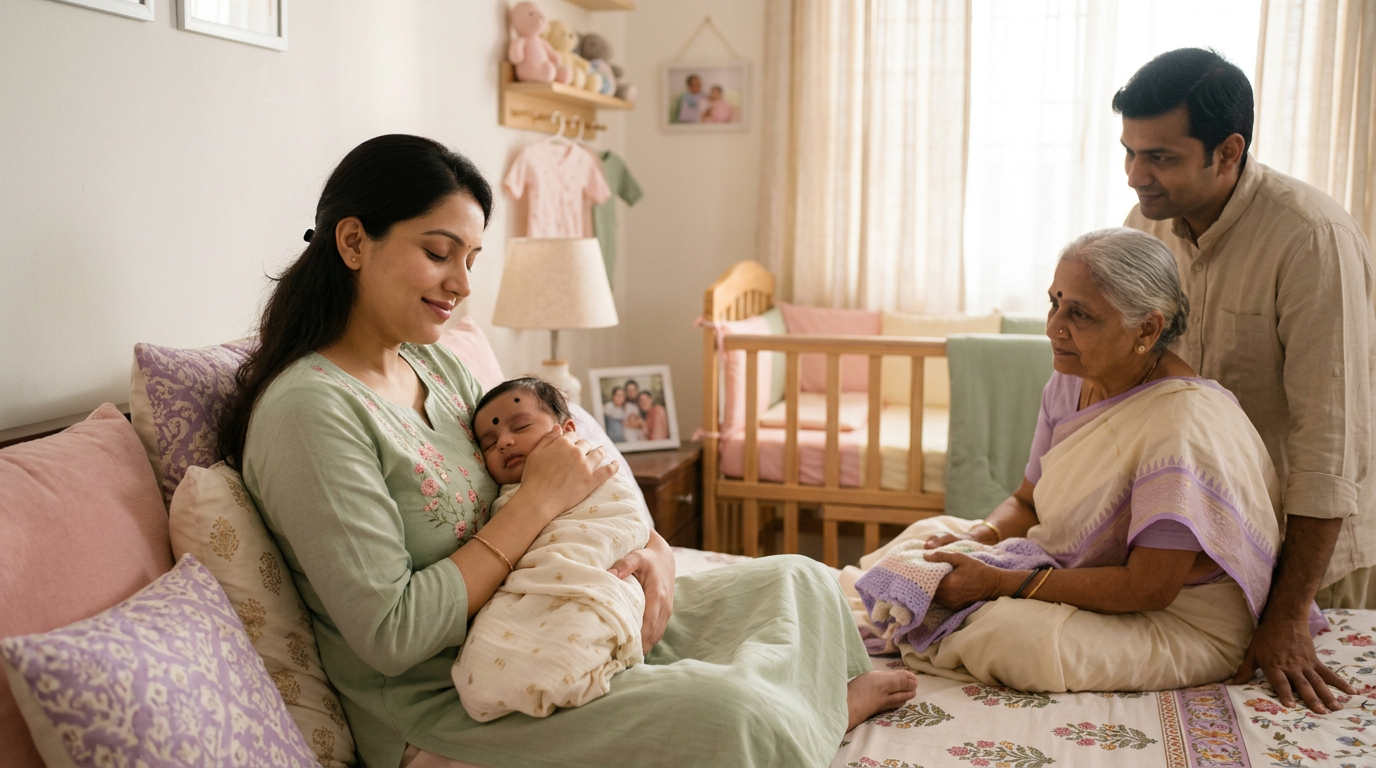
The "Joint Family" Reality of Sleep
Most global sleep training advice assumes you live in a quiet, two-bedroom apartment where you can shut the door and let the baby "cry it out." In India, that’s almost never the case. You likely have a sasu maa who thinks a crying baby is being neglected, a nanad who wants to play with the baby at 10 p.m., or a husband who thinks sleep training is "too Western."
To sleep train in an Indian home, you don't need a stopwatch; you need a strategy that involves the whole family. We aren't looking for a 12-hour stretch of silence immediately; we are looking for a baby who can fall back asleep when their jhoola stops moving or when the breast is tucked away.
Can you sleep train a baby in an Indian joint family?
Yes, but you have to stop calling it "training" and start calling it a "routine" (niyam). In our culture, the word "training" sounds harsh. When you tell your mother-in-law you are "setting a routine for better brain development," she is much more likely to get on board than if you say you’re "sleep training."
The goal is to teach your baby to self-soothe. This means when they wake up at 3 a.m. (which they will, because infant sleep cycles are short), they don't immediately need a maalish, a feeding, or to be rocked for forty minutes to go back to sleep.
Gentle Sleep Training Methods That Actually Work
Forget the "Cry It Out" (CIO) method. It rarely works in Indian households because the moment the baby screams, someone will knock on your door to "rescue" them. Instead, try these high-touch, gentle methods:
1. The "Pick Up, Put Down" (PUPD) Method
This is the gold standard for Indian moms.
* How it works: You follow your bedtime routine and put the baby down while they are drowsy but still awake.
* The pivot: If they start to cry, pick them up and cuddle them until they are calm (but not asleep). Put them back down.
* Why it works for us: It settles the anxiety of the elders in the house. They see you responding to the baby, so they don’t feel the need to intervene.
2. The "Chair Method" (modified for the bed)
Since many Indian families co-sleep or keep the crib in the same room:
* How it works: Sit on a chair (or the edge of the bed) right next to the crib/cot.
* Action: Pat the baby occasionally or whisper "shh-shh." Every few nights, move your chair further away until you are at the door, and eventually, out of the room.
The benefit: Your baby feels your presence (the sparsh*), which lowers their cortisol levels, but they learn to close their eyes without being held.
3. The "Leveled Soothing" Approach
Before jumping to a feed or a rock, wait 60 seconds.
* Level 1: Use your voice (shushing).
* Level 2: Use your hand (patting the tummy/chest).
* Level 3: Pick up and soothe.
* Level 4: Feed (if it’s time).
Managing the Dadi/Nani Factor
Your biggest hurdle isn't the baby; it’s the well-meaning elders. In India, we have a "let the baby sleep when they are tired" culture, which often leads to an overtired baby who refuses to sleep at night.
The Script for Sasu Maa: "Mummyji, the doctor said that if he sleeps by 8 p.m., his growth hormone works better. Can we try to keep the drawing room quiet after 7:30 p.m. so he grows taller and stronger?" (Linking sleep to physical growth usually wins the argument).
Real Talk: The "Maalish" Timing
Maalish (massage) is incredible for sleep, but only if timed right. If your dai comes at 4 p.m. and the baby naps until 6 p.m., they will NOT sleep at 8 p.m. Shift the massage to earlier in the day or do a gentle "mamma-led" massage with warm coconut or sesame oil right before the night bath.
Case Study: Ananya from Bengaluru
Ananya, a mom to 7-month-old Kiaan, lived in a house with seven adults. Kiaan was used to being passed around until 11 p.m. Ananya started the "Bedtime Boundary." She told the family that 7:30 p.m. to 8:30 p.m. was "Kiaan’s Quiet Time." She dimmed the lights in the main hall and moved him to the bedroom. Within two weeks, because the "stimulation" ended early, Kiaan began sleeping 5-hour stretches. "The hardest part wasn't Kiaan crying," Ananya told us, "it was telling my father-in-law he couldn't play with the baby after dinner."
> Mama-to-Mama: Real Talk
> Let’s be honest: Sleep training is exhausting for the first three nights. You will feel like a "bad mom" when they whimper. You aren't. You are teaching them a life skill. Also, wear earplugs if you have to—not to ignore the baby, but to take the edge off the high-pitched crying so you stay calm. A frantic mom cannot soothe a frantic baby.
When to call your paediatrician
Sleep issues are sometimes medical. Consult your doctor if:
* The baby is snoring loudly or gasping for breath (could be sleep apnoea).
* The baby has severe acid reflux (spitting up aggressively) that prevents lying flat.
* There is zero improvement after 2 weeks of consistent routine.
* The baby isn't gaining weight (night feeds may still be medically necessary).
* You feel signs of Postpartum Depression (PPD) or extreme resentment toward the baby.
Frequently Asked Questions
Does sleep training mean I have to stop breastfeeding at night?
No. Sleep training and night weaning are different. You can teach a baby to fall asleep independently at 8 p.m. and still wake up to feed them at 1 a.m. and 4 a.m. The goal is to stop using the breast as the only way the baby knows how to shut their eyes.
Is it okay to use a jhoola or a mosquito net cradle?
A jhoola is great for naps, but for long-term sleep training, the baby needs a firm, flat surface. If they only sleep with motion, they will wake up the second the jhoola stops. Try to transition them to a firm mattress once they hit the 4-6 month mark.
My baby has a "Ragi" or "Rice" dinner. Why don't they sleep through?
The "heavy food equals heavy sleep" is a myth. Overfeeding a baby with heavy solids right before bed can actually cause indigestion and gas, leading to more wakeups. Focus on a balanced day of calories rather than a "loaded" dinner.
At what age should I start?
The IAP and most paediatricians suggest waiting until the baby is at least 4 to 6 months old. Before this, they may genuinely need middle-of-the-night calories, and their circadian rhythms aren't fully developed.
What if we share a room?
Most Indian families do! Use a room divider, a curtain, or simply turn off your phone/TV. The "Chair Method" works perfectly for co-sleeping rooms because you are already there; you’re just changing how you interact.
The Indian Baby Sleep Environment Checklist
* Temperature: 24-26°C with a fan on low.
Clothing: A cotton jhabla* or a light sleep sack. Avoid heavy blankets (SIDS risk).
The "Pooja" Factor: If you light agarbatti or dhoop*, ensure the room is well-ventilated before the baby goes in. Strong scents can irritate tiny airways.
* Noise: Use a white noise machine (or a fan) to drown out the pressure cooker whistles or TV sounds from the next room.
The first night will be tough. The third night will be tested. By the tenth night, you’ll have your evenings back. Consistency is your only friend here—don't let one "bad day" or one comment from a relative make you quit.
You’ve got this, Mama. A well-rested mom is a happy mom.
Sources & further reading
- Indian Academy of Pediatrics (IAP) — Guidelines on Sleep Hygiene for Infants and Children
- National Health Portal (NHP) India — Infant Growth and Development
- World Health Organization (WHO) — Guidelines on Physical Activity, Sedentary Behaviour and Sleep for Children under 5 Years of Age
- AIIMS Delhi — Paediatrics Department: Sleep Disorders in Children
Written by Dr. Anjali Mehta, MBBS, DCH (Paediatrics)
Reviewed by TheMamaCircle Editorial Team
Last updated: 26 April 2026
This article is for general information only and is not a substitute for personalised medical advice. Always consult your paediatrician or obstetrician for your specific situation.