"Humare Zamane Mein..." — How to Handle Traditional Advice
Struggling with 'Dadi ka nuskha' vs. your pediatrician’s advice? Here is how to handle the joint family drama without losing your peace (or your mind!).
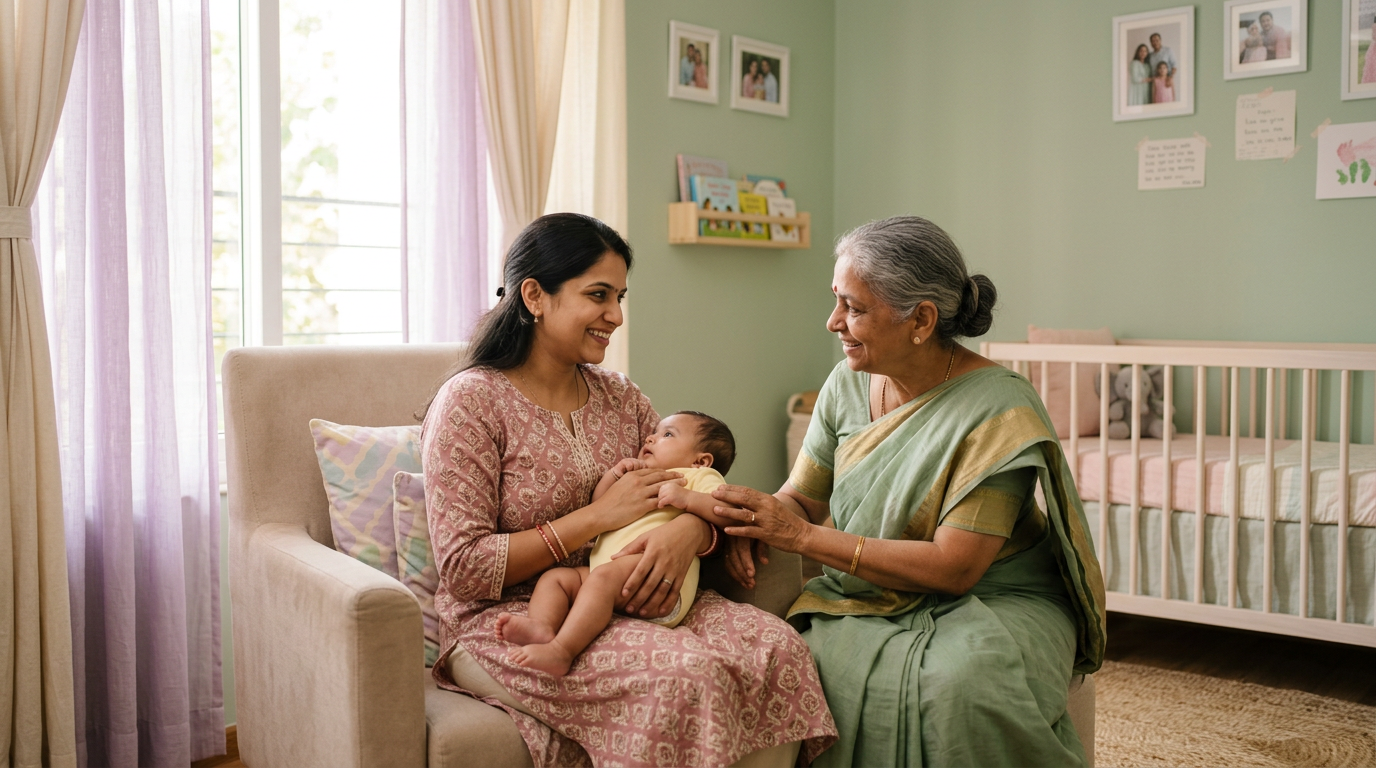
It’s 2 AM, and you’re caught between a PDF and a Dadi-Maa...
I see you, Priya. You’re sitting there in your nursing chair, scrolling through a research paper on "safe sleep," while in the next room, your mother-in-law is already preparing the rai ka takiya (mustard seed pillow) and suggesting a little ghutti for the baby’s colic.
Living in an Indian joint family is a blessing. You have hands to hold the baby while you finally take a hot shower, and there’s always someone to make you that extra bowl of panjiri. But let’s be real: it’s also a minefield of "we did this for thirty years and you turned out fine" vs. "but my pediatrician said World Health Organization guidelines have changed!"
How do you keep the peace without compromising on your baby’s safety and your own parenting style? Grab a cup of ginger chai, and let’s talk about how to bridge that generational gap.
1. The "Doctor Said So" Shield (Your Secret Weapon)
In most Indian households, the Doctor is the ultimate authority. If you say the baby shouldn't have water before six months, it’s a "new-age whim." If the pediatrician says it, it’s a medical mandate.
Actionable Step: Take your mother-in-law or mother with you to the next vaccination appointment at Cloudnine or Apollo Cradle. Before you go, whisper to your doctor: "Could you please emphasize why we don't use talcum powder or honey for newborns?"
When the authority figure in the white coat says it directly to her, it takes the pressure off you. You aren’t the "disobedient daughter-in-law"; you’re just a mother following medical advice.
2. Navigating the 'Maalish' Wars
The maalish-wali didi is an institution in India. But often, their techniques are a bit... aggressive. Your Nani might want a vigorous massage that looks like a wrestling match, while you’ve read that gentle strokes are better for baby's skin.
The Middle Ground: Don't ban the maalish—it’s a great tradition for circulation. Instead, choose your products and set the pace.
The Products: If they insist on mustard oil but you’re worried about rashes, suggest a compromise like Himalaya Baby Oil or Mamaearth Soothing Massage Oil. Tell them, "Ma, the pollution is so high these days, the doctor said his skin is extra sensitive, so we have to use this."*
The Technique: Sit with them during the massage. Compliment her skill (e.g., "Wow, you really know how to soothe his legs!"*), but gently intervene if she starts pulling the joints too hard.
3. The Solid Food Face-off: "Bus ek chammach!"
This is usually where the biggest friction happens. Around the 4-month mark, the elders might start suggesting dal ka paani or a lick of honey.
How to handle it: Research shows that dal ka paani (just the broth) lacks the nutrition of the actual mashed dal.
The Conversation: "I know you want her to grow strong, and I love that. But the latest research shows their kidneys aren't ready for salt/sugar until age one. Let's wait until the 6th month, and then you can be the one to give her the first spoonful of mashed papaya!"*
By involving them in the future plan, they feel included rather than excluded.
4. Modern Safety vs. Traditional Comfort
The "Mustard Seed Pillow" (Rai ka takiya) and the heavy razais are staples. But modern pediatrics warns against these due to SIDS risks.
The Fix: This is a non-negotiable safety issue, but you can frame it softly.
* Instead of: "Stop putting pillows in the crib, it's dangerous!"
* Try: "I'm so worried about the heat/suffocation warnings we're seeing on the news. Let's use these Chicco sleep sacks or a firm mattress instead. It’s the new safety standard in all the hospitals now."
5. The "Japa" Period and Your Mental Health
The traditional 40-day Japa period is meant for rest, but for a modern mom, the isolation and strict diet (no fans, no washing hair, only ajwain water) can be overwhelming.
What to do Today: Pick your battles. If drinking warm water makes them happy and doesn't hurt you—do it. But if the lack of a fan in 40-degree Mumbai heat is making you cry, speak up.
The Script: "Ma, I really value the Japa traditions, but I’m feeling very claustrophobic and it’s making it hard for me to bond with the baby. Can we keep the AC at 26 degrees? It will help me stay calm so the milk flows better." (Linking it to the baby’s well-being is the magic key!)
6. Create a "Circle of Trust" WhatsApp Group
Sometimes, aunts and neighbors chime in with "advice" that contradicts your parenting.
Actionable Tip: Start a family WhatsApp group where you share short, cute videos of "Modern Baby Tips" from trusted Indian pediatricians (like Dr. Nihar Parekh). When the information comes from a neutral third party on their phone screens, it sinks in differently than when it comes from you during a heated moment.
A Note for Your Heart ❤️
Priya, I know it’s exhausting to defend your choices every day. You feel like you’re being a "difficult" person when you’re just trying to be a good mom.
But remember this: Your mother and mother-in-law are acting out of love, not malice. They want the baby to be healthy just as much as you do. Their "advice" is their way of being useful.
When you disagree, try to lead with: "I know you’re saying this because you love the baby so much." That one sentence can de-escalate 90% of household arguments.
You are doing a great job. The fact that you’re worried about doing it "right" means you’re already the perfect mother for your little one. You’ve got this! 🧿
Tell me in the comments—what’s the most "interesting" piece of advice your elders have given you so far? Let's laugh about it together!✨