Joint Family Parenting: 5 Tips to Align Grandparents (India
Struggling with joint family parenting? Learn how to align grandparents with modern paediatric advice on nutrition, safety, and screen time without the drama. 🤱✨
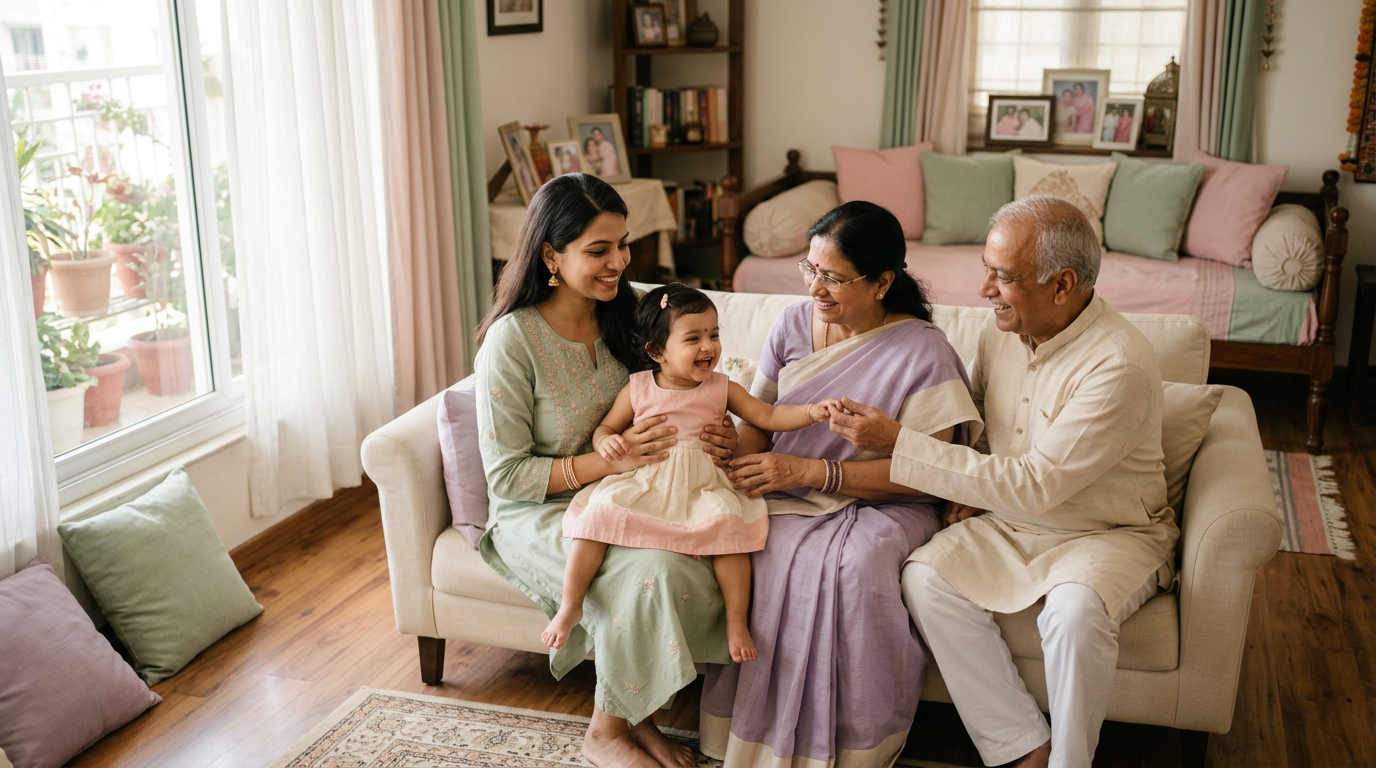
The secret to peaceful joint family parenting is accepting that you aren't just raising a child; you are managing a small, highly emotional corporate board where everyone thinks they are the CEO. In India, the 'village' it takes to raise a child is usually right there in the living room, and while the extra hands are a blessing, the conflicting advice on ghutti, honey, and screen time can make you want to scream into a pillow. To keep the peace, you must transition from being the 'obedient child' to the 'confident parent' while keeping the maryada of the house intact.
Why the 'Generation Gap' feels like a battlefield
Our parents raised us in an era of 'doctor knows best,' but also one where traditional wisdom was never questioned. Today, we have Instagram, WHO guidelines, and evidence-based research at our fingertips. When your sasu maa insists on putting kajal in the baby’s eyes to make them 'bright,' she isn't trying to harm the baby; she’s expressing love the only way she knows how.
The friction usually happens in three areas:
* Safety Standards: Car seats vs. lap-sitting, or sleeping on the back vs. tummy.
Nutrition: Introducing salt/sugar before age one vs. the mishti doi* tradition.
* Discipline: Gentle parenting vs. 'one slap never hurt anyone.'
Real Talk: The 'Maalish' Wars
Let’s be honest: the maalish-wali or your mother-in-law might have stronger hands than a professional wrestler. While massage is great for circulation, the traditional 'vigorous' stretching or putting oil in the ears/navel is medically outdated and potentially risky.
The Fix: Instead of saying "The doctor said you're wrong," try: "The new IAP guidelines suggest a gentle touch helps the baby's nervous system develop better. Let’s try this technique today."
How to align grandparents on modern practices without the drama
You cannot win a confrontation with a grandparent by citing a random blogger. You win by making them feel like allies in the 'Mission: Healthy Grandchild.'
1. The 'Doctor as the Bad Cop' Strategy
This is the oldest trick in the book and the most effective. If your father-in-law wants to give the 4-month-old a taste of chai, don't make it a personal ego battle.
* The Script: "Papa, I know you love him, but the paediatrician at our last check-up was very strict about no caffeine or sugar until he's older. He said it could affect his heart rate. I’m scared to go against his medical chart!"
* Why it works: It shifts the 'blame' from you to a medical authority they respect.
2. Involve them in the 'New' Learning
Grandparents often feel left out or 'obsolete' when we use apps and gadgets.
* The Action: Take them to one vaccination appointment. Let them hear the doctor explain why we don't use talcum powder anymore (respiratory risks) or why honey is a no-go before age one (botulism). When they hear it first-hand, they become your biggest enforcers.
3. Choose your 'Hills to Die On'
You cannot fight every battle. If you do, you’ll be the 'difficult' bahu/beti.
The Negotiables: Wearing a slightly-too-thick sweater, an extra gold chain for 'protection,' or an extra spoon of ghee* in the khichdi (within reason).
* The Non-Negotiables: Car safety, smoke exposure, no honey/salt/sugar before age 1, and no physical hitting.
Digital vs. Dadi: Managing the Screen Time struggle
This is the #1 conflict in modern Indian homes. You want zero screen time; Dadi wants to watch her serial while feeding the baby, or Nani wants to Video Call for 2 hours daily.
Mama-to-Mama Tip: We have to be realistic. In a joint family, some screen exposure is inevitable. Instead of a total ban (which leads to secret screen time), set 'Safe Zones.' Tell the family: "No screens during meal times because we want him to enjoy the taste of your delicious dal, but 15 minutes of rhymes with Dadi in the evening is okay."
Case Study: Ananya’s Victory in Bengaluru
Ananya, a mom to an 18-month-old, lived with her in-laws who insisted on 'distraction feeding' (using a phone to make the baby eat). Ananya didn't argue. Instead, she bought a set of high-quality animal flashcards and a colourful 'feeding chair.' She told her mother-in-law, "Ma, the doctor said his speech is lagging because he doesn't talk while eating. Can you show him these pictures while you feed him? Your voice is better than the YouTube lady's." Within a week, the MIL was proudly 'teaching' the baby instead of reaching for the phone.
Respecting the Ghar ka Khana vs. Nutrition Science
In India, food is the primary love language. When a grandmother offers a 7-month-old a piece of paratha dripping with salt and pickle, she is offering her heart.
The Strategy: Give them a 'Special Dish' responsibility. Ask Nani to be in charge of the baby's Ragi porridge or Moong Dal kheer* (without sugar).
* Specific Indian Context: Explain the concept of 'Gut Health.' Tell them that because of the pollution and changes in food processing today, babies' stomachs are more sensitive than they were 30 years ago. This validates their experience while justifying your 'modern' caution.
When to call your paediatrician
Sometimes, 'traditional' advice can cross into medical danger. If the grandparents insist on the following despite your objections, involve your doctor immediately:
Applying Gobar* or unknown pastes to the umbilical cord stump.
Giving Ghutti* or herbal concoctions to a newborn under 6 months.
* Refusing vaccinations in favour of 'natural immunity.'
* Forcing a baby to eat (force-feeding) which can lead to aspiration or choking.
Treating a high fever with just kadha* instead of paracetamol.
Real talk from Indian moms
* Megha (Delhi, Mom to a 3-year-old): "I used to get so angry when my MIL gave my daughter biscuits. Then I realised she just wanted to see her smile. Now, I keep a box of 'approved' healthy makhana and told her it’s her special treat pond. It saved our relationship."
* Saritha (Hyderabad, Mom to twins): "Real talk: the first year in a joint family is testing. You have to learn the art of 'Listen to everyone, do what is right.' Smile, nod, and then do what the paediatrician advised. If they catch you, use the 'Doctor bad cop' excuse!"
Frequently Asked Questions
How do I handle the 'We raised 4 kids and they are fine' comment?
This is the classic Indian grandparent 'boss move.' Respond with respect: "And you did an amazing job, which is why I value your help so much. But doctors have found new things about safety in the last 30 years—just like we use mobile phones now instead of the old landlines, we have better info on baby safety now."
My MIL keeps putting 'Kajal' in the baby’s eyes. How do I stop it?
Show her a picture or an article from the IAP (Indian Academy of Pediatrics) about lead poisoning and tear duct infections. If she insists, suggest a 'Kaala Teeka' on the foot or behind the ear instead. "Same protection, but safer for the eyes, Ma."
What if they give the baby water before 6 months?
Explain that a baby’s stomach is only the size of a lemon. "If we fill it with water, there’s no room for the 'gold' (breastmilk/formula) that helps him grow. The doctor said even in summer, milk is 80% water anyway!"
How do I deal with 'Jhad-phook' or superstitious rituals?
If the ritual is harmless (like a thread around the waist), let it go. If it involves ingesting something or physical pain, stand firm. "I respect our traditions, but I've made a vow to the doctor to keep his skin/stomach clear of anything non-medical until he's one."
They keep picking up the baby the moment he cries, ruining his sleep!
In India, 'Cry It Out' is culturally impossible in a joint family. Instead of fighting it, focus on 'supervised' sleep. "Ma, let him try to settle for 2 minutes—it helps his brain learn to calm itself. If he cries longer, you can be the hero who rescues him!"
Raising a child in a joint family is a marathon of diplomacy. You are the bridge between the wisdom of the past and the science of the future. It’s okay to be firm about safety, as long as you are soft with their hearts.
Remember: You are the mother, you are the primary gatekeeper, and your instinct—backed by science—is the final word.
Sources & further reading
- Indian Academy of Pediatrics — Parent Information Portal
- WHO — Infant and Young Child Feeding Guidelines
- Ministry of Health and Family Welfare (India) — MAA (Mothers’ Absolute Affection) Programme
- National Institute of Nutrition (ICMR) — Dietary Guidelines for Indians
Written by Dr. Anjali Mehta, MBBS, DCH (Paediatrics)
Reviewed by TheMamaCircle Editorial Team
Last updated: 24 April 2026
This article is for general information only and is not a substitute for personalised medical advice. Always consult your paediatrician or obstetrician for your specific situation.