Joint Family Parenting Tips: Aligning Indian Grandparents
Struggling with grandparents' advice? Learn how to align joint family parenting with modern baby care. Peace at home starts with these expert tips!
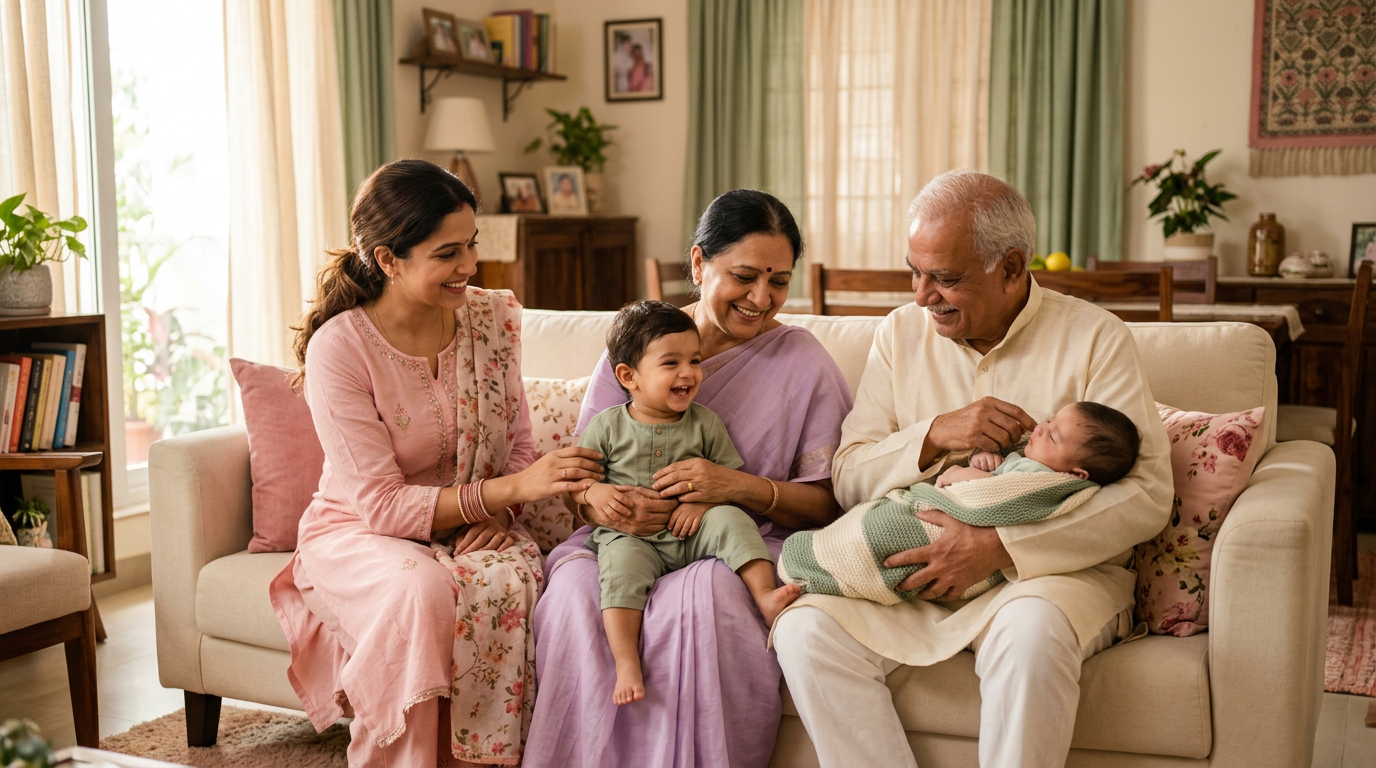
The secret to surviving a joint family with a new baby is realizing that your MIL (Mother-in-Law) isn’t trying to undermine you; she’s just using a 30-year-old software update. Whether it’s the battle over ghutti, the obsession with wrapping the baby in three layers of wool in May, or the "advice" to start solid food at 4 months, the friction is real. You can align grandparents with modern practices by positioning the paediatrician as the neutral authority and involving them in the learning process rather than just correcting them.
Why the "Generation Gap" Feels Like a War Zone
In most Indian households, a baby isn't just born to a couple; they're born to a clan. While the extra hands for maalish and the constant supply of ajwain parathas for you are blessings, the conflict arises because modern science (IAP/WHO) has debunked many things our parents considered gospel truth.
It’s hard for a Dadi who raised four healthy kids on cow’s milk to hear that it’s now considered dangerous before age one. To her, your "modern rules" feel like a rejection of her mothering. To you, her "old ways" feel like a risk to your baby’s safety.
The Shift in Basic Care
* Honey and Ghutti: Previously a staple for "clearing the stomach," we now know honey carries a risk of botulism for infants under 12 months.
* Water intake: The old school thought was "he's thirsty in this heat." Modern science says exclusive breastfeeding/formula provides all the hydration needed until 6 months.
Sleeping position: Many Indian grandparents prefer side-sleeping or using heavy razais*. We now strictly mandate "Back to Sleep" on a firm surface to prevent SIDS.
> Mama-to-mama Real Talk: I remember my mother-in-law sneaking a drop of janam ghutti to my son when I was in the shower. I wanted to scream. But when I sat her down and showed her the IAP (Indian Academy of Paediatrics) booklet explaining the risk of infection, she cried—not because she was mad, but because she realized she almost hurt him. Education works better than ego.
How to Align Grandparents Without Ending Up in a Kalesh
You don’t need to be the "bad guy" who says no to everything. Use these strategic moves to get everyone on the same page.
1. Make the Paediatrician the "Villain"
If you tell your Sasu Maa not to put kajal in the baby's eyes, it’s a daughter-in-law vs. mother-in-law fight. If you say, "The doctor at the clinic gave us a strict warning that kajal can block tear ducts and cause infections," the doctor is the one making the rules. You’re just the messenger.
* Actionable tip: Take the grandparents along for the 6-week or 3-month vaccination visit. Let them ask the doctor their questions. When Dr. Uncle says "No salt until age one," it sticks better than when you say it.
2. The "New Research" Script
Instead of saying "You're wrong," use the phrasing: "I know that was the best way when Amit was a baby, but doctors have discovered new things since then. Just like we swapped our old CRT TVs for LED ones, baby science has updated too."
3. Give Them "Safe" Traditions
Grandparents want to feel useful. If you say "No" to kajal, ghutti, and early solids, they feel stripped of their role. Redirect that energy.
* Assign the Maalish: If they are physically able, let them oversee the oil massage (with safe, non-scented oils).
The Lullaby Duty: Make them the masters of the lori and the jhoola*.
* Sunlight rituals: Let them handle the 10-minute morning sun exposure—a tradition that science actually backs for Vitamin D!
Navigating the Big Three: Feeding, Sleep, and Safety
These are the areas where the most "Hinglish" debates happen in Indian homes.
The Feeding Tug-of-War
In India, the "ceremonial" first bite (Annaprashan) often happens at 5 or 6 months. But the pressure to give "just a lick" of dal ka paani or honey often starts at month 3.
The Modern Rule: Exclusive breastfeeding/formula for 6 months. No dal ka paani* (it lacks calories and fills the stomach with just water).
* How to explain: "His kidneys aren't strong enough yet to process anything but milk. If we give him solids now, it might hurt his tummy."
The "Sardi Ho Jayegi" Myth
The fear of the "cold" is a permanent resident in Indian homes. This leads to over-layering babies in Mumbai's 30-degree humidity.
* The Modern Rule: Overheating is a major risk factor for infant distress. One extra layer than what you are wearing is enough.
* The Test: Tell Dadi/Nani to check the baby’s chest or tummy. If it’s hot or sweaty, the baby is too warm—even if the hands and feet feel cool (which is normal for babies).
The Massage (Maalish) Debates
The Maalish-wali or the grandmother might want to rub the baby vigorously or put oil in the ears/navel.
* The Modern Rule: Gentle strokes only. Never put oil in ears, nose, or the umbilical cord. This is a frequent cause of fungal infections in Indian clinics.
> Real talk: We often feel like our boundaries are being trampled. But remember, in a joint family, your child is growing up with a "village." That village provides emotional security that nuclear-family kids often miss. Pick your battles. If Dadi wears the baby in a slightly "traditional" way but the baby is safe—let it go. Save your "No" for the things that actually impact health.
When to Call Your Paediatrician
In a joint family, you might get conflicting advice on whether a symptom is "normal." Always call the doctor if you see:
* Fever: Any temperature above 100.4°F (38°C) in a baby under 3 months is an emergency.
* Dehydration: Fewer than 6 wet nappies in 24 hours. Don't listen to "give him water"; call the doctor.
* Skin Issues: Severe rashes that look like blisters or if the skin looks yellow (jaundice).
* Breathing: If you see the chest sinking in with every breath (retractions) or a grunting sound.
* The "Gut Feeling": If your mother-in-law says "it's just gas" but your gut says something is wrong—trust your gut.
"Real Talk" from Indian Moms in our Community
Ananya, Bengaluru (Baby 5 months): "My MIL was adamant about giving sabudana water at 4 months because 'the baby looks thin.' I asked my doctor to write 'ONLY MILK' on a prescription pad in big letters. I stuck it on the fridge. It worked like a charm without me having to argue!"
Kritika, Delhi (Baby 12 months): "The hardest part was the kajal. Everyone in my husband's family has it. I eventually compromised—I let her put a 'tika' of kajal behind the ear to ward off 'nazar,' but never in the eyes. Focus on the 'why'—is it for beauty or protection? Protection can be done safely elsewhere!"
Frequently Asked Questions
Is it okay to give baby water in the Indian summer?
No. According to WHO and IAP guidelines, babies under 6 months do not need extra water, even in 45-degree heat. Breastmilk is about 80% water and is perfectly designed for hydration.
Grandma wants to put hing paste on the tummy for colic. Is it safe?
Applying a little hing (asafoetida) paste around the navel (not inside it) is a traditional remedy that many parents find helpful and is generally harmless. However, never feed hing or any other spice to a baby under 6 months.
How do I stop the Maalish-wali from being too rough?
You must be firm here. Boldly tell her: "Dr. ne mana kiya hai" (The Dr. has forbidden it). Vigorous massage can lead to joint displacements or skin trauma. Show her how to do gentle, "butterfly" strokes instead.
Can I use a traditional jhoola (cloth swing)?
While culturally popular, many traditional jhoolas don't provide a flat, firm surface, which is a risk for SIDS. If you use one for napping, a grown-up must be watching the baby constantly. Never let a baby sleep overnight in a cloth swing.
My parents think the baby is "delayed" because they aren't walking at 10 months. Help!
Milestones have a wide range. Most babies walk anywhere between 9 and 16 months. Show your parents a standard "IAP Growth and Development" chart so they can see your baby is right on track.
How do I handle the "You were raised this way and you're fine" argument?
This is the classic Indian parent comeback. The best response: "I’m so grateful you raised me so well! That’s why I’m being so careful with my baby—just like you were. We just have better tools and research now than we did 30 years ago."
Every time you feel overwhelmed by the advice, take a deep breath and remember: it comes from a place of love, even if it's outdated. You are the CEO of your baby, but every CEO needs a supportive board of directors. Use your "village" for the cuddles, the cooking, and the breaks—and leave the medical advice to the professionals.
You’re doing a great job, Mama. Stick to your boundaries, but keep the chai flowing.
Sources & further reading
- Indian Academy of Pediatrics (IAP) — Growth and Development Charts
- WHO — Exclusive Breastfeeding Guidelines
- National Health Portal (NHP) India — Infant and Young Child Feeding
- AIIMS — Newborn Care Guide
Written by Dr. Anjali Mehta, MBBS, DCH (Paediatrics)
Reviewed by TheMamaCircle Editorial Team
Last updated: 25 April 2026
This article is for general information only and is not a substitute for personalised medical advice. Always consult your paediatrician or obstetrician for your specific situation.