Montessori Play Toys India: Open-Ended Guide & Rotation
Transform your home with Montessori play toys! Learn how to use open-ended play and toy rotation to boost your child's focus. Start your calm parenting journey now.
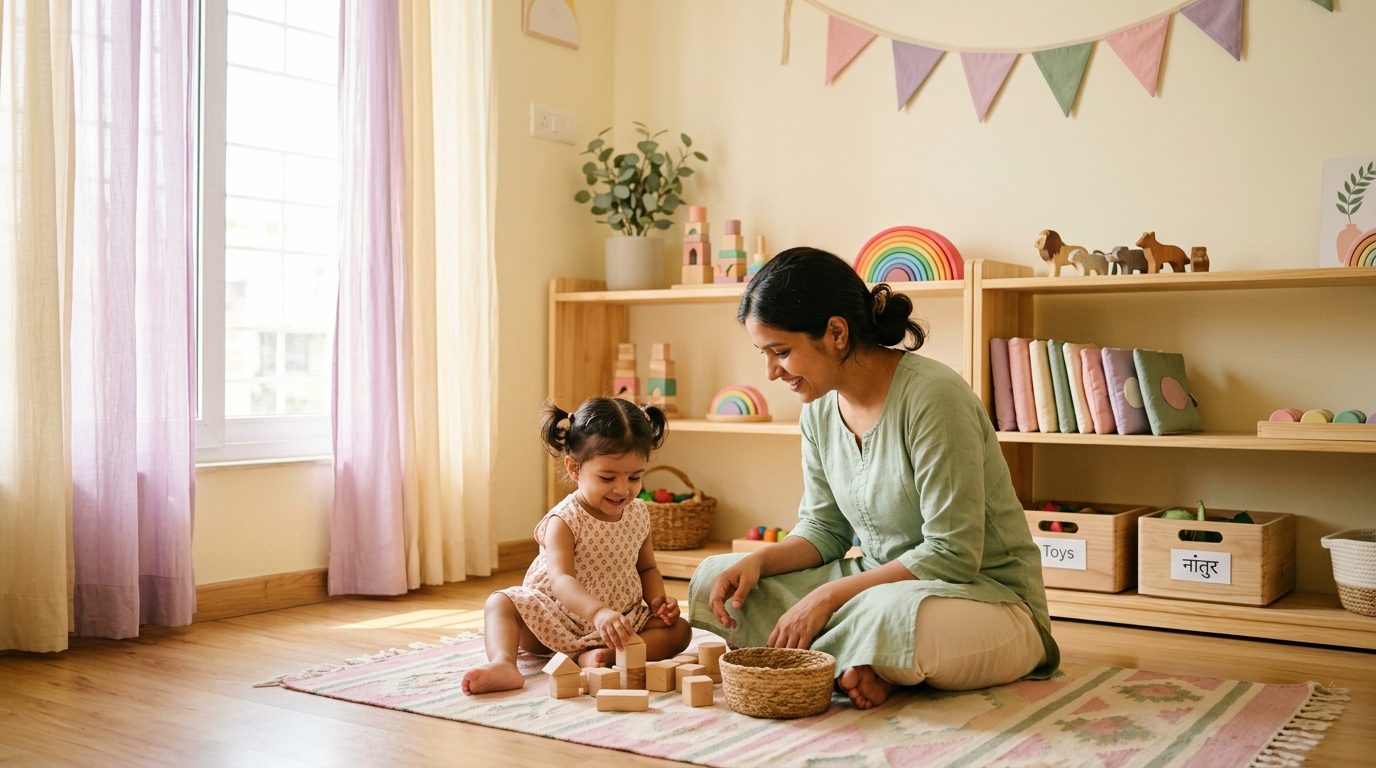
Montessori play toys focus on purposeful, open-ended activity that respects your child's natural psychological development, and you don't need an expensive subscription box to start. In an Indian home, Montessori is less about 'beige aesthetics' and more about giving your child the freedom to explore real-life objects—like a steel katori or a wooden belan—to build independence. By simplifying your toy shelf and rotating items, you turn a chaotic playroom into a calm space where your toddler actually concentrates.
What exactly are Montessori play toys?
If you walk into a Montessori-inspired home, you won't see battery-operated plastic toys that flash lights and sing 'Old MacDonald' at the touch of a button. Dr. Maria Montessori observed that children prefer 'work' over passive entertainment.
Montessori toys are generally:
* Made of natural materials: Wood, cotton, metal, or glass.
* Single-task focused: A shape sorter teaches shapes; it doesn't also teach Spanish and the ABCs simultaneously.
* Open-ended: They can be used in multiple ways as the child grows.
* Realistic: Think animal figurines that look like real cows, not purple cartoon characters.
Real talk: Your kitchen is a Montessori goldmine.
Before you spend ₹3,000 on a wooden 'sensory bin' set, look in your pantry. A tray with a handful of rajma beans, two stainless steel tumblers, and a spoon is a high-level practical life activity. It teaches hand-eye coordination and pouring skills better than any plastic toy ever could.
5 Essential Montessori-Inspired Toys for Indian Homes
You don’t need 50 toys; you need 5 types of activities. Here is what we recommend for an Indian setting where space might be tight but culture is rich.
1. Object Permanence Box & Coin Drop
For infants (6-12 months), this is the 'holy grail'. It teaches them that even if an object disappears, it still exists.
The Indian Budget Hack: Use an old Shoebox. Cut a hole in the top and let them drop large wooden bangles* or clean plastic bottle caps into it.
2. Nesting and Stacking Toys
Forget the plastic rings. Look for wooden stacking towers or even traditional Lacware nesting dolls from Channapatna.
* Why it works: It builds spatial awareness.
Activity Idea: Use different sized dabbas (steel containers) from your kitchen. Letting a toddler figure out which lid fits which dabba* is a 20-minute concentration exercise.
3. Practical Life Tools
In India, we often shield children from 'chores'. Montessori encourages the opposite.
The 'Chotu' Broom: A small hand-broom (jhadu*) allows them to help clean up their own spilled biscuits.
Rolling Pin: A small wooden belan and a bit of atta* dough. This is the ultimate sensory play that also strengthens wrist muscles for future writing.
4. Open-Ended Building Blocks
Invest in a good set of solid wood blocks (brands like Shumee or Ariro are great Indian options).
* Growth Path: At 18 months, they stack them. At 3 years, they build a 'Ghar'. At 5 years, it’s a garage for their cars.
5. Realistic Animal Figurines
Choose Safari Ltd or Schleich, or good quality local wooden animals. Pair these with books. If you are reading a story about a 'Hathi', having a small elephant figurine helps the child bridge the gap between a 2D picture and a 3D object.
How to Set Up Toy Rotation (The 'Anti-Kachra' Method)
The biggest mistake Indian parents make? Throwing every single toy into one large plastic tub. This leads to 'toy dumping'—where the child dumps everything out, gets overwhelmed, and says "Mummy, I'm bored."
The 8-Toy Rule:
Mama-to-mama tip: When you rotate a toy back in after a month, your child will react like it's a brand new birthday present. It saves you thousands of rupees and keeps your living room from looking like a toy shop exploded.
Using 'Open-Ended' Ideas with Desi Materials
Open-ended play means there is no 'right' way to play.
The Dupatta Magic: Give a toddler three old cotton dupattas*. They become a cape, a doll’s blanket, a 'river' on the floor, or a turban.
* The Cardboard Box: After your BigBasket or Amazon delivery, keep the box. A box is a fort, a car, or a canvas for Rangoli colours.
Steel Utensils: A heavy brass khal-batta* (mortar and pestle) with some dried rose petals or coriander seeds provides an incredible sensory and auditory experience for a 3-year-old.
Case Study: Ananya’s Minimalist Transformation
Ananya, a Mumbai mom to 2-year-old Kabir, felt her 2BHK was closing in on her. "I had three tubs of plastic cars and noisy lions. Kabir would just throw them and cry," she told us.
She switched to a low wooden shelf with just 6 items: a puzzle, a basket of wooden blocks, a small pitcher with water, 2 cars, and a book. "The first day, he sat for 15 minutes straight just pouring water from the pitcher to a glass. I finally drank my chai hot. He didn't miss the noise toys at all."
Real talk from Indian moms
"I stopped buying 'educational' laptops and started giving my daughter a small bowl of soaked poha and a spoon. The concentration on her face while she 'stirs' is more than any screen could give her." — Sana, Hyderabad, Mom to 18-month-old.
"We live in a joint family, so 'Sasu Maa' initially thought I was being stingy by not buying big toys. But when she saw my son neatly putting his wooden blocks back in the tray, she was impressed. Montessori isn't 'fancy', it's just organised common sense." — Ridhima, Delhi, Mom to 3-year-old.
When to call your paediatrician
While play is mostly fun, it is also a developmental yardstick. Consult your doctor if:
* Your child consistently avoids eye contact during play.
* By 18 months, they do not engage in any 'functional' play (like putting a phone to their ear or pushing a car).
* They show no interest in 'cause and effect' (dropping a ball to see it bounce) by 12 months.
* They exhibit repetitive 'stimming' with toys (like just spinning wheels for hours) to the exclusion of all other types of play.
Frequently Asked Questions
Isn't Montessori only for rich people?
Absolutely not. Traditional Indian parenting was naturally 'Montessori'. Letting a child sit on the floor and help clean dal, or giving them coconut shells to play within the backyard is 100% Montessori. The 'expensive' part is just modern marketing.
How do I deal with relatives gifting noisy plastic toys?
Don't be rude! Accept the gift. Keep it out for a day so the relative sees it. Then, quietly add it to your 'Rotation Box' or keep it for 'Emergency Distraction' during long car travels. You don't have to have it on the shelf 24/7.
What is a 'Prepared Environment' in an Indian home?
It means making your home accessible. Instead of a high towel rack, put a command hook at the child’s height. Instead of a heavy cupboard, put their 4 daily outfits in a low basket. It’s about saying "You can do this yourself."
My child just throws the wooden toys. What do I do?
Throwing is a physical urge (a 'schema'). If they throw blocks, they need a 'throwing' activity. Give them a soft cloth ball or a bean bag and a laundry basket. Say, "Blocks are for building, balls are for throwing." If they continue, remove the blocks for the day.
At what age should I start toy rotation?
You can start as early as 6 months. When they start reaching for things, having only 2-3 items in their reach helps them focus on grasping and transferring without being overstimulated by a pile of 'stuff'.
Play is the 'work' of the child, and your job is simply to set the stage. Surround them with things that are real, beautiful, and purposeful, and then step back. You will be amazed at what their little hands can do when we stop trying to 'entertain' them.
Focus on the child, not the toy.
Sources & further reading
- Indian Academy of Pediatrics — Growth and Development Guidelines
- UNESCO — Montessori Education and Child Development
- NIN Hyderabad — Nutrient Requirements and Activity for Infants and Toddlers
- AIIMS — Child Development and Early Intervention Cell
Written by Dr. Anjali Mehta, MBBS, DCH (Paediatrics)
Reviewed by TheMamaCircle Editorial Team
Last updated: 20 May 2026
This article is for general information only and is not a substitute for personalised medical advice. Always consult your paediatrician or obstetrician for your specific situation.