Montessori Toys 6-12 Months: Best India Guide & Chart
Looking for Montessori toys 6-12 months? Learn which sensory and motor toys actually help development (and which are just loud plastic). Stop the toy overwhelm today!
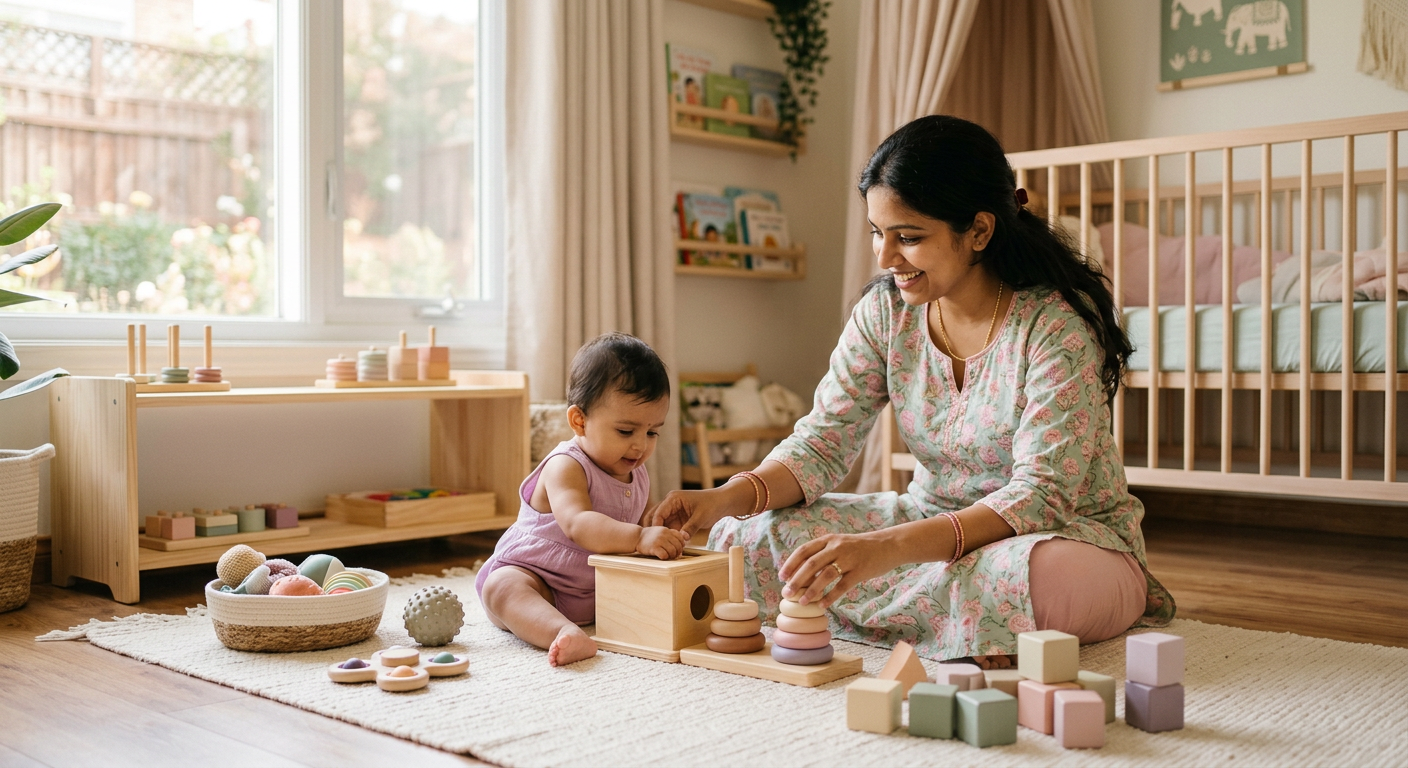
At 7 months, my son would ignore the expensive, battery-operated plastic castle we’d been gifted, preferring to bang a steel katori against the floor for twenty minutes. It was loud, it was repetitive, and unbeknownst to me then, it was his first lesson in cause-and-effect. Between 6 and 12 months, your baby doesn’t need toys that perform for them; they need "work" that allows them to master their environment. In the Montessori world, we look for toys that isolate one skill at a time—whether it’s the pincer grasp, object permanence, or simple problem-solving—using natural materials like wood, cotton, and metal.
What makes a toy "Montessori" for an Indian home?
In India, we are often bombarded with "educational" toys that flash lights and sing "A-B-C" at a six-month-old. A true Montessori toy is quite the opposite. It is "passive," meaning the toy does nothing unless the child acts upon it. This shifts the baby from a spectator to a scientist.
The criteria for 6-12 month materials:
* Isolation of Challenge: If the toy is meant to teach shapes, it shouldn't also play music. One skill at a time prevents sensory overwhelm.
* Natural Materials: Wood, bamboo, stainless steel, and organic cotton provide different weights, temperatures, and textures (sensory input) that plastic simply cannot.
* Realistic over Fantastical: Montessori prioritizes the real world. A wooden dog that looks like a dog is better than a purple flying cartoon dog.
* Purposeful "Work": The toy should help them master a developmental milestone they are currently obsessed with, like dropping things or pulling to stand.
Top Montessori toys for 6-9 months: The "Sitter" Phase
Once your baby can sit (with or without support), their hands are finally free to explore. This is the age of the Object Permanence Box. You've likely seen this wooden box with a hole on top and a tray.
1. The Object Permanence Box (₹800 - ₹1,500)
This is the holy grail of 8-month-old play. Your baby drops a wooden ball into the hole, it disappears for a split second, and then rolls out into the tray.
* The Lesson: "Even if I can't see the ball, it still exists." This helps with separation anxiety later on!
* Indian Mama Hack: If you aren’t ready to buy one, use a shoe box and a tennis ball. Cut a hole in the lid and let them drop the ball in. It serves the same cognitive purpose.
2. The Spinning Drum
This is a wooden drum with colourful panels (often including a mirror). When the baby bats at it, it spins.
* The Lesson: Hand-eye coordination and strengthen the core. It encourages them to stay in the sitting position longer.
* Why it works: The immediate "payoff" of the spin and the sound of a bell inside teaches cause-and-effect beautifully.
3. Treasure Baskets (The ultimate budget Montessori tool)
Collect 5-6 safe household items of different materials. Think: a large silicone cupcake liner, a wooden honey dipper, a stainless steel loya, a chunky cotton tassel, and a large sea shell.
* The Lesson: Sensory discrimination. Plastic feels the same everywhere; a kitchen whisk feels cold and hard, while a woollen ball feels warm and soft.
> Real Mama-to-Mama Talk: Don't let Instagram make you feel like you need a ₹10,000 wooden shelf. Montessori is a philosophy of child-respect, not a furniture aesthetic. Your baby will learn more from exploring a drawer of clean whisks and spatulas than from a shelf of toys they aren't allowed to touch.
Top Montessori toys for 9-12 months: The "Mover" Phase
As your baby begins to crawl and pull to stand, their toys need to move with them.
1. The Imbucare Box with Coins/Discs
Similar to the ball box, but this time they have to line up a flat wooden coin with a slim slot.
* The Lesson: This requires a more refined "pincer grasp" (using the thumb and forefinger). It’s the foundational work for holding a pencil one day.
Indian Brand Watch: Look for brands like Ariro, Shumee, or Skola Toys* which use neem wood and non-toxic dyes.
2. Vertical and Horizontal Ring Stackers
Standard stackers usually have a tapered pole. A Montessori stacker has a straight pole and identical rings (all one colour).
* The Lesson: The challenge is purely the motor skill of getting the ring on the pole, not "sizing" them. Once they master vertical, move to the horizontal ring stacker (the pole sticks out sideways), which requires a wrist rotation.
3. The Pushing Wagon (The "Chalti Gaadi")
Avoid those sit-in walkers that doctors (including myself!) warn against because they can delay natural gait and lead to accidents. Instead, a heavy wooden "Push Wagon" allows the baby to pull themselves up and walk at their own pace.
* The Lesson: Gross motor control and balance.
Tip: Put a few heavy bags of atta* or books inside the wagon so it doesn't fly away when the baby leans on it.
Real talk from Indian moms
"I used to feel guilty that we didn't have the 'proper' Montessori shelf. Then I realized my 10-month-old's favourite 'work' was taking the dahibada containers out of the bottom kitchen cabinet and putting them back in. I just made sure that cabinet was safe for her." — Ananya, Bengaluru (Mom to 11-month-old Advik)
"Stop buying toys that require batteries. We hid all the noisy plastic stuff for a week and noticed my daughter started playing for 15 minutes straight with just a basket of silk scarves. The silence was glorious for my ears too!" — Meher, Mumbai (Mom to 9-month-old Zoya)
When to call your paediatrician
While "slow play" is wonderful, we use play as a marker for development. Consult your paediatrician if by 12 months your baby:
* Does not search for an object that you hide right in front of them (Object Permanence).
* Does not use a "pincer grasp" (grabbing small bits of food with thumb and finger).
* Does not track moving objects with their eyes while playing.
* Shows no interest in "cause and effect" (like dropping a spoon repeatedly to see what happens).
* Is not yet sitting independently or attempting to pull to stand.
Frequently Asked Questions
Are wooden toys better than plastic for babies?
Yes, for two reasons: sensory feedback and safety. Wood has a natural texture, weight, and even a faint scent. Plastic is thermally neutral (stays the same temperature) and often "too smooth." Also, wooden toys (if high quality) are less likely to have small bits of plastic break off during the "mouth everything" phase.
How many toys should I put out at once?
Montessori advocates for "Toy Rotation." Put out only 6-8 items on a low shelf. Keep the rest in a dabba in the cupboard. When you see your baby losing interest (usually every 2-3 weeks), swap out 2-3 toys. This prevents "choice paralysis."
My baby just throws the Montessori toys. Is this normal?
Yes! Throwing is a gross motor trajectory. They are exploring "Maximum Effort" and gravity. If they are in a throwing phase, give them soft woollen balls or bean bags that are meant to be thrown.
Is Montessori expensive in India?
It can be if you buy everything "branded." However, India is the land of Montessori-friendly items. A brass ghungroo attached to a ribbon, a wooden belan (rolling pin) for tactile play, and steel bowls are all perfect. Look for local wooden toy clusters like Channapatna or Kondapalli for affordable, handcrafted items.
Should I help my baby when they struggle with a puzzle?
Try to wait. We call this the "struggle point." If you jump in too fast, you rob them of the "I did it!" moment. If they get really frustrated, just give a tiny hint—like rotating the coin slightly so it’s easier for them to drop in.
Your baby doesn't need a room full of gadgets to become smart. They need freedom, a few thoughtfully chosen objects, and a floor they are allowed to explore. Put down the flashing remote, hand them a wooden spoon, and watch their little mind go to work.
Keep it simple, Mama. You're doing great.
Dhanya ho!
Sources & further reading
- Indian Academy of Pediatrics — Growth and Development Milestones
- WHO — Improving Early Childhood Development Guidelines
- AIIMS — Early Childhood Stimulation Modules
- UNICEF India — The Magic of Play
Written by Dr. Anjali Mehta, MBBS, DCH (Paediatrics)
Reviewed by TheMamaCircle Editorial Team
Last updated: 14 May 2026
This article is for general information only and is not a substitute for personalised medical advice. Always consult your paediatrician or obstetrician for your specific situation.