Montessori Toys for 2 Year Olds: India Guide to Play
Looking for the best Montessori toys for 2 year olds in India? Boost fine motor skills and pretend play with these expert-vetted, dadi-approved picks.
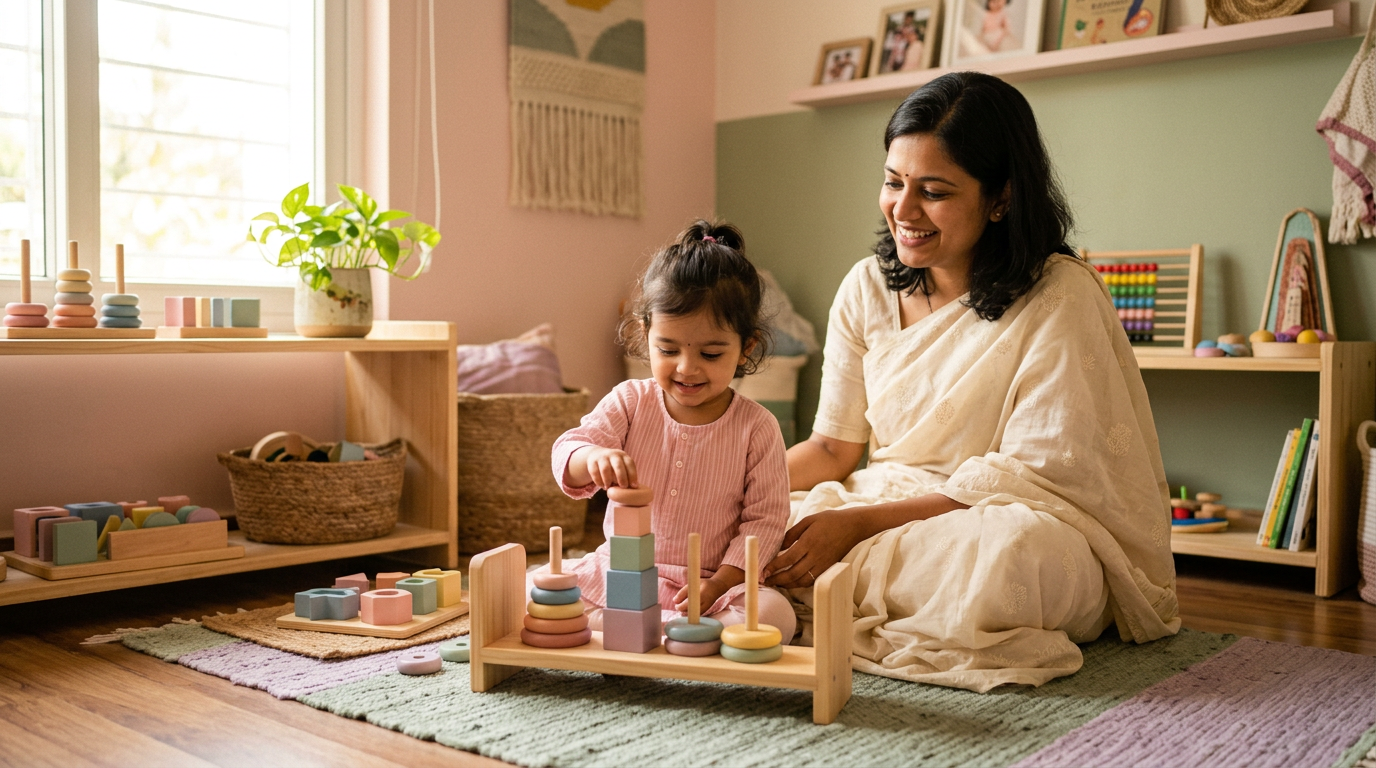
At 24 months, your toddler is less of a 'baby' and more of a 'little scientist' who also happens to be a professional chaos-maker. If you’re looking for Montessori toys for 2 year olds, you don't need a massive budget or a dedicated playroom; you need tools that mirror real-life Indian households. The best Montessori picks for this age focus on functional independence—think peeling a banana, pouring water without a flood, and mimicking how Nani makes rotis.
What actually makes a toy 'Montessori' at age two?
In the Montessori philosophy, "play is the work of the child." At two, their "work" shifts from simple sensory exploration to mastering Fine Motor Skills (the small movements in hands and wrists) and Practical Life (helping at home).
A true Montessori toy isn't just wooden; it is:
* Purposeful: It has a clear goal (e.g., fitting a peg into a hole).
* Realistic: It looks like the real version (a metal whisk, not a purple plastic one that flashes lights).
* Self-Correcting: The child can see for themselves if they’ve done it right (like a puzzle piece that only fits one way).
Fine Motor Mastery: The Indian Toddler Edition
By age two, your child wants to do everything themselves. This is the "Main karungi!" (I'll do it!) phase. Investing in toys that build hand strength now will pay off later when they start holding a pencil or zipping up their school bag.
Look for chunky wooden beads (often shaped like animals or fruits). This requires "bilateral coordination"—using both hands together.
Real-life hack: If you don't want to buy a set, use large penne* pasta and a thick shoelace.
These are classic. The child drops a wooden coin into a slot. It builds the "pincer grasp" (the thumb and index finger pinch) which is crucial for eating and writing.
Let’s be honest, 2-year-olds have a lot of energy. A pounding bench allows them to use their arm strength and hand-eye coordination safely.
Mama Tip:* Brands like Shumee or Ariro make beautiful neem wood or rubberwood versions in India (ranging from ₹800 - ₹1500).
Pretend Play: Mirroring the Indian Kitchen
In Montessori, we call this "Practical Life" rather than just pretend play. At two, they don't need a fantasy castle; they want a mini version of your kitchen.
* The Vegetable Cutting Set:
These are wooden vegetables held together by Velcro that make a satisfying 'crunch' sound when cut with a blunt wooden knife. It’s excellent for hand strength and teaching them about healthy foods like bhindi, gajar, and tamatar.
* The Tea Set (Steel or Ceramic):
Skip the plastic. Give them a small stainless steel lota or a tiny chai set. Learning to pour water from one vessel to another is a cornerstone Montessori activity that builds focus and a steady hand.
* A Mini Cleaning Set:
A child-sized broom (jhaadu) or a small microfiber cloth is a "toy" they will actually use. When they see you cleaning after a spill, they will want to join.
> Real talk: We spent ₹3,000 on a fancy "learning tower" because an Instagram influencer said it was essential. My daughter used it twice, then preferred pushing a sturdy old kitchen stool to the counter. Don't feel pressured to buy the aesthetic. The best Montessori "toy" in my house is a bowl of soaked chana that my toddler helps me peel.
How to Set Up a Montessori Toy Rotation
If you leave 20 toys on the floor, your 2-year-old will play with none of them. They will just throw them.
Case Study: Ananya and the "Dabba" Obsession
Ananya, a Mumbai mom of a 26-month-old, was frustrated that her son, Ishaan, ignored his expensive Montessori wooden blocks. "He just wanted to play with my Tupperware," she told us.
We advised Ananya to lean into it. She created a "Kitchen Drawer" for Ishaan filled with safe, real items: a small steel whisk, different sized containers with lids, and a wooden belan (rolling pin). Ishaan spent 40 minutes a day "cooking," which built more fine motor control and focus than the blocks ever did.
When to call your paediatrician
While every child develops at their own pace, keep an eye on these fine motor milestones by age 2.5. Consult your doctor if:
* Your child cannot grasp a small object (like a grape or a coin).
* They consistently use only one hand and ignore the other.
* They cannot stack 3-4 small blocks.
* They lose skills they previously had.
* They have no interest in "mimicking" your daily actions (like pretending to talk on a phone or stir a pot).
Real Talk from Indian Moms
"I used to get so stressed that my house didn't look like a Montessori classroom. Then I realized—my daughter learning to put her own chappals in the stand is more Montessori than any ₹5,000 wooden rainbow." — Sana, Delhi (Mom to a 2-year-old)
"The best fine motor activity we have is 'Flower Work.' My son helps me pull petals off marigolds (gendha phool) after a puja. It keeps him quiet for 20 minutes and his pincer grasp is amazing now!" — Priyanka, Bengaluru (Mom to a 2.5-year-old)
Frequently Asked Questions
Is Montessori just a fancy word for wooden toys?
No. While Montessori prefers natural materials like wood, metal, and cotton (because they provide better sensory feedback), a toy isn't Montessori just because it's wood. It's about how the toy encourages independence and mastery of a specific skill.
Why are Montessori toys so expensive in India?
Imported brands like Lovevery are pricey, but the "Indian Montessori" movement is growing. Brands like Ariro, Shumee, Skillmatics, and Hungry Brain offer amazing local alternatives at much better price points (₹500 - ₹2000). You can also find great "Montessori-aligned" items at your local Sunday market!
My 2-year-old still puts everything in their mouth. Is it safe?
This is a valid concern. Avoid small beads or marbles if your child is still "mouthing." Stick to larger wooden blocks, silk scarves, and chunky puzzles. Always check that the paint used is non-toxic and BIS certified (look for the IS 9873 mark).
How do I stop my toddler from throwing the wooden toys?
If they throw it, the toy "goes to sleep." Montessori is also about "Grace and Courtesy." Explain, "Toys are for working/playing, not for throwing. Since we are throwing, I am putting this away for now." Try again in a few hours.
Can I do Montessori with plastic toys?
Absolutely. If you have a plastic tea set or plastic blocks that challenge your child's fine motor skills, use them! The philosophy is more important than the material. Focus on the activity—pouring, sorting, and building.
Does my child need a "Play Gym" or "Toddler Gym" indoors?
At two, they need to move. If you have space for a Pikler Triangle (a wooden climbing frame), it’s great for gross motor skills. If not, a few firm cushions on the floor and a low stool to climb on works just as well.
Choose toys that challenge their hands but don't frustrate their hearts. Your 2-year-old doesn't need a perfect toy; they need a patient mama who lets them try to peel their own boiled egg.
"I can do it myself" is the greatest victory of a two-year-old.
Sources & further reading
- Indian Academy of Pediatrics (IAP) — Growth and Development Milestones
- World Health Organization (WHO) — Play and Early Childhood Development
- Bureau of Indian Standards (BIS) — IS 9873 Safety of Toys Standards
- National Institute of Nutrition (NIN) Hyderabad — Learning through play/nutrition nexus
Written by Neha Kapoor, RD (Registered Dietitian, Maternal & Child Nutrition)
Reviewed by TheMamaCircle Editorial Team
Last updated: 25 April 2026
This article is for general information only and is not a substitute for personalised medical advice. Always consult your paediatrician or obstetrician for your specific situation.