Pikler Triangle India Guide: When to Buy, Safety & Chart
Looking for a Pikler Triangle in India? Learn when to introduce this Montessori climber, where to buy the best brands, and safety tips for Indian homes. Check it out!
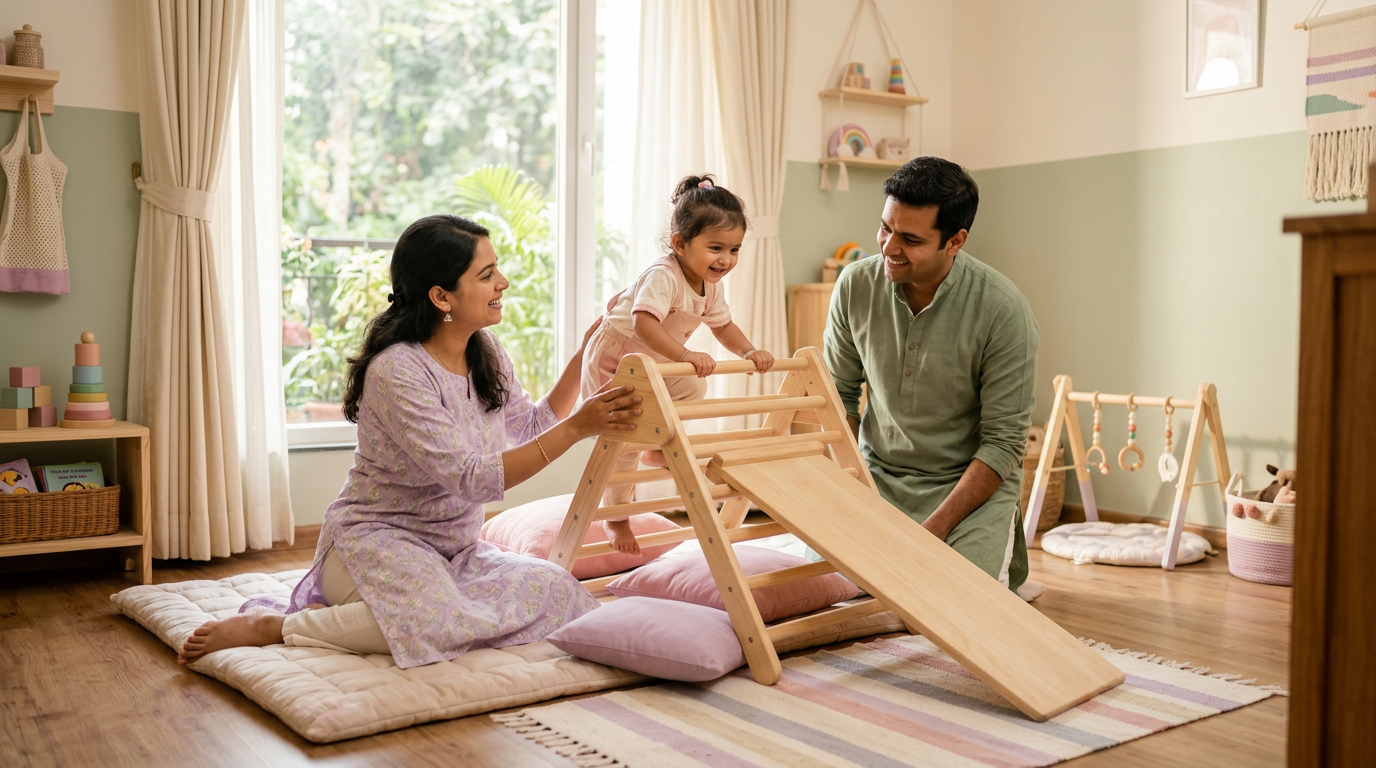
Pikler Triangle India: Your Ultimate Guide to Open-Ended Play
The Pikler Triangle India parents are increasingly searching for is more than just a wooden climbing frame; it is a gateway to your child’s physical and cognitive development. Most Indian experts suggest introducing the Pikler Triangle between 6 months and 5 years to encourage gross motor skills, confidence, and spatial awareness.
If you are a mom in India trying to navigate the world of Montessori furniture, you’ve likely seen these beautiful wooden structures on Instagram. But in our Indian homes—where space can be tight and the floors are often cold marble or tile—you need more than just aesthetic advice. You need a practical, desi-mom-approved guide on how to choose, use, and maintain a Pikler Triangle.
What Exactly is a Pikler Triangle?
Developed by Hungarian pediatrician Dr. Emmi Pikler over 100 years ago, this climbing frame is based on the philosophy that children should be allowed to move freely and reach developmental milestones at their own pace.
In the Indian context, think of it as a modern, indoor version of the trees we used to climb or the chajjas and stairs in our ancestral havelis. It allows your toddler to satisfy their "climbing urge" safely inside the house, especially when the pollution outside is high or it’s too hot to visit the local park.
How it Benefits Your Bachha
When to Introduce Pikler Triangle to Your Child?
The most common question Indian moms ask is: “Abhi toh mera baby crawling bhi nahi kar raha, is it too early?”
The 6 to 12 Months Phase (The Pull-Up Station)
At this stage, your baby isn't climbing. They are using the rungs to pull themselves up to a standing position. It acts as a sturdy support, much better than a wobbly coffee table. This is the "look at me, I'm standing" stage where they gain leg strength.
The 1 to 3 Years Phase (The Climber)
This is the golden age for the Pikler Triangle. Your toddler will start by climbing one or two rungs, then eventually find the courage to go over the top. This is also when you introduce the reversible ramp (slide on one side, rock-climbing grips or slats on the other).
The 3 to 5 Years Phase (The Imaginative Play)
By now, the physical challenge might lessen, but the imaginative play peaks. It becomes a mountain, a castle, or a tunnel. Many Indian brands offer "Foldable" or "Transformable" Piklers that can be adjusted to different heights and shapes to keep older kids engaged.
Is Pikler Triangle safe for toddlers in Indian homes?
This is a People Also Ask (PAA) favorite. The short answer is: Yes, if used under supervision and placed on the right surface.
In India, most of us have hard flooring like vitrified tiles, marble, or granite. Unlike the soft wooden or carpeted floors seen in Western nurseries, these can be slippery and unforgiving.
Safety Checkpoints for Indian Parents:
The Surface: Always place the Pikler on a play mat. Look for non-toxic EVA foam mats or thick cotton dhurries*. Avoid placing it directly on tiles.
Distance from Furniture: Keep a "landing zone" of at least 3-4 feet away from sharp corners of diwans*, glass coffee tables, or TV units.
* Supervision (The Golden Rule): While Pikler promotes "independent play," it does NOT mean "unsupervised play." Stay within an arm's reach, but try not to hover. Let them figure out the descent on their own.
* The Foldable Lock: If you buy a foldable version (highly recommended for Mumbai/Bangalore apartments), ensure the locking mechanism is "toddler-proof" and doesn't collapse during use.
Where to Buy Pikler Triangle in India: Top Recommendations
A few years ago, you had to DIY or import these, but today, we have amazing "Made in India" brands that use sustainable wood and non-toxic finishes.
1. Ariro Toys
Based in Chennai, Ariro is perhaps the most well-known Montessori brand in India. Their Piklers are made from Neem wood, which is naturally antibacterial—perfect for babies who love to mouth everything.
* Price Range: ₹8,000 – ₹15,000.
* Best for: Young toddlers and eco-conscious parents.
2. Woodbee Toys
Another fantastic Southern Indian brand. Their finish is incredibly smooth, and they offer "Jumbo" variants for older kids. Their reversible ramps are sturdy and integrate beautifully.
* Best for: Durability and smoothness.
3. All Things Baby / Bloom My Room
These platforms curate high-end, aesthetically pleasing climbers. If you are looking for pastel colours or specific birchwood finishes to match your modern nursery decor, check these out.
4. Local Carpenters (The DIY Route)
If you have a trusted local mistri, you can share a blueprint. However, ensure they use Birch Plywood or Solid Wood (Rubberwood/Teak) and avoid MDF or cheap ply that can splinter. The rungs must be sanded to perfection and finished with food-grade oil (like beeswax or coconut oil) rather than toxic chemical varnishes.
What to Look for Before Buying (The Checklist)
Don't just go by the price; look at the specs.
* Weight Capacity: A good Indian-made Pikler should hold at least 50-60 kg. This allows for long-term use and even the occasional sibling play.
* Wood Quality: Look for FSC-certified wood. Avoid any brand that doesn't specify what finish they use. In India’s humid climate, cheap wood can warp or develop mold.
* Rung Distance: The gap between rungs should be narrow enough so a child’s head cannot get stuck, but wide enough for their boots or bare feet to grip.
* Foldability: Space is a luxury in Indian metros. A foldable Pikler that can slide under a bed or hide behind a cupboard is a lifesaver.
Maintenance and Care in the Indian Climate
Our weather can be harsh. Here is how to keep your Pikler in top shape:
* Dusting: Use a dry microfiber cloth daily. Dust in India is relentless!
Cleaning: For stains (like haldi* or crayon marks), use a damp cloth followed immediately by a dry one. Never soak the wood.
* Termite Protection: Since most Piklers are solid wood, ensure your home has regular pest control, especially during the monsoon.
* Seasonal Check: Wood expands and contracts. Every few months, check the screws and bolts to ensure they haven't loosened.
Pikler Triangle vs. Other Climbers: Which one to choose?
Many parents get confused between a Pikler, a Waldorf Rocker, and a Swedish Wall.
* Pikler: Best for climbing and building gross motor confidence in early years.
* Waldorf Rocker (Moon Seesaws): Better for balance and imaginative play (it can be a boat, a bridge, or a bed).
* Swedish Wall (Gym Wall): Best for older kids (4+) as it is fixed to the wall and requires more upper body strength.
For a first-time parent in India, the Pikler Triangle with a Ramp offers the best ROI (Return on Investment) and "playability" from infancy to pre-primary school.
Frequently Asked Questions
Is the Pikler Triangle worth the money in India?
Yes, absolutely. While the initial cost (₹7k to ₹15k) seems high, it replaces multiple plastic toys. It is durable, has high resale value in second-hand "Montessori India" Facebook groups, and lasts through multiple siblings.
At what age should a child stop using it?
While most brands say up to 5 or 6 years, kids usually move on to more complex climbing (like trees or jungle gyms) by age 5. However, it often stays in the room as a "den" or "fort" for several more years.
Can I use it outdoors in my garden or balcony?
You can use it outdoors on a dry day, but don't leave it there. Indian sun can bleach the wood, and monsoon humidity will cause the wood to rot or swell. Always bring it inside after play.
How do I teach my child to climb it?
You don’t! The philosophy is to let them explore. You can place a favorite toy (jhunjhuna or a car) on a higher rung to entice them, but never force their limbs or "place" them on top. Let their own instinct guide them.
What is the best wood for a Pikler Triangle in India?
Neem wood and Rubberwood are excellent choices available locally. Birch Plywood is the gold standard globally for its strength-to-weight ratio and resistance to warping.
Can two kids play on it at once?
If the weight limit allows and the brand confirms it is "twin-sturdy," yes. However, for safety, it's best to have one child climbing while the other waits their turn, teaching them patience and social boundaries.
Final Thoughts: Encouraging the Little Climber
At the end of the day, whether you call it a Pikler or just a "shaitaan-khana" (mischief corner), this piece of furniture respects your child's natural urge to move. In our traditional Indian homes, we often say "Beta, neeche utro, gir jaoge!" (Son, get down, you'll fall!). The Pikler Triangle changes that narrative to "Beta, take your time, you are safe."
It builds more than just muscles; it builds a mindset of "I can do hard things." So, clear a little space in your living room, lay down a soft gadda, and watch your little one conquer their first mountain!
Happy Climbing, Mamas! 🧗♀️✨⚖️