Pregnancy Yoga Second Trimester: Best Poses & Safety Guide
Discover safe pregnancy yoga second trimester poses for Indian moms. Relieve back pain, build strength, and connect with your baby using these expert tips.
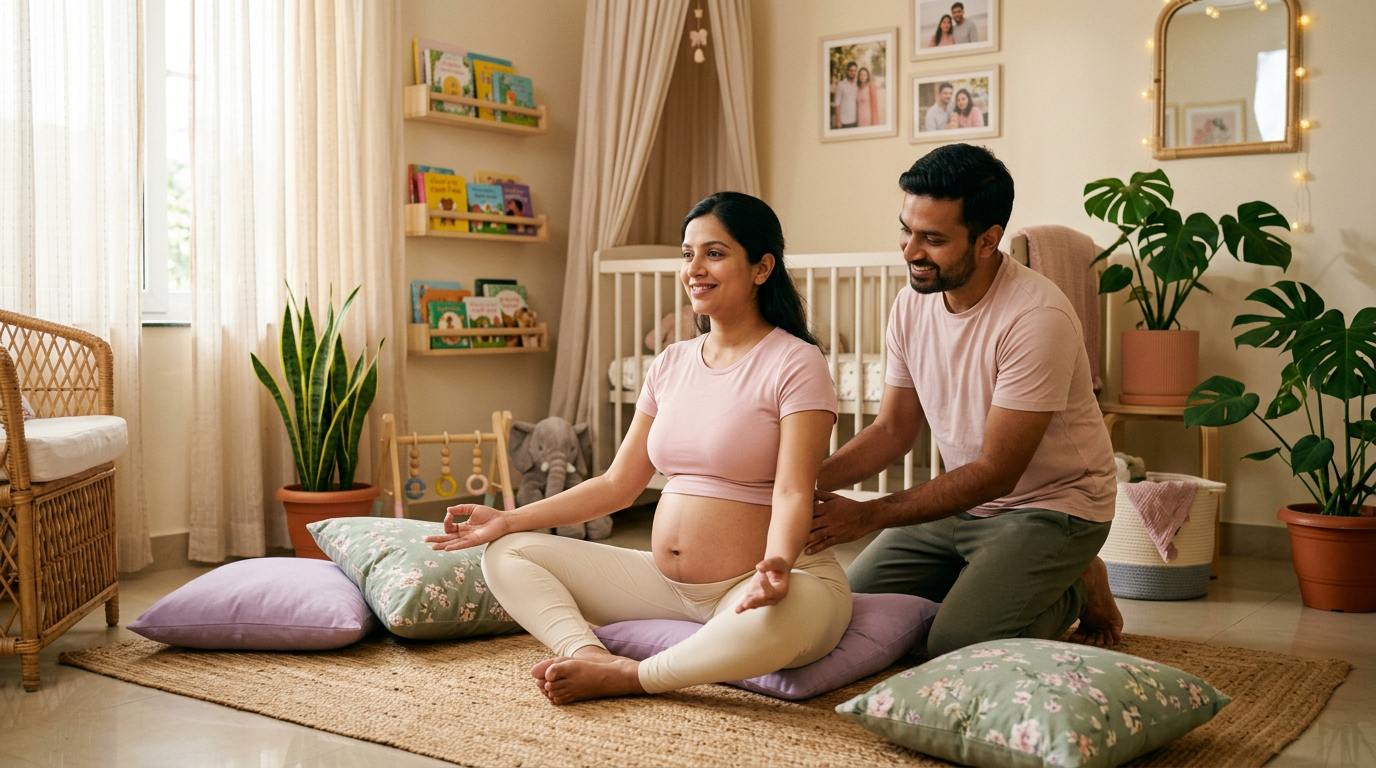
The second trimester is often called the 'honeymoon phase' of pregnancy because that morning sickness (finally) fades and your energy levels bounce back. Practising pregnancy yoga second trimester style is the absolute best way to use this newfound energy to strengthen your pelvic floor, ease that creeping lower back pain, and connect with the tiny human doing somersaults in your garbh.
While you might feel like you can conquer the world, your body is changing rapidly. Your centre of gravity is shifting, and the hormone relaxin is making your joints as flexible as a rubber band—which sounds great but actually increases your risk of injury. In this guide, we bridge the gap between ancient Hatha principles and modern FOGSI (Federation of Obstetric Surgeons and Gynaecologists of India) safety standards to keep you and your baby safe on the mat.
Is pregnancy yoga second trimester safe for everyone?
If you have already cleared your 12-week scan and your OBGYN hasn't flagged any issues like a low-lying placenta (placenta previa) or cervical incompetence, the answer is a resounding yes. If you are transitioning from pregnancy yoga first trimester, you will notice we move away from just 'surviving' the nausea and start focusing on 'thriving' through movement.
The primary goal of pregnancy yoga second trimester practice is to create space. Space for your lungs to breathe as your uterus moves up, space for your digestive system (hello, acidity!), and space for your mind to prepare for the shakti required for labour.
Best pregnancy yoga second trimester poses for Indian Moms
In the Indian context, we often spend a lot of time sitting on the floor or bending during daily chores. These modified asanas help counteract the strain on your spine while preparing your hips for a normal delivery.
1. Marjaryasana-Bitilasana (Cat-Cow Stretch)
This is the "gold standard" for relieving backache.
* How to do it: Get on all fours. As you inhale, look up slightly (don't over-arch the neck) and let your belly drop. As you exhale, round your back like a mountain and look towards your bump.
* Why it works: It helps move the baby into an optimal position and takes the weight of the uterus off your spine.
2. Tadasana (Mountain Pose)
As your bump grows, your posture often suffers. You might start walking with a "duck waddle."
* How to do it: Stand with feet hip-width apart. Balance your weight evenly. Imagine a thread pulling you up from the crown of your head.
* Benefit: Improves balance and prevents the common "pregnancy slouch" that leads to shoulder pain.
3. Utkatasana (Modified Chair Pose)
Think of this as the yoga version of a squat, but with wall support.
* How to do it: Lean your back against a wall and slide down into a partial sit. Hold for 3-5 breaths.
Benefit: Builds the thigh strength you’ll need for the pushing stage of labour. It’s like doing your baithaks* but with more "om" and less "ouch."
4. Baddha Konasana (Butterfly Pose)
This is the quintessential prenatal yoga poses staple that every Nani and Dadi will recommend.
* How to do it: Sit with the soles of your feet touching. Gently move your knees up and down.
* Benefit: Increases blood flow to the pelvic region and improves hip flexibility.
Essential Pranayama During Pregnancy
Breathing is your superpower. In the second trimester, we focus on cooling and calming breaths to manage the increased body heat (Pitta) many Indian moms experience.
* Anulom Vilom: Alternating nostril breathing is excellent for balancing hormones.
Bhramari (Bee Breath): Making a humming sound while exhaling. This is incredible for when your sasu maa* is stressing you out about the baby shower (Godh Bharai) guest list!
* Sheetali: If you’re dealing with pregnancy-induced acidity or "burning chest," this cooling breath (curling the tongue and inhaling) is a lifesaver.
For a deeper dive into safe breathing techniques, check out our guide on pranayama during pregnancy.
Precautions: What to avoid after week 14
The second trimester comes with a few "No-Go" zones to protect your baby and your own abdominal wall.
* No Lying Flat on Your Back: After month four, the weight of the uterus can compress the vena cava (a major vein), reducing blood flow to the baby and making you feel dizzy. Always use a bolster or pillow to stay inclined or lie on your left side.
* No Deep Twists: We don't want to "wring out" the midsection. Only do "open twists" where you move your shoulders but leave your belly facing forward.
* No Inversions: Unless you are a long-term practitioner, avoid headstands or handstands. Fall risks are higher now.
* Avoid Over-stretching: Thanks to the hormone relaxin, you might feel like you can do a full split. Don't! Stick to 70% of your maximum range to avoid ligament tears.
Real talk from Indian moms
> "I thought yoga was just for thin influencers. But doing pregnancy yoga second trimester poses helped me manage my gestational diabetes. My doctor at AIIMS was actually happy I was staying active through gentle Vinyasa." — Ananya S., Delhi (Baby is 4 months)
> "In our house, I was told not to move much 'taaki bachcha gir na jaye'. But my yoga teacher explained how movement helps the garbh. Doing the Butterfly pose daily made my pelvic pain so much better." — Priya M., Pune (Baby is 11 months)
How to set up your home practice in India
You don't need a fancy studio. A standard PVC-free yoga mat (available on Amazon India for ₹500–₹1200) is enough.
* Timing: Practice early morning (Brahma Muhurta) before the kitchen noise starts.
* Clothes: Wear breathable cotton leggings or a loose kurti. Stay away from tight synthetic activewear that traps heat.
* Snack: Don't practice on an empty stomach if you’re prone to low BP. Have a handful of soaked almonds or a glass of coconut water 30 minutes before.
For a comprehensive look at the entire journey, read our pillar guide on pregnancy yoga.
When to call your doctor (Red Flags)
As much as we love the mat, your safety comes first. Stop your pregnancy yoga practice immediately and call your obstetrician if you experience:
Frequently Asked Questions
Is pregnancy yoga second trimester enough to prepare for a normal delivery?
While yoga helps significantly with hip opening and stamina, a "normal" delivery depends on many factors including fetal position and medical history. However, prenatal yoga poses definitely give you the mental tools (breathing and focus) to handle labour pains more effectively.
Can I start pregnancy yoga first trimester poses if I missed the early weeks?
Absolutely. Most of the gentle stretches from the first trimester are perfectly safe to incorporate now. The key is to avoid any sudden movements or abdominal pressure.
What should I do if I feel pressure in my lower abdomen?
Stop the pose immediately. Try resting in Balasana (Child's Pose) with your knees wide to make room for your bump. If the pressure persists, consult your doctor.
Can I do yoga if I have a high-risk pregnancy?
Only under strict medical supervision. If you have conditions like Preeclampsia or a history of preterm labour, you should stick to very gentle pranayama during pregnancy rather than physical asanas.
How often should I practice pregnancy yoga third trimester poses as I move forward?
As you transition into the final months, your frequency might stay the same (3-4 times a week), but the intensity will drop. You can read more about that transition in our guide on pregnancy yoga third trimester.
Your body is performing a miracle every single second. Yoga isn't about being flexible; it's about being present for your baby.
Main aaj apni aur apne bachche ki sehat ke liye handle-vash kaam kar rahi hoon. (Today, I am working with intention for my and my baby's health.)
Sources & further reading
- FOGSI: Physical Activity and Exercise in Pregnancy
- NHP India: Yoga in Pregnancy
- ICMR: Nutrient Requirements and Dietary Guidelines for Indians
Written by Priya Raman, Certified Prenatal Yoga Instructor & Mama of two
Reviewed by TheMamaCircle Editorial Team
Last updated: 8 June 2026
This article is for general information only and is not a substitute for personalised medical advice. Always consult your paediatrician or obstetrician for your specific situation.