Teething Chart by Age: Indian Baby Tooth Order Guide
Check our Indian baby teething chart by age! Learn the tooth eruption order, how to handle "teething fever," and safe desi remedies for your little one.
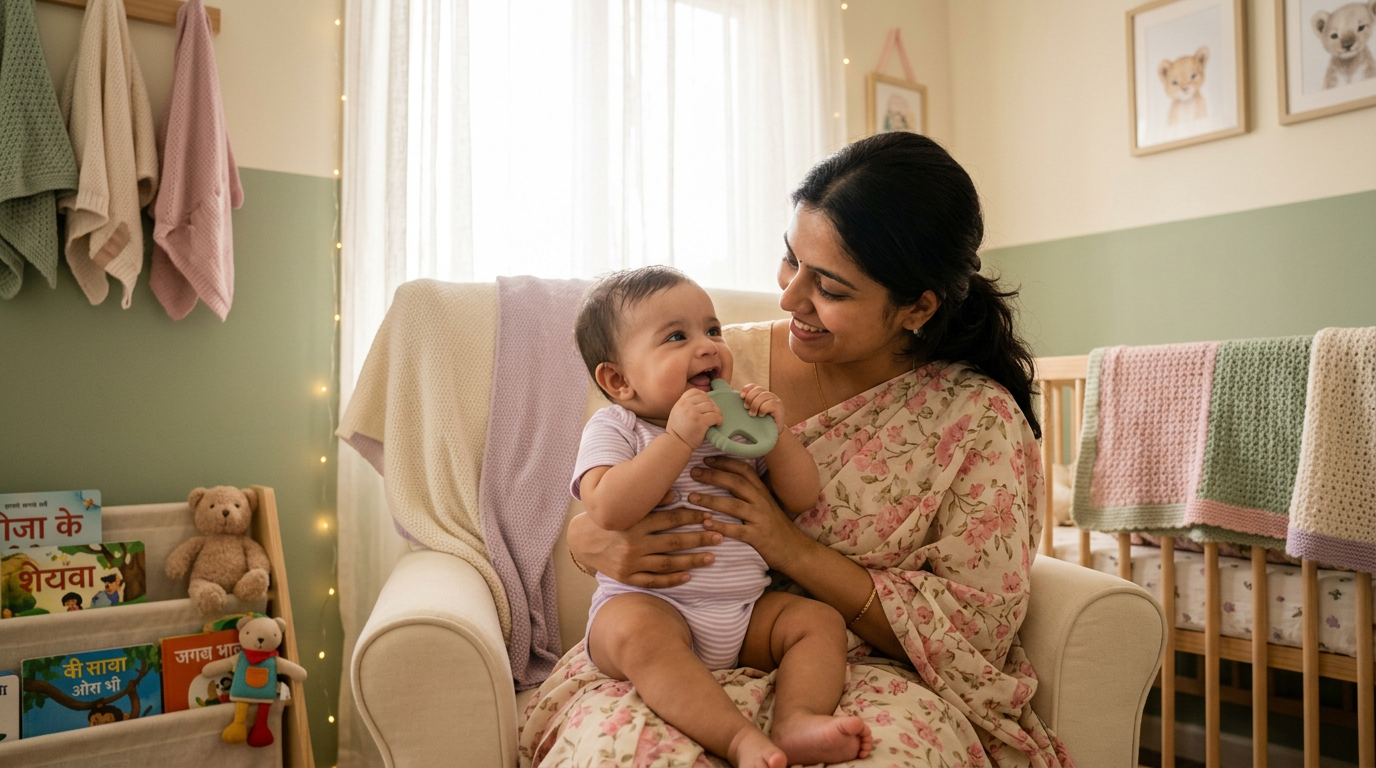
Most Indian babies get their first tooth—usually a lower front one—between 6 and 10 months of age. While your sasu-maa might insist that late teething means "weak bones" or early teething causes "loose motions," the truth is that every baby’s dental calendar is hardwired by genetics. If you see a tiny white pearl poking through at 4 months or 11 months, both are perfectly normal.
At my clinic in South Delhi, I often see parents panicking because their neighbour’s 7-month-old has two teeth while their 9-month-old is still gummy. Take a breath. Unless your child hits 13 months without a single tooth, there is usually no cause for clinical concern.
Teething Chart by Age: What to Expect and When
The sequence of "teeth arrival" is actually more important than the exact date. Teeth usually emerge in pairs—one on the left and one on the right—starting from the bottom and moving up.
6 to 10 Months: The Lower Central Incisors
These are the superstars of the first-tooth photos.
* Location: The two bottom front teeth.
* Experience: This is often when the "drool factory" opens. You will go through three bibs a day.
* Actionable tip: Give them a cold (not frozen) cotton hanky to chew on. The texture provides better relief than many expensive plastic toys.
8 to 12 Months: The Upper Central Incisors
Next come the "bunny teeth."
* Location: The two top front teeth.
* What to notice: Many Indian parents worry about a gap (diastema) between these two. Real talk: Don't worry. This gap often closes naturally as the other teeth crowd in.
9 to 16 Months: The Lateral Incisors
These fill in the spots next to the central ones.
* Sequence: Usually the top two first, then the bottom two.
Feeding shift: This is the perfect time to move from smooth purees to mashed khichdi or soft idli* pieces.
13 to 19 Months: The First Molars
This is the "cranky phase." Molars have a flat, wide surface area, making them harder to push through the gums than sharp front teeth.
* Symptoms: You might notice your toddler pulling at their ears or refusing solid food.
Indian Home Remedy: Many families use honey or janam ghutti on the gums. Stop! Honey is a botulism risk for babies under 1, and many ghuttis* contain unlisted ingredients or high sugar. Use a clean finger to gently massage the gum instead.
16 to 23 Months: The Canines (Cuspids)
These are the pointy "vampire" teeth that sit between the incisors and the molars.
23 to 33 Months: The Second Molars
The final set! By age three, your child should have a full set of 20 milk teeth.
Is Teething Causing Fever and Loose Motions?
In India, there is a deep-rooted cultural belief that teething causes diarrhoea. Let’s set the record straight: Teething does not cause diarrhea or high fever.
What actually happens is that a teething baby puts everything in their mouth to soothe their itchy gums—the TV remote, the edge of the charpai, or their own unwashed hands. This introduces bacteria into their system, leading to "loose motions" or a mild "teething fever" (usually under 100.4°F/38°C).
Real Talk: If your baby has watery stools more than 3-4 times a day or a fever over 101°F, it’s an infection, not a tooth. Don't "wait it out"—call your doctor.
Essential Indian Teething Kit (₹0 to ₹500)
You don't need fancy imported gels. Most "teething gels" containing benzocaine or lidocaine are actually discouraged by the IAP because they can be dangerous if swallowed.
Real Talk from Indian Moms
> "My MIL insisted on putting a silver 'kaala dhaaga' around my son's neck for 'teeth nazar'. Total hazard! I compromised by tying it loosely around his ankle where he couldn't choke on it. Pick your battles, moms."
> — Ridhima, Delhi, Mom to 14-month-old Kabir
> "When Ishani was 14 months and had ZERO teeth, I was crying every night. My doctor laughed and said, 'Have you ever seen a teenager without teeth? They will come.' They finally popped up at 15 months, four at once!"
> — Ananya, Bengaluru, Mom to 2-year-old Ishani
When to Call Your Paediatrician
While teething is a milestone, it shouldn't be a medical emergency. Contact us if:
* The 13-Month Mark: No teeth have appeared by 13 months (Delayed Eruption).
* High Fever: Temperature above 101°F (38.3°C).
* Dehydration: Sunken soft spot (fontanelle), crying without tears, or dry nappies for 6+ hours during a bout of "teething diarrhoea."
* Extreme Lethargy: If the baby is too tired to play or eat.
* Bleeding Gums: A small bruise (eruption cyst) is normal, but active bleeding needs a look.
Frequently Asked Questions
Can I give Calcarea Phosphorica (biochemic tablets) for teething?
While many Indian households swear by these small white tablets, there is no clinical evidence that they speed up teething. If you choose to use them, ensure they are from a reputable brand and don't replace actual nutritional needs like Vitamin D and Calcium from milk and sunlight.
My baby is 4 months old and drooling. Is it teething?
Likely not. At 3-4 months, a baby's salivary glands "turn on," but they haven't learned how to swallow that extra spit yet. This is often just a developmental stage, though the first tooth might still be weeks or months away.
Should I stop breastfeeding if my baby starts biting?
No! When a baby is actively breastfeeding, their tongue covers their bottom teeth, making biting impossible. Biting usually happens at the end of a feed when they are bored or using you as a teether. Give a firm "No," take them off the breast for a minute, and offer a toy instead.
When should we start brushing?
The moment the first tooth peeps out! Use a soft finger-brush or a tiny smear (rice-grain size) of fluoride-free toothpaste twice a day. In India, many start "brushing" only after the child can spit, but the IAP suggests cleaning gums even before teeth arrive.
Is it okay if the teeth come out of order?
Yes. While the "bottom-first" rule is common, some babies get their top teeth first. As long as they are coming in, the order doesn't impact their long-term dental health.
Teething is a messy, sleepy-deprived season of life, but it’s also a sign your little one is growing exactly as they should. Buy some extra bibs, keep the carrots cold, and remember: this too shall pass (usually by age three!).
Your baby’s smile is beautiful, gummy or pearly.
Sources & further reading
- Indian Academy of Pediatrics — Parent's Guide to Children's Teeth
- AIIMS New Delhi — Department of Paedodontics guidelines
- WHO — Oral Health Fact Sheets
- National Health Portal India — Child Dental Care
Written by Dr. Anjali Mehta, MBBS, DCH (Paediatrics)
Reviewed by TheMamaCircle Editorial Team
Last updated: 3 May 2026
This article is for general information only and is not a substitute for personalised medical advice. Always consult your paediatrician or obstetrician for your specific situation.