Teething Order in India: Timeline & Chart for Your Baby
The baby teething order usually starts with bottom front teeth at 6 months. Learn the sequence, weaning foods, and why dadi's jaiphal might need to stay in the spice box.
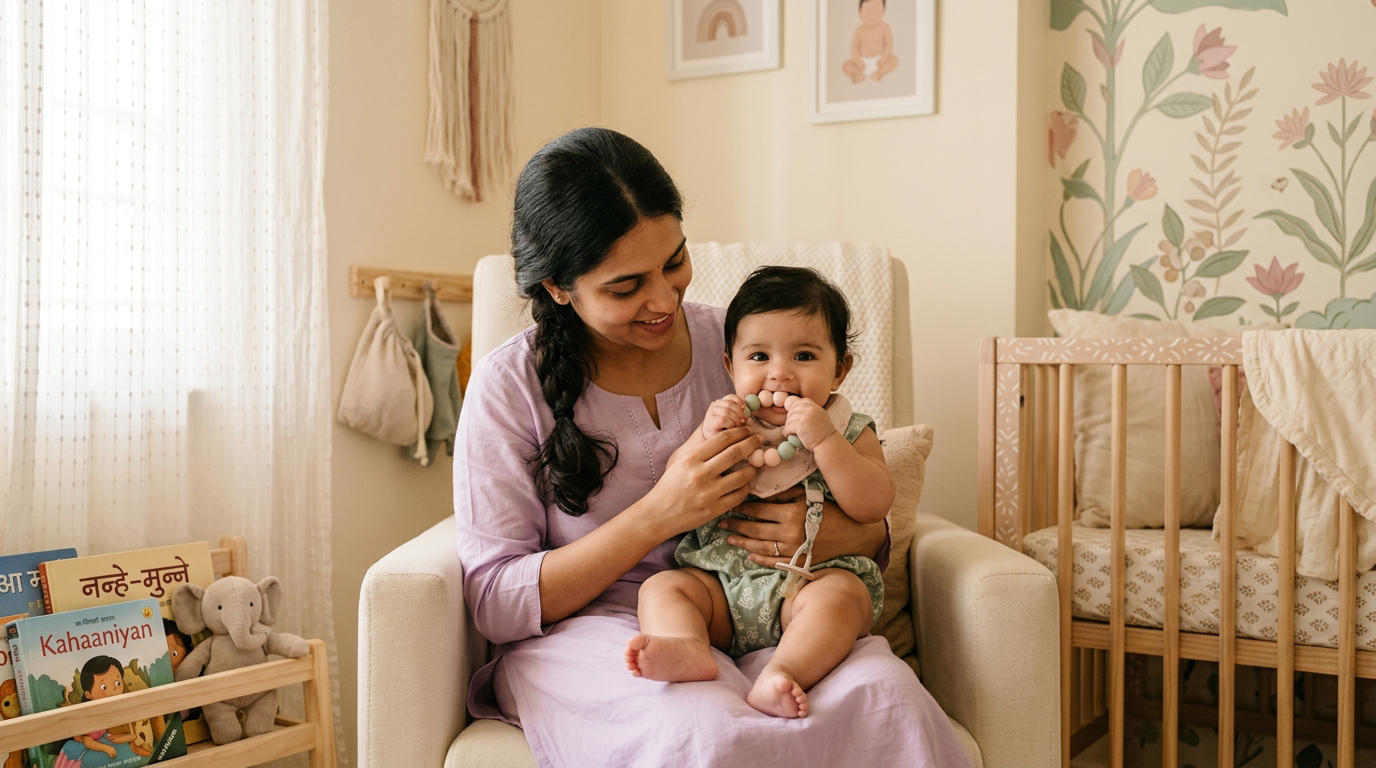
The teething order typically begins between 6 to 10 months of age, usually starting with the two lower central incisors. While every Indian baby has their own unique timeline, most will follow a predictable sequence: bottom front teeth first, followed by top front teeth, lateral incisors, first molars, canines, and finally the second molars by age three. If your little one is currently chewing on their khilona or your dupatta, you are officially in the teething phase.
Knowing the sequence helps you prepare for the specific challenges of each stage—like the "vampire look" when the canines peek through or the intense sleep regressions that come with those heavy-duty molars.
What is the Standard Baby Teething Order in India?
While we often joke in Punjabi households that a baby is "biting before walking," the biological sequence is remarkably consistent across cultures. However, in India, we often see slight variations due to nutritional factors or genetics. According to the Indian Academy of Pediatrics (IAP), the general timeline is a roadmap, not a strict rulebook.
The Sequence of Eruption
By the time your child is three, they should have a full set of 20 primary teeth. If you are wondering when do babies start teething, remember that some "early birds" start at 4 months, while others wait until their first birthday. Both are usually normal.
Understanding the Teething Chart: A Visual Guide
A teething chart is your best friend when trying to figure out why your toddler is suddenly cranky or refusing their dal-chawal.
Why the order matters
The teething order allows the jaw to expand naturally. The front teeth arrive first because they are designed for "incising" or cutting into soft foods like steamed apple or khichdi. The molars arrive later to help with the "mashing" required for more complex textures.
| Tooth Type | Position | Typical Age (Months) |
| :--- | :--- | :--- |
| Central Incisors | Bottom Front | 6–10 |
| Central Incisors | Top Front | 8–12 |
| Lateral Incisors | Top | 9–13 |
| Lateral Incisors | Bottom | 10–16 |
| First Molars | Top & Bottom | 13–19 |
| Canines | Top & Bottom | 16–23 |
| Second Molars | Bottom & Top | 23–33 |
If you notice a significant delay or if teeth are erupting out of sequence (like a molar appearing before an incisor), it is worth a quick check-up with a paediatric dentist to ensure there is no crowding or "shielded" teeth.
Indian Dadi Remedies: Myths vs. Science
In every Indian home, as soon as the drooling starts, the advice pours in. From Sasu Maa suggesting Jaiphal (nutmeg) to the local chemist recommending "teething tablets," it is hard to know what is safe.
The Jaiphal (Nutmeg) Rub
* The Tradition: Rubbing a paste of nutmeg on the gums.
* The Medical View: Skip it. In concentrated amounts, nutmeg can be toxic to infants and cause drowsiness or even seizures. Stick to a clean, cold washcloth.
Silver Teethers and Spoons
* The Tradition: Giving a baby a pure silver spoon or ring to chew on.
* The Medical View: Silver has natural antimicrobial properties. As long as the object is smooth, solid (not plated), and too large to be a choking hazard, it is a safe, traditional cooling agent. Just ensure it meets BIS (IS 9873) safety standards for toys.
Honey Gums
* The Tradition: Rubbing honey on the gums to "soften" them.
* The Medical View: Absolute No. Honey can cause infant botulism (a serious toxin) in babies under 12 months.
Instead of these risks, look for safe teething remedies for babies like chilled (not frozen) carrots or cucumbers under supervision.
Common Teething Symptoms Baby Might Face
As the teething order progresses, you will notice a pattern of symptoms that precede each eruption by about 3 to 5 days.
* Excessive Drooling: This can lead to a "drool rash" on the chin. Apply a thin layer of coconut oil or a basic barrier cream.
* Gum Swelling: The gums may look red, angry, or slightly bruised.
* Sleep Disturbances: Especially common with molars, as the pressure builds in the jaw.
The "Chew Everything" Phase: From their Sophie the Giraffe* to your knuckles, everything goes in the mouth.
A common myth in India is that teething causes loose motions (diarrhea). Biologically, teething does not cause diarrhea. However, because babies put everything in their mouths during this time, they often pick up infections. If the stool is watery or contains mucus, it is an infection, not the teeth. Similarly, while a slightly warm forehead is common, a true baby teething fever (above 100.4°F or 38°C) usually indicates a viral bug rather than the teeth themselves.
Regional Indian Foods for Teething Relief
When your baby is following the teething order and reaches the first molar stage (around 13 months), their appetite might dip. Soft, cooling Indian comfort foods can help:
* Chilled Curd (Dahi): Probiotic-rich and soothing for inflamed gums.
* Sattu Porridge: Cool and easy to swallow without much chewing.
* Cold Makhana: If the baby is old enough for solids, large, slightly softened (but not soggy) roasted makhanas can provide a satisfying crunch for itchy gums.
* Watermelon Rinds: Cold, hard, and sweet—just ensure there are no seeds and you are holding the rind while they gnaw.
Real Talk from Indian Moms
"Aarav got his top teeth first! Everyone in my housing society said it was bad luck (oops!), but my paediatrician laughed it off. He followed his own teething order, and now at 2 years, his smile is perfect."
— Megha R., Bengaluru (Mom to 24-month-old)
"We used a cold silver katori to soothe Sunita's gums during the molar phase. It was the only thing that stopped the crying at 2 AM. Forget the fancy gel teethers!"
— Anjali K., Pune (Mom to 14-month-old)
"I thought it was teething symptoms baby making him cranky, but it turned out he had an ear infection. Always check the ears if they are rubbing them constantly!"
— Deepika S., Delhi (Mom to 10-month-old)
When to Call Your Paediatrician
Teething is a developmental milestone, not a disease. However, "teething" is often blamed for things it doesn't do. See a doctor if:
* Fever exceeds 101°F (38.3°C): This is likely a viral infection.
* Prolonged Diarrhea: If it lasts more than 24 hours or leads to dehydration.
* Ear Pulling + Crying: Could be an ear infection (the nerves are close to the jaw).
* No teeth by 15 months: This is known as delayed eruption and may need a Vitamin D check or an X-ray.
* Bleeding Gums: While a tiny "eruption cyst" (blue bubble) is normal, active bleeding needs a professional look.
Frequently Asked Questions
Which teeth come first in the teething order?
The two lower central incisors (bottom front teeth) are almost always the first to arrive, usually between 6 and 10 months.
When do babies start teething in India?
Most Indian babies start showing signs around 6 months. However, factors like birth weight and Vitamin D levels (common deficiency in India) can push this to 10 or 12 months.
Can teething cause a high fever?
No. While a baby teething fever might result in a slight rise in body temperature (low-grade), any fever over 100.4°F (38°C) should be treated as a separate illness and discussed with a doctor.
Are homeopathic teething pills safe?
The IAP and international bodies like the FDA advise against homeopathic teething tablets because they often contain inconsistent amounts of belladonna, which can be toxic. Stick to physical soothing like gum massage.
Is the teething order always the same?
Not always. While 90% of babies follow the teething chart, some may get their "fangs" (canines) or lateral incisors earlier. As long as the teeth look healthy and the gums aren't infected, variation is okay.
How do I clean new teeth?
As soon as the first tooth pops up (first in the teething order), start cleaning it with a soft muslin cloth or a finger brush. Once they have several teeth, use a pea-sized amount of 1000ppm fluoride toothpaste as per modern IAP guidelines.
Teething is a long road, often lasting two years, but remember that each tooth is a sign of your baby growing and reaching a new stage of nutrition. Keep the cold washcloths ready, the maalish gentle, and your patience high.
This too shall pass, one tooth at a time.
Sources & further reading
- Indian Academy of Pediatrics (IAP) - Teething Guide
- National Health Portal India - Infant Care
- WHO - Oral Health for Children
Written by Dr. Anjali Mehta, MBBS, DCH (Paediatrics)
TheMamaCircle Editorial Team
Last updated: 7 June 2026
This article is for general information only and is not a substitute for personalised medical advice. Always consult your paediatrician or obstetrician for your specific situation.