Week by Week Pregnant: The Ultimate Indian Mom’s Guide
Track your baby's growth from amla to nariyal size. Our week by week pregnant guide covers Indian diets, scans (NT/Anomaly), and ₹5000 PMMVY benefits. Read more!
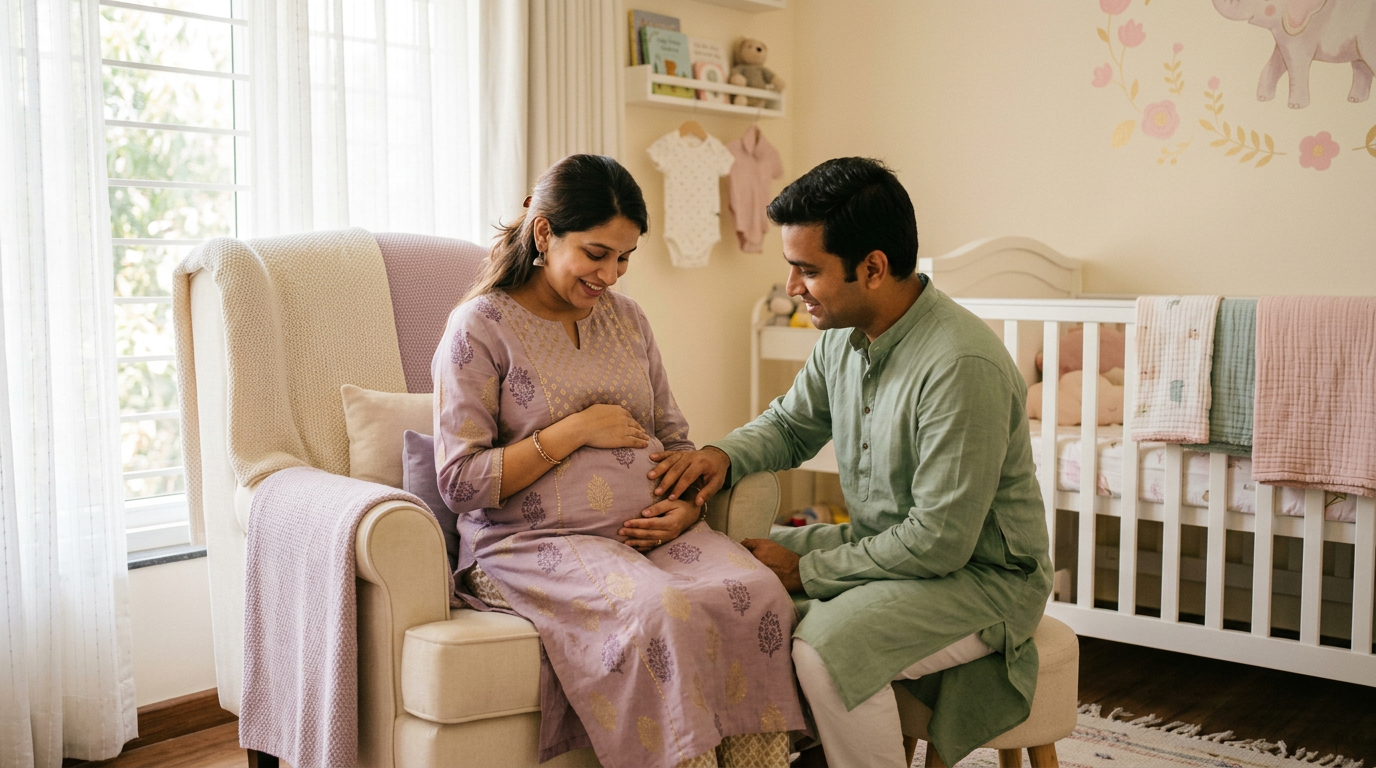
The moment that double line appears on the UPT kit, your world flips. You aren't just eating for two; you are growing a whole human being from a microscopic cell. To stay sane, you need to know exactly what is happening inside your garbh (womb). Being week by week pregnant in India means balancing modern scans with Dadi Maa’s advice on saffron milk, all while your body undergoes a massive hormonal overhaul.
What happens when you are week by week pregnant?
Pregnancy is technically a 40-week marathon, though most Indian families still count by months. Doctors follow the clinical 40-week timeline starting from the first day of your last period (LMP). This helps in scheduling critical scans like the NT scan or the Anomaly scan, ensuring baby’s growth aligns with FOGSI (Federation of Obstetric and Gynaecological Societies of India) standards.
If you are ever confused about your timeline, using a pregnancy calculator week by week is the fastest way to get your estimated date of delivery (EDD).
The First Trimester: Weeks 1 to 12
This is the "secret" phase. You might feel "green" at the smell of tadka or find yourself napping at 11 AM.
Key Milestones:
* Weeks 1-4: Your body prepares for ovulation and then implantation. You aren’t technically pregnant in weeks 1-2!
* Weeks 5-8: Baby is the size of an Amla (Indian gooseberry). The heart starts beating. This is when you should start your Folic Acid (5mg) as per ICMR guidelines to prevent neural tube defects.
* Weeks 9-12: Baby transitions from an embryo to a fetus. Vital organs are forming.
Pro-tip: Start using a week by week pregnancy chart to track your weight gain. In India, many women are pressured to "eat for two," but you only need an extra 350 calories in the second trimester, not the first!
The Second Trimester: Weeks 13 to 26
The "Golden Period." Your morning sickness usually fades, and you finally get that "pregnancy glow."
Baby Size in Indian Fruits:
* Week 16: Size of a Nagpur Orange. You might feel "quickening" (the first tiny kicks, like butterflies).
* Week 20: Size of a Nariyal (Small Coconut). This is the halfway mark! You will undergo the TIFFA/Anomaly scan now to check organs and limb development.
* Week 24: Size of a Papaya (long and lean).
Nutrition Milestone: Your doctor will likely prescribe Iron and Calcium supplements now. Do not take them together; calcium inhibits iron absorption. Take your iron with a glass of nimbu paani (Vitamin C) for better results.
The Third Trimester: Weeks 27 to 40
The "Heavy" phase. Your back might ache, and you’ll find yourself Googling "how to sleep with a huge belly" at 3 AM.
Final Preparations:
* Weeks 28-32: Baby is practicing breathing. You should start a "Kick Count." Aim for 10 movements in 2 hours after a heavy meal.
Weeks 33-36: The nesting instinct kicks in. Time to wash those tiny jablas* and cotton nappies.
* Weeks 37-40: Baby is "Full Term." At this stage, your baby is roughly the weight of a Kalingad (Watermelon), between 2.5kg to 3.5kg.
During this home stretch, many Indian moms look at a pregnancy month week by week breakdown to explain their progress to elders who might not understand the 40-week system.
Crucial Indian Government Schemes You Should Know
The Government of India provides support for pregnant women that many urban moms overlook:
Real talk from Indian moms
"I thought I'd be okay with just home food, but the iron tablets made me so constipated! My mom suggested manuka (black raisins) soaked in water, and it was a lifesaver." — Ananya S., Mumbai (Baby boy, 4 months)
"In my 7th month (Godh Bharai), everyone was feeding me sweets. My sugar levels spiked. Please listen to your Gynaecologist about Gestational Diabetes testing (OGTT); it's very common in Indian genes." — Preeti K., Bengaluru (Baby girl, 8 months)
When to call your Gynaecologist or Paediatrician
While most symptoms are normal, never ignore the following:
* Vaginal bleeding or spotting: Any amount, any time.
* Decreased Foetal Movement: If you don’t feel 10 kicks in 2 hours.
* Sudden Swelling: Especially in the face and hands (could be Preeclampsia).
* Consistent Contractions: If they happen more than 4 times an hour before 37 weeks.
* High Fever: Above 100.4°F (38°C) which can affect the baby.
Frequently Asked Questions
How do I use a pregnancy calculator week by week?
To use a pregnancy calculator week by week, you simply need the date of your last menstrual period (LMP) and your average cycle length. The tool adds 280 days to your LMP to give you an estimated due date.
Can I see my progress on a pregnancy week by week pregnancy calculator?
Yes! A pregnancy week by week pregnancy calculator allows you to see exactly which trimester you are in, how many days are left until your due date, and what developmental milestones your baby is reaching today.
How do I explain the pregnancy month week by week to my family?
In India, we often say 9 months, but medical pregnancy is 10 lunar months (4 weeks each). You can explain that months 1-3 are the first trimester, 4-6 are the second, and 7-9/10 are the third. A pregnancy month week by week guide helps bridge the gap between clinical weeks and traditional months.
Where can I find a reliable week by week pregnancy chart?
Most Indian maternity hospitals provide a week by week pregnancy chart during your first booking. You can also download one from government portals like the National Health Portal (NHP) of India to track vaccinations, scans, and weight.
Is saffron (Kesar) necessary during pregnancy?
While many Indian households swear by Kesar doodh for "fair skin," there is no scientific evidence for this. However, saffron in moderation is a safe mood-lifter. Do not exceed 1-2 strands a day as excess can cause uterine contractions.
What should my diet look like when I am week by week pregnant?
Focus on 'Ghar ka khaana'. Include dal, leafy greens (Palak, Methi), curd for probiotics, and ragi for calcium. Follow the ICMR "My Plate" recommendation—half your plate should be vegetables and fruits.
Every week brings you closer to holding your little one. Trust your body, eat your ghee (in moderation!), and remember: your body was built for this.
Main akeli nahi hoon, mera baccha mere saath hai. (I am not alone; my baby is with me.)
Sources & further reading
- Ministry of Health and Family Welfare - Pregnancy Care
- ICMR-NIN Dietary Guidelines for Indians
- FOGSI Perinatology Committee Guidelines
Written by Dr. Ritu Sharma, MD (Obstetrics & Gynaecology)
Reviewed by TheMamaCircle Editorial Team
Last updated: 21 June 2026
This article is for general information only and is not a substitute for personalised medical advice. Always consult your paediatrician or obstetrician for your specific situation.