Weight Chart for Kids: Essential India Guide (WHO & IAP)
Master the weight chart for kids (IAP & WHO versions) for Indian babies. Track monthly percentiles, identify red flags, and stop the 'kamzor' baby anxiety today.
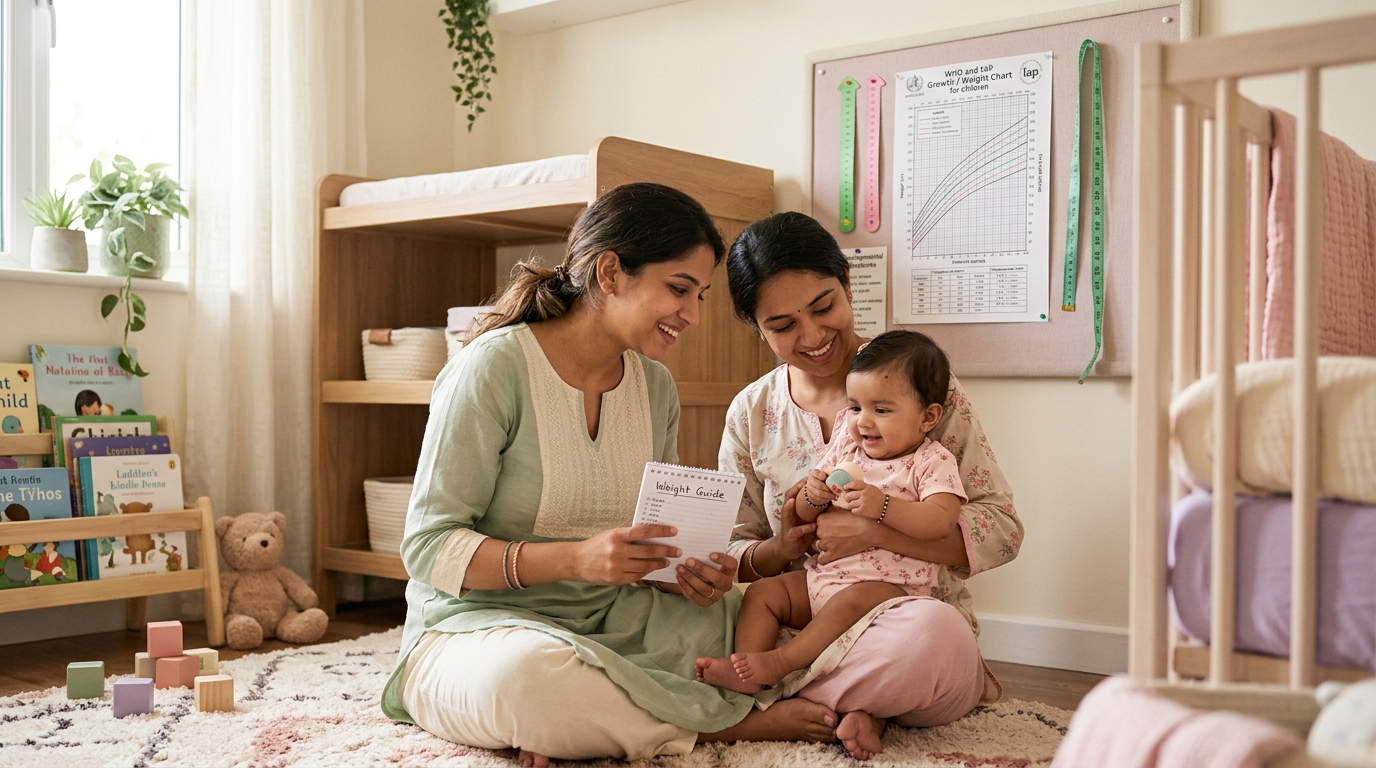
Is my bachcha growing properly? This is the one question that keeps every Indian mother awake at 2 AM. Using a weight chart for kids is the most reliable way to track if your little one is hitting their milestones or if that extra bowl of dalia is actually doing its job. In India, we specifically follow the growth standards set by the World Health Organization (WHO) and the Indian Academy of Pediatrics (IAP) because they represent the healthy growth of breastfed babies in our specific demographic.
Why a Weight Chart for Kids is Your Best Friend
In our culture, a 'chubby' baby is often seen as a healthy baby. We have all dealt with a door-ki-maasi or a neighbor commenting on how the baby looks 'weak' (kamzor). However, medical health isn't about rolls of fat; it is about tracking progress on a weight chart for kids.
A growth chart isn't a one-time test. It is a movie, not a snapshot. It tracks how your child is growing over time relative to their own birth weight. For most Indian babies, doubling their birth weight by 5 months and tripling it by their first birthday is the golden rule.
Indian Academy of Pediatrics (IAP) vs. WHO Standards
While the WHO charts are the global gold standard, the Indian Academy of Pediatrics (IAP) has refined these to better suit the Indian context. Indian children often have different growth trajectories compared to Western counterparts due to genetics and local diet.
Understanding Percentiles
When you look at a baby growth chart, you will see lines labeled 5th, 50th, and 95th percentiles.
* 50th Percentile: This is the average. If your child is on the 50th percentile, 50 kids are heavier than them and 50 are lighter.
* 3rd to 97th Percentile: This is the 'Normal Range'. Being on the 10th percentile is NOT 'bad'—it just means your child is naturally leaner.
* The Curve: The most important thing is that the growth line stays steady. A sudden 'drop' across two percentile lines is what requires a chat with your doctor.
Baby Weight Chart India: Month-by-Month Expectations
Here is a simplified version of the weight chart for kids based on IAP and WHO data for Indian babies (approximated averages).
| Age | Boy Weight (Avg) | Girl Weight (Avg) | Milestone Focus |
| :--- | :--- | :--- | :--- |
| Birth | 2.8 - 3.5 kg | 2.7 - 3.4 kg | First Maalish sessions |
| 1 Month | 4.5 kg | 4.2 kg | Exclusive Stanpaan (Breastfeeding) |
| 3 Months | 6.4 kg | 5.8 kg | 3 month baby weight check |
| 6 Months | 7.9 kg | 7.3 kg | Introduction of Annaprashan solids |
| 9 Months | 8.9 kg | 8.2 kg | Crawford/Pincer grasp |
| 1 Year | 9.6 kg | 8.9 kg | Triple birth weight goal |
Factors That Influence Your Child's Weight in India
Many factors beyond a simple baby weight chart india influence that number on the scale:
* Birth Weight: A baby born at 2.5 kg (common in India) will follow a different curve than a 4 kg baby.
Nutrition: From exclusive breastfeeding to introducing moong dal khichdi with a teaspoon of homemade ghee* (approx. ₹600-800/kg for pure A2 cow ghee), the quality of calories matters.
* Activity Levels: Once they start crawling or walking, weight gain often slows down because they are burning calories like little athletes!
* Illness: Common Indian woes like monsoon-season stomach bugs or the occasional viral fever can cause temporary weight plateaus.
Real Talk from Indian Moms
> "I used to cry because my MIL said my daughter was too thin. But our paediatrician showed me her weight chart for kids and she was perfectly on the 40th percentile. Now I just ignore the 'khilao-pilao' comments!"
> — Ananya S., Bengaluru (Mom to 14-month-old Arpit)
> "During the 10th month, Myra completely stopped gaining weight. I panicked. My doctor explained that because she started walking early, she was burning it all off. The baby weight chart by month showed she was still height-proportionate."
> — Ridhima K., Delhi (Mom to 2-year-old Myra)
When to Call Your Paediatrician
While we don't want you to obsess over every gram, certain 'red flags' on the weight chart for kids require a professional consultation at clinics like AIIMS or your local private paediatrician:
* Weight Loss: Any actual loss of weight (not just a plateau) after the first two weeks of life.
* Crossing Percentiles: If your baby drops from the 75th percentile to the 25th percentile.
* Lethargy: If the child is not gaining weight and seems constantly tired or lacks interest in play.
* Frequent Illness: If poor weight gain is accompanied by chronic diarrhea or repeated respiratory infections.
* Feeding Issues: Difficulty swallowing, persistent vomiting, or extreme refusal of all solids.
Beyond the Scale: Look for the 'Happy' Signs
Weight is just one marker. Is your child active? Are they hitting their motor milestones like sitting up or waving 'Tata'? Are they passing urine 6-8 times a day? These are often better indicators of health than a single number on a weight chart for kids.
Focus on nutrient-dense Indian foods: ragi kanji, mashed banana, curd rice, and seasonal fruits. Avoid 'empty calories' from biscuits or sugary 'health drinks' that often flood the Indian market.
Frequently Asked Questions
What is the ideal weight chart for kids in India?
There isn't one "perfect" number. We use the WHO/IAP charts that show a range. As long as your child is following their own curve between the 3rd and 97th percentile, they are generally considered healthy.
How do I use a baby growth chart?
You plot your child's age on the horizontal axis and their weight on the vertical axis. Where they meet is their percentile. Mark this every month to see the 'trend' or the direction the line is moving.
What should be the 3 month baby weight?
On average, a 3-month-old boy weighs about 6.4 kg and a girl weighs about 5.8 kg. However, this varies wildly based on birth weight. The goal at 3 months is that they are steadily gaining about 150-200 grams per week.
How often should I check the baby weight chart india?
For infants (0-1 year), a monthly check during vaccination visits is perfect. For toddlers, checking every 3 months is sufficient unless your doctor suggests otherwise.
Why does the baby weight chart by month slow down after 6 months?
This is because babies become more mobile. They start rolling, sitting, and crawling. Also, the transition to solids takes time as they learn to swallow textures other than milk.
Is my baby underweight if they are on the 10th percentile?
No. The 10th percentile means your baby is lighter than 90% of babies their age, but they are still in the 'normal' range. Some babies are just genetically predisposed to be leaner.
Remember, Mama, you are doing a great job. Your worth isn't measured in kilograms, and neither is your baby's health.
My child is unique, and their growth journey is their own.
Sources & further reading
- Indian Academy of Pediatrics (IAP) Growth Charts
- WHO Child Growth Standards
- All India Institute of Medical Sciences (AIIMS) Paediatrics
- National Health Portal (NHP) India - Growth Monitoring
Written by Dr. Anjali Mehta, MBBS, DCH (Paediatrics)
Reviewed by TheMamaCircle Editorial Team
Last updated: 10 June 2026
This article is for general information only and is not a substitute for personalised medical advice. Always consult your paediatrician or obstetrician for your specific situation.