When Do Babies Start Crawling? A Guide for Indian Parents
When do babies start crawling? Learn the typical timeline for Indian babies, from army crawling to skipping it entirely. Plus, tips for slippery floors!
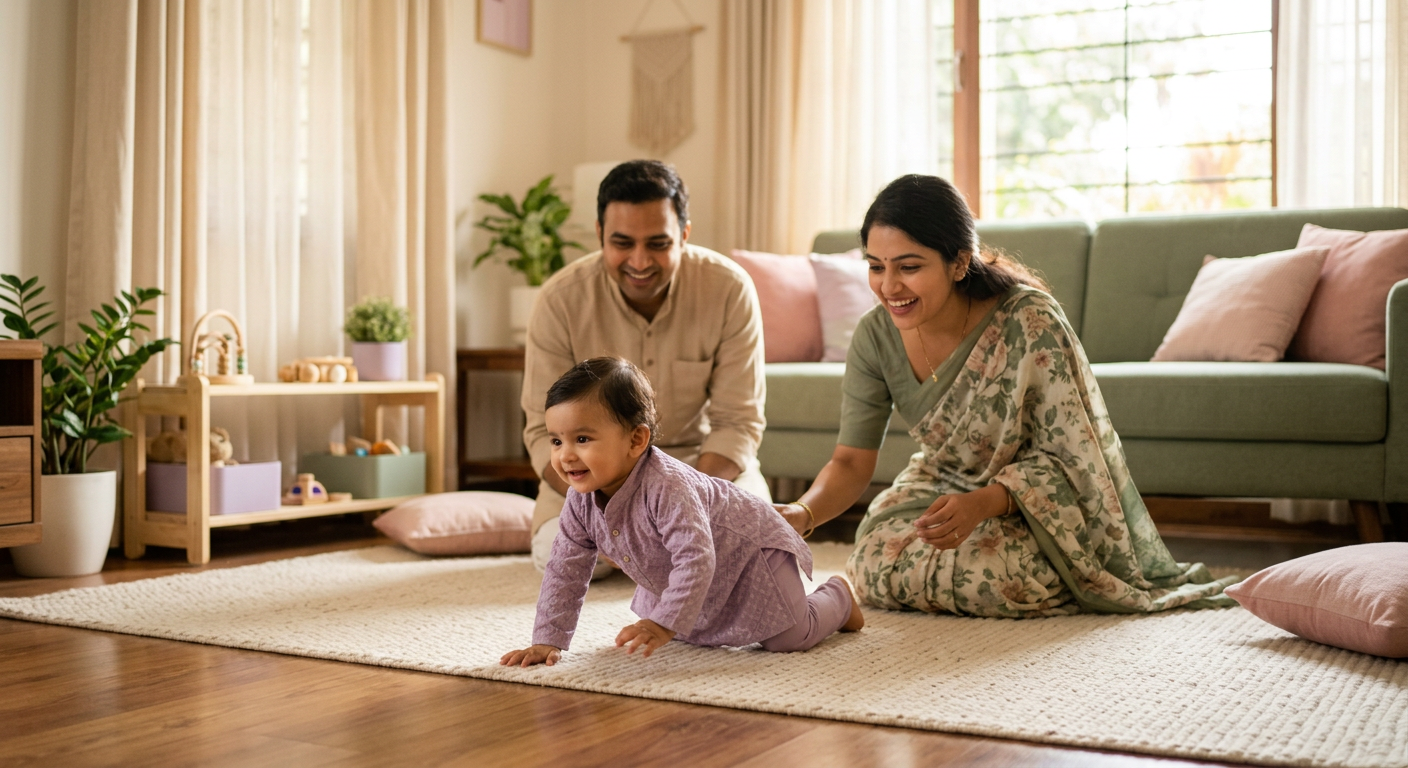
Most Indian babies start crawling between 7 and 10 months of age. However, this isn't a hard deadline — some babies skip crawling entirely and go straight to "cruising" (walking while holding furniture), while others are "bottom-shufflers" who move around on their bums. If your little one is hitting other milestones like sitting up steadily without support and reaching for toys, they are likely right on track.
At my clinic in Delhi, I often see parents panicking because their neighbour’s 6-month-old is already zip-lining across the floor while theirs is still happily doing a "land-rowing" motion in one spot. Movement isn't a race; it’s a series of muscle-strengthening exercises that happen every time your baby spends time on the floor.
The Crawling Timeline: What to Expect
Crawling is a major developmental leap because it requires the left and right sides of the brain to talk to each other while the core, arms, and legs coordinate. Here is the typical progression we see in Indian homes:
Phase 1: The "Mini-Plank" (4–6 Months)
Before moving forward, your baby needs a strong neck and upper body. You’ll notice them pushing up on their hands during tummy time, looking like a tiny yogi in cobra pose.
Phase 2: The Pivot and Rock (6–7 Months)
The baby starts spinning on their tummy like a clock needle to grab a toy. Soon after, they’ll push up onto all fours and rock back and forth. This rocking is a huge sign! They are literally testing their "engines" before they shift into gear.
Phase 3: The Army Crawl (7–9 Months)
Also called the "commando crawl." They pull themselves forward using their arms while their belly remains on the floor. This is very common in India where we often have smooth marble or vitrified tile flooring—it’s just easier to slide!
Phase 4: The Classic Cross-Crawl (9–10 Months)
The gold standard—moving the opposite arm and leg simultaneously. By this stage, no rangoli or floor vase is safe.
Does the Type of Flooring Matter in Indian Homes?
Absolutely. In many Indian households, we have hard, cold floors like marble, granite, or tiles. While these are easy to clean, they can be slippery and a bit "thanda" for a baby’s knees.
* The Grip Problem: On slippery tiles, a baby’s knees often slide outwards (the "frog" position), making it hard to get traction.
* The Comfort Factor: If the floor is too cold or hard, a baby might naturally prefer sitting or "bottom-shuffling" instead of putting their weight on their knees.
The Solution: Use an EVA foam play mat or a large cotton dhurrie* with a non-slip backing. Avoid very thick, plush carpets which can actually be harder to navigate because the baby’s hands sink into them.
> Real talk: Don't waste your money on those "baby knee pads" you see on Instagram. They usually slide down to the ankles within two minutes and actually make it harder for the baby to feel the Floor—and feeling the floor is how they learn balance. Simple leggings or bare knees are best.
How to Encourage Your Baby to Crawl
You don't "teach" a baby to crawl, but you can definitely set the stage. Think of yourself as the "Stage Manager" rather than the "Coach."
* Tummy Time is Non-Negotiable: If your baby hates tummy time, do it in short bursts of 2–3 minutes after every diaper change. No tummy time, no crawling. It’s that simple.
The "Lure" Technique: Place their favourite jhunjhuna* (rattle) or a colourful silicone spoon just out of reach. Don't make it so far that they give up and cry—keep it "frustratingly close."
Get on Their Level: Literally. Get down on all fours next to them. Babies are the world’s best mimics. If they see Mummy or Papa* crawling, they’ll want to join the "herd."
* Use a Mirror: Place a safe, floor-level mirror in front of them. The "other baby" in the mirror is a fantastic motivator for them to move forward and investigate.
Limit "Container" Time: This is the most important tip. If your baby spends hours in a jhoola*, a walker, a bouncer, or a car seat, they aren't building the muscles needed to move. Limit these to 15-20 minute stretches.
The Controversy: Should You Use a Walker?
In India, the "circular walker" is a staple gift from dadi or nani. However, as a paediatrician, I must be clear: The Indian Academy of Pediatrics (IAP) and the WHO strongly discourage walkers.
Why?
If you want something for your baby to stand with, opt for a "push-toy" (a sturdy wagon they can push from behind) once they are already pulling themselves up to stand.
Real Talk from Indian Moms
"My son Kabir never crawled. He just sat on his bum and used one leg to scoot himself around like a little scooty. I was so worried he'd have weak legs, but he started walking at 13 months and now I can't catch him!"
— Priya, Bengaluru (Mom to 18-month-old)
"In our joint family, everyone was always holding the baby. At 8 months, she wasn't even rolling. I had to tell my sasu maa, 'Please, let's put her on the mat for an hour a day.' Within two weeks of 'floor time,' she started army crawling."
— Megha, Indore (Mom to 9-month-old)
> Real talk: Sometimes the biggest obstacle to crawling is a well-meaning family member who refuses to put the baby down. A "carried" baby has no reason to move!
Why "Bottom Shuffling" is Common in India
Many Indian babies are "bottom shufflers" or "scooters." This often happens because:
If your baby is moving somehow—even if it looks like a weird breakdance move—and they are using both sides of their body equally, it is usually nothing to worry about.
When to Call Your Paediatrician
While there is a wide range for "normal," keep an eye out for these red flags:
* No movement by 12 months: If they aren't crawling, shuffling, or trying to scoot.
* Asymmetrical movement: If they only use one side of their body to pull themselves, or if one leg consistently drags behind like dead weight.
* Floppiness: If the baby feels very "loose" or "rag-doll-like" when you pick them up.
Loss of skills: If they were* crawling and suddenly stop or seem to lose the ability.
* No sitting: If they cannot sit upright without support by 9 months.
Frequently Asked Questions
Is it okay if my baby skips crawling?
Yes, about 10% of healthy babies skip crawling and go straight to walking. As long as they are meeting other milestones (sitting, pulling to stand, pincer grasp), it’s generally not a concern. However, crawling is great for hand-eye coordination later in life, so we still encourage floor time!
Will my baby crawl faster if I use a walker?
No. In fact, research shows that babies who spend time in walkers may actually start walking and crawling later than those who don't, because they don't learn how to balance their own weight.
My baby only crawls backwards. Is this normal?
Very normal! A baby’s arms are often stronger than their legs initially, so when they try to push up, they accidentally launch themselves backwards like a little reverse-gear car. Eventually, they’ll figure out how to coordinate the "push" with their knees to go forward.
Should I put shoes on my baby to help them get a grip?
No, bare feet are best for crawling. The toes provide essential grip and sensory feedback from the floor. Use non-slip socks only if the floor is dangerously cold.
How do I baby-proof for a crawler in an Indian kitchen?
Indian kitchens often have low-level gas cylinders, open shelves for heavy dabbas, and spices stored within reach. Once the crawling starts, you must use latches on lower cabinets and ensure the gas pipe is protected. Also, watch out for "door-stoppers" and floor-level electrical sockets, which are common in many Indian flats.
Crawling is your baby's first real taste of independence. One day they are exactly where you left them, and the next, they are under the dining table trying to eat a fallen piece of bhindi. Celebrate the "commando" phase, take the videos, and maybe buy a better vacuum cleaner—life is about to get very fast!
Repeat after me: My baby is on their own timeline, and the floor is their best teacher.
Sources & further reading
- Indian Academy of Pediatrics (IAP) — Growth and Development Milestones
- WHO — Multicentre Growth Reference Study Group on Motor Development Outcomes
- AIIMS — Early Childhood Development Guidelines
- National Health Portal (NHP) India — Child Development
Written by Dr. Anjali Mehta, MBBS, DCH (Paediatrics)
Reviewed by TheMamaCircle Editorial Team
Last updated: 14 May 2026
This article is for general information only and is not a substitute for personalised medical advice. Always consult your paediatrician or obstetrician for your specific situation.