When Do Babies Start Walking? India Milestones Guide
When do babies start walking? Learn the 9-15 month milestones, why to skip walkers, and India-specific safety tips for your toddler's first steps.
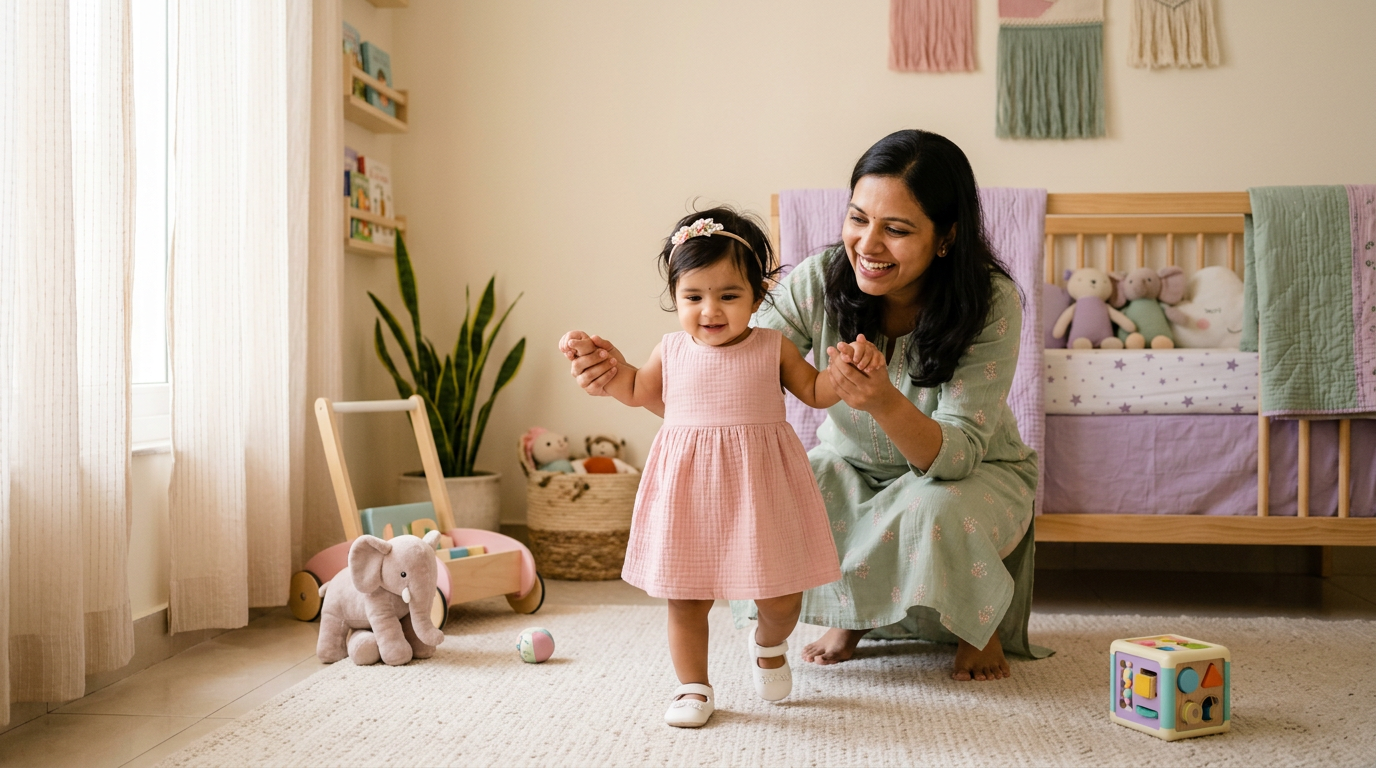
Most babies take their first independent steps between 9 and 15 months, though the \u201cnormal\u201d window is wide, stretching up to 18 months. If your 10-month-old is already cruising or your 14-month-old is still happily crawling, both are usually right on track. Walking isn't an overnight event; it\u2019s the grand finale of a year-long performance involving neck control, sitting, and the core strength built during all those maalish sessions.
The Roadmap to Those First Steps
Walking is the result of a "gross motor" sequence. In my clinic in South Delhi, I often see parents panicking because a neighbour\u2019s child walked at 9 months. Remember: walking early doesn't predict IQ, but the process matters.
1. The Foundation: 6 to 9 Months
Before the feet move, the core must be solid.
* Sitting without support: This builds the spinal strength needed to stay upright.
* Pivoting and scooting: Whether it\u2019s a classic crawl or a "commando crawl" (on the belly), moving from point A to B is the goal.
2. Pulling Up: 9 to 11 Months
This is when your furniture gets a workout. Your baby will use the edge of the sofa or your kurta to pull themselves into a standing position.
* The "Plop": Initially, they won't know how to get back down. You\u2019ll hear a lot of frustrated cries until they learn to bend their knees and drop safely on their diaper-padded bottom.
3. Cruising: 10 to 13 Months
Cruising is walking while holding onto furniture. At this stage, they are testing their balance and shifting weight from one foot to the other.
The Indian Home Setup: Watch out for lightweight plastic stools or moras* that might slide away when a baby leans on them. Ensure your heavy wooden coffee tables don't have sharp brass edges.
4. Standing Alone and The First Steps: 12 to 15 Months
One day, they\u2019ll let go of the chair, stand for two seconds with a look of pure shock, and then... ek, do, teen... they take those wobbly, Frankenstein-like steps toward your open arms.
Why "No Walkers" is the Best Advice
In India, the circular plastic walker (the "dabba" walker) is often gifted by well-meaning relatives. However, the Indian Academy of Pediatrics (IAP) and most global bodies strongly advise against them.
* False Sense of Balance: Walkers teach babies to walk on their tiptoes and don't strengthen the muscles needed for independent balance.
* Safety Hazards: Every year, I see infants with head injuries because a walker tipped over a doorstep or scooted toward the kitchen "choolha" or a flight of stairs.
Developmental Delay: Ironically, babies who spend heavy time in walkers may actually walk later* because they aren't practicing the floor-based movements (like crawling) that build hip strength.
Mama-to-mama tip: Swap the seated walker for a "push toy" or a sturdy wooden trolley. Even a heavy carton filled with books can work as a DIY push-toy that won't move too fast.
Real Talk: The "Dadi vs. Science" Debate
Real talk: Your sasu maa might tell you that putting salt on the baby's legs or using a specific sarson tel (mustard oil) will make them walk faster. While the oil itself doesn't have magical walking properties, the act of maalish (massage) is incredible. It stimulates blood flow and helps you check for muscle tone. Just keep the pressure gentle and avoid the "stretching" of joints that some traditional dais might attempt.
Real talk: We spend so much energy wanting them to walk, but once they do, your \u201cme-time\u201d is officially over. Bid goodbye to sitting down for a hot cup of chai. You are now a full-time bodyguard.
Making Your Indian Home "Walker-Friendly"
Our homes often have hard marble or vitrified tile flooring, which can be slippery and unforgiving for a falling toddler.
* Go Barefoot: Indoors, keep the baby barefoot. Grippy socks are okay, but feeling the floor with their toes helps develop the arches and balance. Avoid stiff-soled shoes until they are walking confidently outside.
The Rug Strategy: Place dhurries* or foam play mats in high-traffic areas.
* Corner Guards: If you have heavy teak or sheesham furniture, those sharp corners are at the exact height of a cruising baby\u2019s forehead. Silicone corner protectors are a ₹200 investment that saves a trip to the ER.
Ananya's Story: The Late Bloomer
Ananya, a mom from Bengaluru, was worried because her 15-month-old, Ishaan, showed no interest in walking. He was an "expert crawler" who could move faster on all fours than most kids could on two legs. "I felt judged at every family function," she told us. At his 15-month check-up, I observed that Ishaan had great muscle tone and was hitting his social milestones. We decided to wait. At 17 months, Ishaan simply stood up and walked across the living room to grab a remote. Within a week, he was running. Some babies are just cautious observers!
When to Call Your Paediatrician
While every baby has their own timeline, certain "red flags" warrant a visit to the clinic:
* By 12 months: Not pulling up to a stand or not crawling.
* By 15 months: Not able to stand with support or "cruising."
* By 18 months: Not walking independently at all.
* Asymmetry: If the baby uses one side of the body significantly more than the other, or drags one leg while crawling.
* Stiffness: If their legs feel very stiff or they seem to "toe-walk" exclusively even after months of practice.
Frequently Asked Questions
Does wearing shoes help a baby walk sooner?
Actually, no. Barefoot is best for learning. Shoes are only for protecting feet from heat, cold, or sharp objects outdoors. Look for shoes with very flexible soles that you can easily bend in half with one hand.
Is it true that "chubby" babies walk later?
Sometimes, yes. Heavier babies may need a little more muscle strength to haul their weight up. As long as they are meeting other milestones, a little "baby fat" is usually not a concern for walking timelines.
My child only walks on their tiptoes. Is this okay?
Many babies experiment with walking on their toes in the first few months of finding their feet. It usually disappears by age 2. However, if they cannot put their heels flat on the ground, consult your doctor to check for a tight Achilles tendon.
Can a baby skip crawling and go straight to walking?
Yes, some babies go from sitting to shuffling on their bottoms to walking. While crawling is great for bilateral coordination, skipping it isn't necessarily a sign of a problem, provided they are moving and exploring.
Does "Malish" really help with walking?
Massage is excellent for bonding and keeps the skin hydrated, but it won't "force" a baby to walk before their nervous system is ready. Use it as a time to talk and play, not as a medical treatment for walking.
Should I use those "leash" backpacks for safety?
In crowded Indian markets or airports, a safety harness can be a lifesaver for a "runner." It\u2019s a personal choice and doesn't hurt the baby's development, though some parents find it controversial.
Your baby will walk when their brain, muscles, and confidence all align at the same "station." For now, enjoy the last few weeks of them staying exactly where you put them.
Trust the process, Mama. Those tiny shoes will be worn out soon enough.
Sources & further reading
- Indian Academy of Pediatrics — Parent's Guide to Physical Milestones
- World Health Organization — Windows of Achievement for 6 Gross Motor Milestones
- AIIMS New Delhi — Early Childhood Development Guidelines
- National Health Portal India — Growth and Development
Written by Dr. Anjali Mehta, MBBS, DCH (Paediatrics)
Reviewed by TheMamaCircle Editorial Team
Last updated: 7 May 2026
This article is for general information only and is not a substitute for personalised medical advice. Always consult your paediatrician or obstetrician for your specific situation.