6 Month Old Baby India: Milestones, Weight & Care Guide
6 month baby milestones for Indian parents — sitting with support, rolling, babbling, first solids (Annaprashan), average 6-month weight and the red flags worth a paediatrician visit.
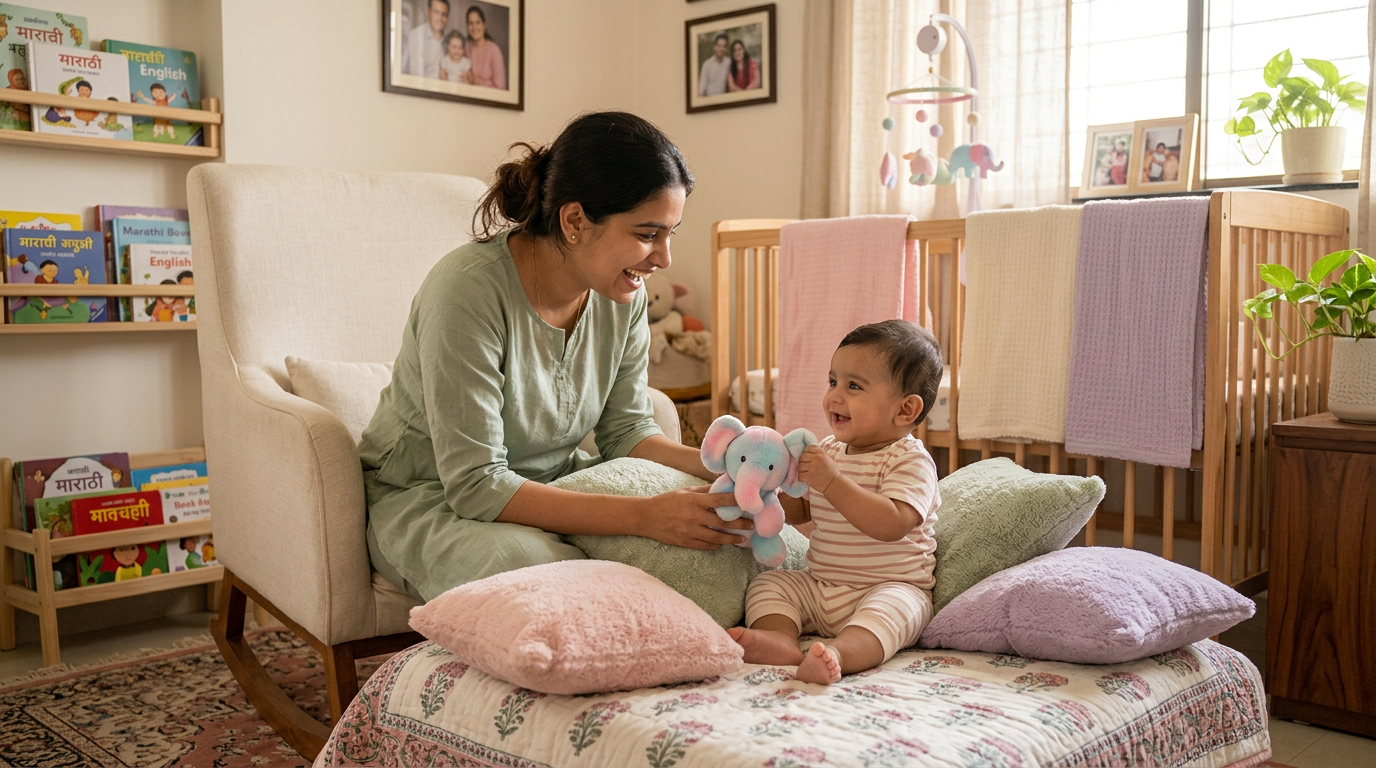
Hitting the half-year mark is the ultimate "level up" in your parenting journey. At 6 months, your baby transforms from a sleepy newborn into a tiny human with a personality, a preference for certain rhymes, and a very messy relationship with dal pani. Your 6 month baby milestones guide focuses on three major shifts: the start of solid foods (Annaprashan), the transition to sitting, and the beginning of "stranger danger."
While every baccha follows their own timeline, we look to the Indian Academy of Pediatrics (IAP) and WHO standards to ensure development is on track. Here is exactly what to expect as your little one turns six months old.
What are the 6 month baby milestones for physical growth?
Physically, your baby is likely doubling their birth weight. If they were 3kg at birth, seeing them hit 6kg now is a textbook win. But beyond the weighing scale at the clinic, their movement is becoming more intentional.
Gross Motor Skills: The Road to Sitting
Sitting with support: Most babies can now sit when propped up with a godadi* (comforter) or nursing pillow. Some might even sit unaided for a few seconds before toppling over like a cute little sack of potatoes.
* Rolling both ways: By now, they should be rolling from tummy to back and back to tummy. If they were hitting their 5 month baby milestones consistently, this movement should be fluid.
* Bearing weight on legs: When you hold them upright on your lap, they will likely bounce or try to support their weight on their feet.
Fine Motor Skills: The "Everything in Mouth" Phase
* Palmar grasp: They use their whole hand to grab toys. If you’re wearing a mangalsutra or a dupatta, consider this a warning—they will pull it with surprising strength.
* Transferring objects: You’ll notice them passing a rattle from the left hand to the right hand.
Hand-eye coordination: They can see an object (like a brightly coloured jhunjhuna*) and reach for it accurately without missing.
Cognitive and Communication Milestones at 6 Months
Your house is about to get much louder. The "cooing" of the earlier months matures into "babbling."
Language Development
* Stringing vowels: Expect a lot of "ah," "eh," and "oh."
* Consonant sounds: You might hear the occasional "ba," "ma," or "da," though they don't yet associate "Mama" with you (don’t worry, that heartbreak comes later!).
* Responding to names: If you call out "Chinnu" or "Aarav," they should turn their head toward the sound.
Social and Emotional Growth
Social Smiling: They don't just smile at walls anymore; they smile at you* to get a reaction.
* Recognizing familiar faces: They know Dadi, Nani, and the house help. This is also when "Stranger Anxiety" might kick in. If a distant uncle tries to grab them at a wedding, expect some tears.
* Expression of joy and displeasure: They will squeal with delight during peek-a-boo and grunt or cry when a toy is taken away.
The Big Milestone: Starting Solids (Annaprashan)
In India, the 6-month mark is synonymous with the Annaprashan or Mujhoot ceremony. This is the official IAP-recommended age to introduce complementary foods while continuing stanpaan (breastfeeding) or formula.
What should they be eating?
* Iron-rich foods: Their natural iron stores from birth are depleting. Iron-fortified ragi porridge (nachni) is an Indian superfood for this stage.
* Single-grain cereals: Rice kanji or mashed banana are gentle first steps.
Texture: Everything must be a smooth puree. Think dal ka pani* (though the thick dal itself is more nutritious) or well-mashed papaya.
* The 3-day rule: Introduce one food at a time and wait 3 days to check for allergies before moving to the next.
Pro-tip: Avoid salt, sugar, and honey until age one. Their tiny kidneys cannot process added salt, and honey carries a risk of infant botulism.
How can I support my 6 month old’s development?
You don't need expensive Montessori toys from Instagram ads to help your baby hit their 6 month baby milestones.
Real talk from Indian moms
"We celebrated Shlok’s 6-month birthday with a small pooja. I was so worried about him not sitting, but the moment he saw the ladoos, he lunged forward and sat straight for five seconds! Motivation is everything."
— Ananya S., Bengaluru (Mom to 6-month-old Shlok)
"The stranger danger is real. My daughter used to love her chacha, but the day she turned six months, she started howling the moment he entered the room. My Sasu Maa said it’s a sign of 'tej dimaag' (sharp brain), which made me feel better!"
— Meher P., Lucknow (Mom to 7-month-old Zara)
When to call your paediatrician (Red Flags)
While we tell everyone "don't compare," there are specific clinical red flags that require a visit to your doctor. If your baby is 6 months old and:
* Does not try to reach for objects.
* Shows no affection for parents or primary caregivers.
* Does not respond to sounds (potential hearing issue).
* Is very stiff or very floppy (poor muscle tone).
* Does not roll in either direction.
* Does not make vowel sounds ("ah", "eh", "oh").
* Has eyes that seem crossed or don't follow moving objects.
baby milestones are a spectrum, but these indicators warrant a professional check-up at your local clinic or AIIMS outreach centre.Frequently Asked Questions
What are the 3 month baby milestones I should have checked?
By 3 months, your baby should have had steady head control, the ability to follow objects with their eyes, and the start of social smiling. If these were missed, mention them during your 6-month vaccination visit. You can read more about 3 month baby milestones here.
My baby isn't sitting yet; are these normal 6 month baby milestones?
Yes. Most babies sit with support at 6 months. Sitting without support is often a 7 month baby milestones achievement. As long as they have good head control and are attempting to prop themselves up, they are likely on track.
Can I give my 6-month-old cow's milk?
No. The WHO and IAP strictly advise against cow's milk as a primary drink until 12 months. It lacks the iron your baby needs and is hard on their digestive system. Stick to breast milk or formula.
What should I look for in 4 month baby milestones if my baby seems "behind"?
If you feel your 6-month-old is lagging, look back: did they push up on their elbows during tummy time? Did they bring hands to their mouth? Reviewing 4 month baby milestones can help you identify if a delay started earlier or if it's just a temporary plateau.
How much sleep does a 6-month-old need?
Usually 12-15 hours in a 24-hour cycle. This typically includes two or three daytime naps. If they are teething, expect this schedule to go out the window for a few days!
Is it normal for my baby to lose weight when starting solids?
No. While they might get more active and "thin out" as they grow taller, actual weight loss is a red flag. Solids are 'complementary'—breast milk or formula remains the main source of calories.
This half-year mark is a beautiful, messy, and exhausting transition. You are transitioning from a 'caregiver' to a 'teacher' as you show them how to eat, talk, and move. Trust your gut, ignore the "my baby did this at 4 months" brag from the park aunties, and enjoy those gummy smiles.
Repeat after me: My baby is learning a new world at their own perfect pace.
Sources & further reading
- Indian Academy of Pediatrics (IAP) Growth Charts
- World Health Organization (WHO) Infant Development Standards
- National Health Portal (NHP) India - Infant and Young Child Feeding
Written by Neha Kapoor, RD (Registered Dietitian, Maternal & Child Nutrition)
Reviewed by TheMamaCircle Editorial Team
Last updated: 14 July 2026
This article is for general information only and is not a substitute for personalised medical advice. Always consult your paediatrician or obstetrician for your specific situation.