7 Month Baby Milestones: Indian Guide & Growth Chart
Discover the key 7 month baby milestones, from sitting steadily to babbling. Learn IAP-aligned growth tips and when to consult an Indian paediatrician.
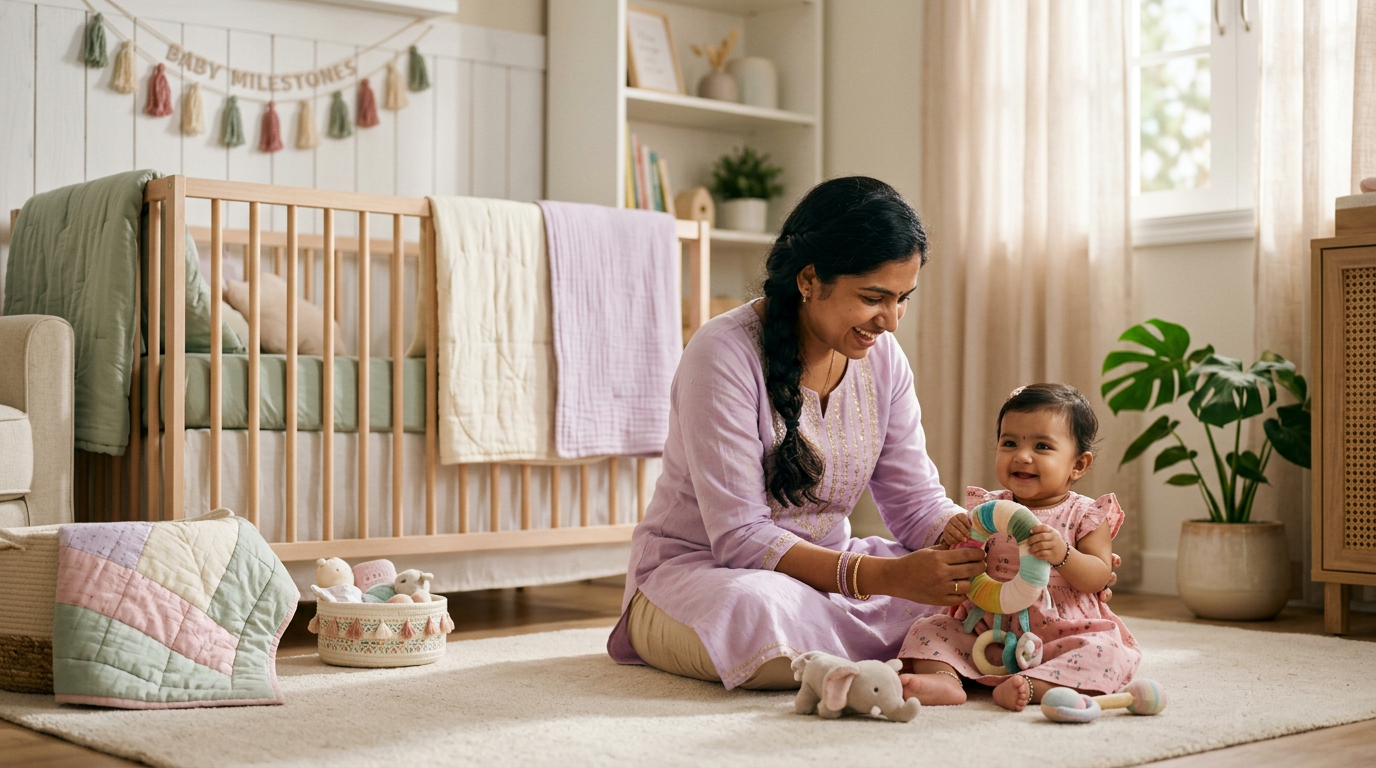
At seven months, your little one is officially leaving the 'potato phase' behind and entering their 'explorer era.' The 7 month baby milestones are dominated by newfound mobility, stronger core strength, and a personality that starts to sparkle brighter than your wedding jewellery. From sitting up without support to recognizing their own name, this is the month where your house suddenly needs a lot more baby-proofing.
What are the key 7 month baby milestones?
By now, you’ve likely seen the massive shifts that occurred during the 6 month baby milestones, but the seventh month is where coordination really clicks. The Indian Academy of Pediatrics (IAP) notes that while every child follows a unique timeline, most seven-month-olds are hitting specific Gross Motor, Fine Motor, and Social benchmarks.
Physical and Gross Motor Development
* Sitting sturdy: Most babies can now sit without using their hands for balance (tripod sitting). This is a great time to use a baby growth chart to ensure their physical development is on track with WHO standards.
* The "Commando Crawl": You might see your baby dragging their belly across the floor or pushing themselves backward.
* Weight-bearing: When held upright, they love to bounce and can support a significant amount of weight on their legs.
* Rolling like a pro: Rolling from tummy to back and back to tummy is now second nature.
Fine Motor and Cognitive Skills
* The Raking Grasp: Instead of picking things up with two fingers, they use their whole hand to "rake" objects toward them.
* Transferring objects: You’ll notice them moving a toy from the left hand to the right hand effortlessly.
* Depth perception: Their baby vision simulator is almost fully developed, allowing them to track moving objects and judge distances better.
* Response to "No": They are beginning to understand the tone of your voice, even if they choose to ignore the 'no' when reaching for your chai cup!
Feeding and Nutrition: Beyond the First Tastes
By seven months, Oonshaprashan or Annaprashan is usually over, and your baby is likely enjoying two to three small meals a day along with stanpaan (breastfeeding) or formula.
Traditional Indian Foods: This is the perfect age for well-mashed Khichdi with a drop of ghee, Suji halwa* (without refined sugar), and mashed seasonal fruits like banana or papaya.
* The Pincer Practice: While they haven't mastered the pincer grasp yet, offering soft finger foods like steamed carrot sticks (the size of an adult finger) helps them practice.
Iron-Rich Focus: The National Institute of Nutrition (NIN) emphasizes iron-rich foods at this stage. Think Palak puree or well-cooked Dal* (lentils).
If you are still navigating your own physical recovery while managing a busy seven-month-old, remember that your health matters too. Many moms find that issues like core weakness persist; you can take a free diastasis recti self-check to see if your abdominal muscles need specific postnatal exercises.
How do 7 month baby milestones differ from 5 month baby milestones?
It feels like just yesterday you were tracking the 5 month baby milestones. The jump between five and seven months is massive. At five months, your baby was likely just starting to roll and couldn't sit without significant propping. By seven months, their social interaction has skyrocketed. They now recognize emotions in your voice and may start showing a preference for specific caregivers—often leading to the start of "stranger danger."
Social and Emotional Leap: The "Mini-Me" Phase
Your baby is now a social butterfly—but only with people they know!
Indian Parenting Essentials for 7-Month-Olds
As your baby becomes more mobile, you’ll need to invest in a few items. In India, most parents look for:
* Quality Crawling Mat: Look for BIS-certified non-toxic EVA foam mats (Price range: ₹800 – ₹2,500).
Training Cups: Transitioning from bottles to a sippy cup or an open steel lota* for water.
* Safety Gates: If you have stairs or a kitchen with a low threshold, these are non-negotiable.
Real talk from Indian moms
> "At 7 months, Advait started doing this 'plank' thing on the floor. I thought he was trying to exercise with me, but it was just him prepping to crawl! My Sasu Maa insisted on giving him Ragi Malt every morning, and honestly, it’s been the best for his weight gain."
> — Sunita R., Bengaluru (Mom to 7-month-old Advait)
> "I was so worried because my daughter wasn't sitting as straight as the baby in my WhatsApp group. My paediatrician reminded me that her 3 month baby milestones were a bit late too, and she's just on her own clock. Two weeks later, she was sitting like a queen!"
> — Meher V., Mumbai (Mom to 8-month-old Zoya)
When to call your paediatrician
While we celebrate the 7 month baby milestones, we must also keep a "teekhi" (sharp) eye on development. Consult your doctor if your baby:
* Does not attempt to roll in either direction.
* Seems excessively stiff or very floppy (like a rag doll).
* Does not respond to sounds or follow objects with both eyes.
* Cannot sit with help or support.
* Does not make vowel sounds ("ah," "eh," "oh").
* Does not show affection to parents or caregivers.
If you are concerned about their growth patterns, you can always use our baby milestones tracker to keep a digital log for your next clinic visit.
Frequently Asked Questions
What are the most important 7 month baby milestones?
The most significant milestones include sitting without support, transferring objects between hands, responding to their name, and beginning to babble with consonant sounds. Most babies also start showing some form of independent movement, like rocking on hands and knees.
Is it normal if I missed some 4 month baby milestones but my baby is 7 months?
Yes, development is not always linear. However, if your baby skipped major 4 month baby milestones like supporting their head or pushing up during tummy time, you should discuss this with your paediatrician to rule out any underlying motor delays.
How do 7 month baby milestones compare to 6 month baby milestones?
By seven months, babies are much more stable in a sitting position than they were during the 6 month baby milestones phase. Their communication is also more intentional—they might reach out to be picked up or use specific babbles to get your attention.
My baby isn't crawling yet; should I be worried?
Not at all. Crawling is actually not considered a "standard" milestone by many developmental charts because some babies skip it entirely and go straight to cruising or walking. As long as they are moving their limbs equally and trying to navigate their environment, they are likely fine.
What toys are best for this age?
Montessori baby toys like wooden rattles, stacking rings, and soft balls are excellent. At seven months, toys that encourage reaching and following (like a ball that rolls slowly) are perfect for motivating them to move.Your baby is becoming a little person with big opinions and even bigger smiles. Enjoy this messy, loud, and beautiful phase—and don't forget to take a thousand pictures, because next month they'll be even faster!
Every child is a unique blossom; some bloom early, some take their time, but all are beautiful.
Sources & further reading
- Indian Academy of Pediatrics (IAP) Growth Charts
- WHO Child Development Milestones
- National Institute of Nutrition (NIN) - Infant Feeding Guidelines
Written by Dr. Anjali Mehta, MBBS, DCH (Paediatrics)
Reviewed by TheMamaCircle Editorial Team
Last updated: 22 July 2026
This article is for general information only and is not a substitute for personalised medical advice. Always consult your paediatrician or obstetrician for your specific situation.