8 Month Baby Milestones: India Guide to Growth & Red Flags
Your 8 month baby milestones guide: from sitting & crawling to first words. Compare WHO benchmarks with IAP red flags and get expert Indian parenting tips.
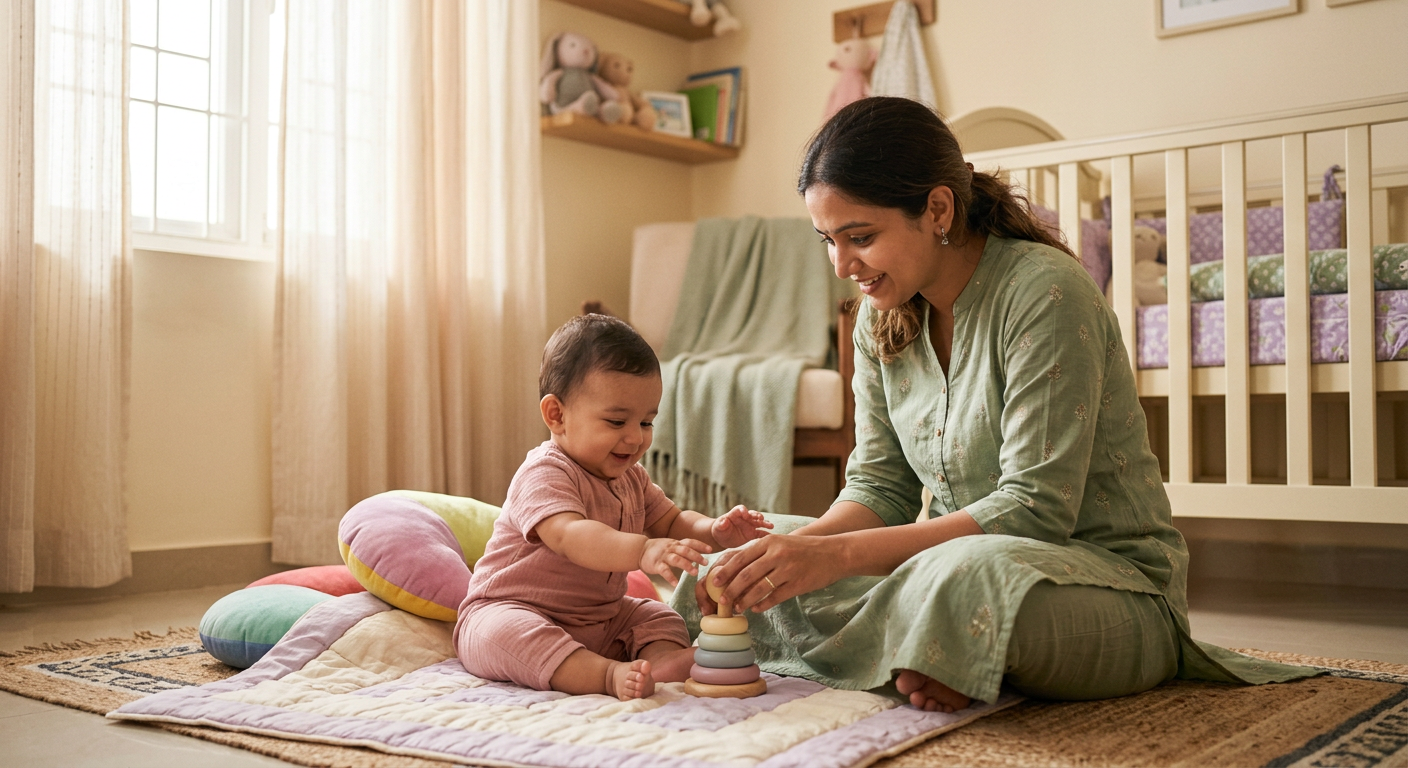
Eight months is officially the "Goldilocks Zone" of parenting. Your baby is no longer a fragile newborn but isn't yet a chaotic toddler running toward every electrical outlet. At this stage, 8 month baby milestones shift from quiet observation to active participation. You can expect your little one to sit steadily without support, start "commando crawling," and perhaps offer you a gummy, half-chewed piece of paratha. Most importantly, this is the age of deep social bonding and the beginning of real communication.
What are the 8 month baby milestones for physical development?
By the eighth month, the Indian Academy of Paediatrics (IAP) notes a significant surge in motor skills. The days of you propping them up with takiya (pillows) are mostly over.
Gross Motor Skills
* Sitting Strong: Most babies at 8 months can sit upright for extended periods. They have developed the core strength to reach for a toy while sitting without toppling over. If you are concerned about their posture or core strength, you might want to perform a free diastasis recti self-check for yourself as well, as picking up an 8kg baby requires your own core to be functional!
* The Army Crawl: While some babies skip crawling entirely, many 8-month-olds start the "commando crawl," using their arms to pull their belly along the floor.
Pushing to Stand: You might notice your baby grabbing the edge of the sofa or your kurta* to pull themselves into a kneeling or standing position.
Fine Motor Skills and Coordination
The Pincer Grasp (Early Stages): Your baby is moving away from the "raking grasp" (using the whole hand) to using the thumb and forefinger. This is the perfect time to introduce small, soft finger foods like well-cooked dal khichdi or softened makhana*.
* Passing Objects: Success! They can now move a toy from one hand to the other effortlessly.
Object Permanence: If you hide their favorite rattle under a dupatta*, they will now pull the cloth away to find it. They finally realize that just because they can't see you, doesn't mean you've vanished into thin air.
Why is my 8 month old suddenly crying when I leave the room?
If your once-social butterfly is now clinging to your pallu and screaming when Dadi tries to hold them, congratulations—they are hitting a major cognitive milestone. Separation anxiety and stranger danger usually peak around this time.
In India, where "joint family" living or frequent visitors are the norm, this can feel embarrassing. You might feel pressured when a relative says, "Humare paas kyun nahi aa raha?" (Why isn't he coming to me?). Rest assured, this is a sign of a healthy attachment. Your baby now has a clear preference for their primary caregivers.
During this phase of postnatal recovery (also called postnatal), your emotional health is just as vital as the baby's. If the constant clinging is feeling overwhelming, check in with your own mental state using our postnatal wellness assessment.
Feeding and Nutrition: Beyond the Mash
At 8 months, the World Health Organization (WHO) and the National Institute of Nutrition (NIN) suggest that complementary feeding should be in full swing. Breast milk or formula remains the primary nutrition, but solids are becoming more varied.
The 8-Month Menu Checklist:
Texture Shift: Move away from completely smooth purees. Your baby needs texture to develop jaw muscles. Think mashed banana, crumbled paneer, or thick ragi porridge*.
Iron-Rich Foods: Their iron stores from birth are depleted. Ensure they get iron-through palak* (spinach) puree, well-cooked lentils, or egg yolk.
Hydration: Offer boiled and cooled water in a "sippy cup" or a small steel katori-chammach*.
* Safety Standards: Ensure any plastic bowls or teethers used meet BIS (Bureau of Indian Standards) IS 9873 safety requirements to avoid toxic chemicals.
If you are worried about their growth trajectory while introducing these foods, you can track their percentiles using our baby growth chart.
Communication: Ba-ba, Ma-ma, and the "No"
Your house is about to get a lot noisier. One of the most exciting 8 month baby milestones is the transition from random cooing to intentional babbling.
* Syllable Doubling: You will hear "ba-ba," "da-da," and hopefully "ma-ma." While they might not strictly associate "Ma-ma" with you yet, they are practicing the phonetic sounds.
Understanding "No": They might not obey yet, but if you say a firm "Nahi" when they reach for your hot chai*, they will likely pause and look at you.
* Gesturing: Many 8-month-olds start waving "bye-bye" or pointing at the ceiling fan (every Indian baby’s favorite first friend).
How does this compare to earlier months?
It feels like just yesterday you were looking at 3 month baby milestones and wondering when they’d finally hold their head up. By the time you reached 6 month baby milestones, you were likely starting solids and seeing the first tooth.
The leap from 6 to 8 months is mostly about mobility and intent. At 6 months, the baby is a "receiver" of the world; at 8 months, they are an "explorer." They aren't just sitting; they are leaning. They aren't just eating; they are trying to grab the spoon.
Real talk from Indian moms
"My daughter started doing the 'creepy crawl' at 8 months. I thought I had time to baby-proof, but suddenly she was under the dining table chewing on a fallen kaju! I had to buy those ₹500 corner guards for every table in the house immediately."
— Ridhima S., Bengaluru, Mom to 9-month-old Ira
"Everyone told me 8 months is when they start talking. My son just blows raspberries all day and says 'Abba'. My Sasu-maa is convinced he’s calling his grandfather, but I think he just likes the 'B' sound!"
— Meher P., Lucknow, Mom to 8-month-old Kabir
When to call your paediatrician
While every baby develops at their own pace, the IAP suggests keeping an eye out for these "Red Flags" at 8 months:
* No Weight Bearing: Does not put any weight on legs when held in a standing position.
* No Independent Sitting: Cannot sit without support (even for a few seconds).
* Lack of Social Response: Does not smile, make eye contact, or respond to their name.
* Silence: Does not babble or make vowel sounds like "ah" or "ee".
* Rigidity: Limbs seem very stiff or, conversely, very floppy like a rag doll.
* Vision issues: If you notice a persistent squint or if they don't follow moving objects, use our baby vision simulator to understand what they see and consult a doctor.
Frequently Asked Questions
What are the 4 month baby milestones compared to 8 months?
At 4 months, the focus is on head control and "pushing up" during tummy time. By 8 months, the baby has moved to sitting independently and potentially crawling. The 4-month-old explores with their eyes; the 8-month-old explores with their hands and mouth.
How do 5 month baby milestones differ from 8 months?
A 5-month-old is usually learning to roll from tummy to back. An 8-month-old has evolved far beyond rolling and is usually working on "tripod sitting" (leaning forward on hands) or pulling to stand.
Should I be worried if my 8-month-old isn't crawling?
Not necessarily. Crawling is not considered a "hard" milestone by many paediatricians because some babies go straight from sitting to cruising (walking holding onto furniture). However, they should be showing some form of independent movement (scooting, rolling) to reach items they want.
My baby reached the 6 month baby milestones late; will they be late for 8 months too?
Development isn't always a straight line. A baby might be "slow" to roll but "fast" to talk. As long as your paediatrician is happy with the overall trend, occasional delays in specific areas are common.
Can an 8-month-old eat honey or cow's milk?
No. In India, it’s common for elders to suggest "Ghutti" or honey, but the IAP and WHO strictly advise against honey before age 1 (due to botulism risk) and cow's milk as a primary drink before age 1 (due to kidney strain and low iron).
How much sleep does an 8-month-old need?
Typically 12–14 hours in a 24-hour period, usually including two distinct daytime naps.
Eight months is a whirlwind of "firsts"—the first tooth, the first "mama," the first time they actually stay in one place long enough for a photo (just kidding, they move fast now!). Enjoy this stage of baby milestones; the toddler years are just around the corner, and you’ll soon miss the days when they stayed exactly where you put them.
You are doing a great job, Mama—trust your gut and enjoy the gummy smiles.
Sources & further reading
- IAP Guide to Growth and Development
- WHO Complementary Feeding Guidelines
- AIIMS Paediatrics Milestone Chart
- National Institute of Nutrition - Diet for Infants
Written by Dr. Anjali Mehta, MBBS, DCH (Paediatrics)
Reviewed by TheMamaCircle Editorial Team
Last updated: 31 July 2026
This article is for general information only and is not a substitute for personalised medical advice. Always consult your paediatrician or obstetrician for your specific situation.