9 Month Baby Milestones: Indian Guide to Growth & Safety
Discover the key 9 month baby milestones for Indian infants, from crawling to pincer grasp, plus expert tips on diet, safety, and your postnatal health.
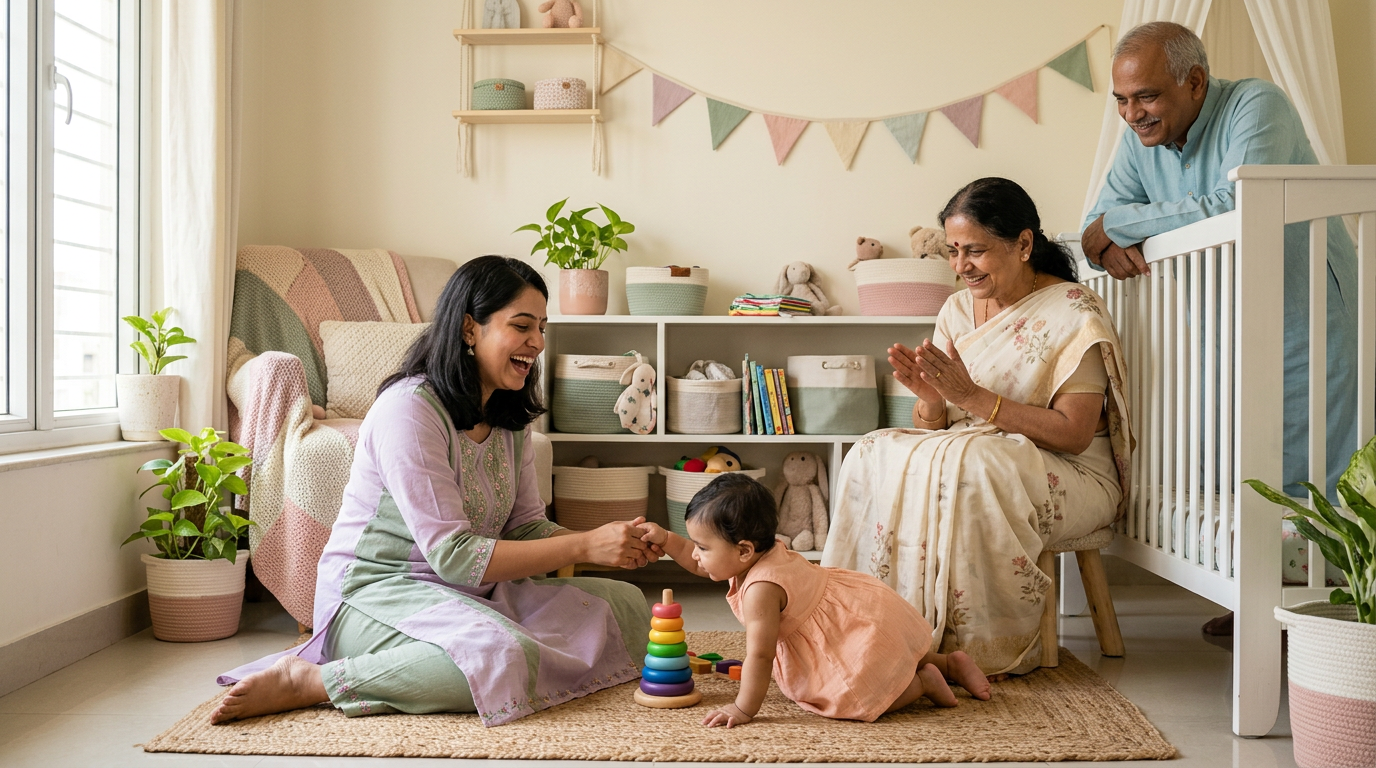
By the time you reach the 9 month baby milestones mark, life feels like a constant game of "catch me if you can." Your baby is no longer a stationary bundle; they are a curious, crawling, and perhaps slightly chaotic little human. This is a critical transition period where cognitive leaps meet physical agility, often coinciding with your own postnatal recovery milestones as you settle into a long-term routine. At nine months, your baby is transitioning from a dependent infant to an active explorer of your home.
What are the key 9 month baby milestones for Indian babies?
At nine months, the Indian Academy of Pediatrics (IAP) and WHO focus on three main pillars: gross motor skills (moving), fine motor skills (grabbing), and social-communication (connecting). Unlike the earlier 6 month baby milestones where sitting was the "big win," nine months is about verticality and intent.
Gross Motor Development: The Mobile Explorer
Most babies hit these physical benchmarks between 8 and 10 months:
* The Commando Crawl or Classic Crawl: Whether they are belly-crawling or on all fours, they are moving. Some babies even "bottom shuffle."
Pulling to Stand: Your baby will use the diwan, the edge of the bed, or your kurta* to pull themselves up.
* Sitting without Support: They can sit steadily for long periods while playing with toys, a progression from the 5 month baby milestones where they still needed a hand behind them.
* Changing Positions: They can go from a tummy-down position to a sitting position independently.
Fine Motor Skills: The Pincer Grasp
This is the age of the "Pincer Grasp." Your baby will start using their thumb and index finger to pick up small objects.
Feeding Themselves: This is the perfect time to introduce soft finger foods like well-cooked khichdi clumps, small pieces of banana, or soft paneer* cubes.
Banging Objects: They love the sound of a steel katori* hitting the floor. It’s not just noise; it’s a lesson in cause and effect.
Pointing: They will start pointing at the pankha* (fan) or the street dog outside the window.
Cognitive and Language Development at 9 Months
Your baby’s brain is like a sponge, soaking up the multilingual environment of an Indian household. Even if they aren't speaking yet, they are understanding "No" (though they might ignore it!) and recognizing their name.
Object Permanence: If you hide their favorite toy under a dupatta*, they will look for it. They now know that things exist even when they can’t see them.
* Babbling with Intent: You’ll hear "Ma-ma," "Da-da," or "Ba-ba." While these might have started as random sounds during the 4 month baby milestones phase, they now often associate the sound with the person.
Gesture Mimicry: They will start waving "bye-bye" or doing namaste when prompted by Dadi*.
Nutrition and the 9-Month Diet Chart
By now, your baby should be having three solid meals a day along with stanpaan (breastfeeding) or formula. According to the National Institute of Nutrition (NIN) India, the focus should be on iron-rich and calorie-dense foods.
If you are tracking your child's physical growth alongside these developmental leaps, using a baby growth chart can help ensure their weight-for-height ratio is on track with WHO standards for India.
Postnatal Life at 9 Months: The "New Normal"
By nine months postnatal (also called postnatal), many moms feel they should be "back to normal," but the reality of sleep deprivation and the physical toll of chasing a crawler is real. If you are still experiencing core weakness or a "pooch" that won't go away, it might be worth doing a free diastasis recti self-check.
It is also a time when many Indian moms return to work. The emotional shift can be heavy. Whether you are dealing with separation anxiety (yours or the baby's), remember that your postnatal health—both mental and physical—is still a priority. If you feel overwhelmed, checking in with a professional through postnatal wellness assessment tools can provide clarity.
Real talk from Indian moms
"I thought once Kabir started crawling, I’d have more free time. Instead, I spend my day making sure he doesn't eat the dry mud from the gamla (flower pot). The pincer grasp is great for his development but terrible for my floor hygiene!"
— Sana, Mumbai, mom to 9-month-old Kabir
"Ishani started doing 'Namaste' and 'Tata' this month. My sasu maa is thrilled! We spent about ₹2,000 on those plastic-free wooden toys from Channapatna because she’s putting everything in her mouth right now."
— Priya, Bengaluru, mom to 10-month-old Ishani
"The separation anxiety hit us hard at 9 months. If I even go to the kitchen to make chai, he starts crying like I’ve left the country. Our paediatrician says it's a sign of a healthy attachment, but it's exhausting!"
— Megha, Delhi, mom to 9-month-old Aarav
When to call your paediatrician (Red Flags)
While every baby develops at their own pace, the IAP suggests a check-up if your 9-month-old:
* Does not sit even with support.
* Does not babble or make sounds like "ba-ba" or "ma-ma."
* Does not recognize familiar faces or look where you point.
* Does not put weight on their legs when held in a standing position.
* Does not look for objects that you hide (lack of object permanence).
* Loses skills they previously had.
Safety First: Baby-Proofing the Indian Home
Indian homes have unique hazards. At this stage, you must:
* Secure low-level sockets: With the monsoon moisture, open sockets are dangerous. Use socket covers (available on Amazon India for ₹300-₹500 for a pack).
Check the floor: Small stones from dal* cleaning or loose mustard seeds can be choking hazards for a baby with a new pincer grasp.
* Stair Gates: If you have an internal staircase, install a gate that meets BIS/IS 9873 safety standards.
Frequently Asked Questions
What are the 9 month baby milestones I should look for?
The primary milestones include crawling, pulling to stand, using a pincer grasp to pick up small objects, and responding to their own name. They should also begin to show separation anxiety and understand simple commands or gestures like "No" or a wave.
My baby is reaching 3 month baby milestones late; will they catch up by 9 months?
Developmental timelines vary widely. A baby who was slightly behind on 3 month baby milestones—such as steady head control—often catches up by the 9-month mark. However, if multiple milestones are missed across different months, a paediatric evaluation is necessary.
How do 9 month baby milestones differ from 4 month baby milestones?
At 4 months, milestones are about discovery—discovering hands, rolling over, and laughing. By 9 months, milestones are about mobility and communication—moving across the room, standing up, and using specific sounds to get your attention.
What should a 9-month-old be eating in India?
A 9-month-old should eat mashed family foods. Think khichdi with extra ghee, mashed idli, ragi ambali, or soft-cooked vegetables. Avoid salt, sugar, and honey. Ensure they are getting iron-rich foods to prevent anaemia, which is common in Indian infants.
Is it normal for a 9-month-old to not be crawling yet?
Some babies skip crawling entirely and go straight to walking, while others are "late crawlers." If your baby is sitting well and moving in other ways (like rolling or scooting), it is usually not a concern. Use a baby milestones tracker to see the full range of "normal."
Why is my baby crying so much at 9 months?
At this age, separation anxiety and teething (usually the upper incisors) are the main culprits. If the crying seems unusual or inconsequential, you can use an AI cry analyzer to help distinguish between hunger, sleepiness, or pain.
Nine months is a whirlwind of growth, and as you watch your little one master their world, take a moment to acknowledge how far you’ve come in your own journey since birth.
I am doing a great job, and my baby is growing exactly as they need to.
Sources & further reading
- Indian Academy of Pediatrics (IAP) Growth Charts
- WHO Developmental Milestones
- National Institute of Nutrition - Diet for Infants
Written by Dr. Anjali Mehta, MBBS, DCH (Paediatrics)
Reviewed by TheMamaCircle Editorial Team
Last updated: 13 August 2026
This article is for general information only and is not a substitute for personalised medical advice. Always consult your paediatrician or obstetrician for your specific situation.