Can Newborn Babies See? Week-by-Week Vision Guide for Moms
Can newborn babies see? Discover what your baby sees week-by-week, from blurry shadows to high-contrast colors, and when to track eye color changes.
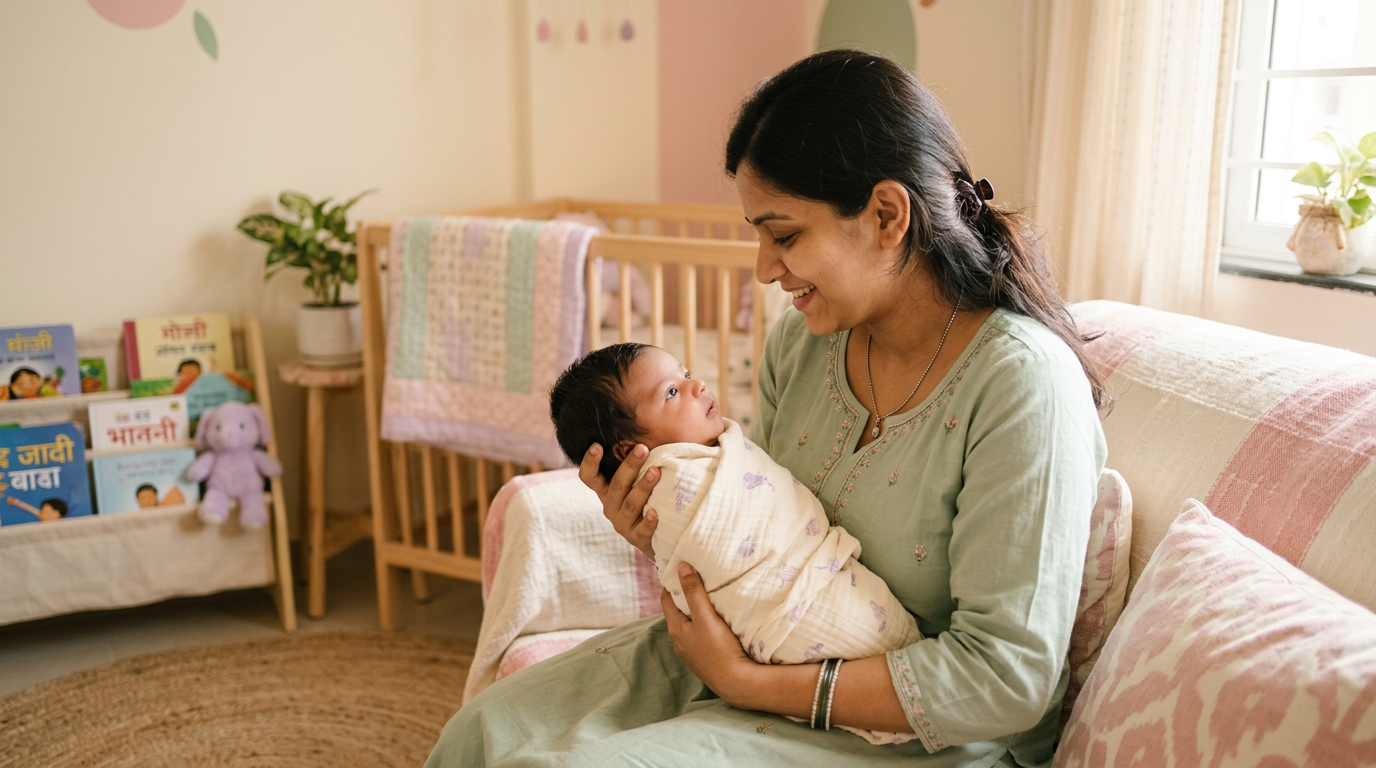
Yes, can newborn babies see? Absolutely, but their world looks like a very blurry, out-of-focus Bollywood film from the 70s. At birth, a baby’s vision is roughly 20/600, meaning they can only see things clearly that are about 8 to 12 inches away—exactly the distance from your face to theirs during stanpaan (breastfeeding). While their eyes are physically capable of seeing, their brain isn't yet ready to process all that complex visual data.
The First Look: What Can Newborn Babies See Week by Week?
In the early postnatal weeks (also called postnatal), your baby’s visual system is under construction. It is a slow, fascinating transition from a world of shadows to a world of vibrant colours and sharp edges.
Week 0 to 4: High Contrast and Shadows
In this initial postnatal phase, the world is mostly shades of grey, black, and white. Because their retinas aren't fully developed, they can't distinguish between similar tones (like red and orange). They are, however, incredibly sensitive to light. You might notice your baby squinting if you turn on a bright LED bulb or take them out into the harsh Indian afternoon sun.
* Focus Range: 20–30 cm (the distance to your face while cradling).
* Visual Interest: They love high-contrast patterns. This is why black-and-white newborn vision examples like stripes, checkerboards, or simple "B&W" flashcards are so mesmerizing to them.
* The "Face" Preference: Humans are hardwired to look at faces. Your baby will spend a lot of time staring at your hairline or your eyes—the high-contrast areas of your face.
Month 2 to 3: The Arrival of Colour
Around the 8-to-12-week mark, your baby’s ability to track moving objects improves. This is also when the "primary colour" switch flips on. Red is usually the first colour they perceive, followed by green.
Tracking: They can follow a slow-moving jhunjhuna* (rattle) from side to side.
* Depth Perception: They are starting to understand that objects have volume, though they’ll still frequently poke themselves in the eye while trying to grab a toy.
* Coordination: Their eyes are starting to work together as a team, reducing that slightly scary "cross-eyed" look common in the first month.
Decoding Newborn Vision: Lighting, Distance, and Focus
To understand newborn vision, you have to realize they aren't seeing the room; they are seeing a series of blobs. If you stand across the room and wave, they aren't ignoring you—they literally cannot see you.
Lighting Sensitivity
Indian households are often brightly lit with tube lights or heavy chandeliers. A newborn's pupils are very small to limit the amount of light entering the eye. In the first few weeks, use dim "zero-watt" bulbs or soft lamps during the evening. This helps them open their eyes wider and actually look at you.
The Power of High Contrast
Since their colour vision is weak, they rely on "luminance contrast." If you put a pale pink teddy bear on a white bedsheet, it’s invisible to them. If you put a dark navy blue cushion on a white sofa, they’ll stare at it for minutes. You can use our baby vision simulator to see exactly how these contrasts appear to your little one.
Eye Contact and Social Smiling
Between 6 and 8 weeks, their vision develops enough to recognize your facial expressions. This leads to the "social smile"—one of the most rewarding baby milestones tracker moments. They aren't just smiling at the ceiling anymore; they are smiling at you because they can finally see your grin.
When Do Babies Start Seeing and Hearing Together?
Parents often ask, when do babies start seeing and hearing in a way that makes sense? While hearing is almost fully developed at birth (they’ve been eavesdropping on your conversations in the garbh for months), the integration of sight and sound happens around the 2-to-3-month mark.
Sensory Integration: By 3 months, if they hear a payal* (anklet) jingling to their left, they will turn their eyes to look for the source.
* Audio-Visual Mapping: This is a great time to introduce musical toys or simply talk to them while moving around the room so they can practice "locating" you with both senses.
The Great Mystery: Newborn Eye Color
Will the baby have your "cat eyes" or your partner's deep brown ones? The question of newborn eye color is a favorite topic during Godh Bharai and postnatal visits.
* The Melanin Factor: Most Indian babies are born with dark grey or brown eyes. If a baby is born with lighter eyes (blue or grey), they often change.
* The Timeline: The permanent pigment, melanin, takes time to deposit in the iris. You won't know the final, permanent eye colour until the baby is at least 6 to 9 months old, and sometimes even up to a year.
* Genetics: While brown is dominant in the Indian population, recessive genes can lead to lighter shades if both parents carry the trait.
Real Talk from Indian Moms
"I was so worried because Kabir would look 'through' me instead of at me for the first three weeks. I thought he had a vision problem. Then my paediatrician told me to get closer—about 10 inches away. The moment I did, he focused right on my nose. It was pure magic."
— Ridhima, Delhi (Mom to 4-month-old)
"We bought all these expensive pastel-coloured soft toys, but Advait ignored them completely. My Nani told me to show him a black dupatta with white embroidery. He was obsessed! Now I know that bold patterns are the way to go for the first few months."
— Meera, Bengaluru (Mom to 2-month-old)
Indian Eye Care Traditions: What to Avoid
In many Indian homes, Kajal or Surma is applied to a newborn’s eyes to "make them larger" or ward off the "evil eye" (nazar). As a paediatrician, I must be firm: Do not put anything inside a newborn's eyes.
If you want to follow tradition for nazar, apply a small teeka (dot) on the forehead, behind the ear, or on the sole of the foot instead.
When to Call Your Paediatrician
While blurry vision is normal, certain signs require a visit to a paediatric ophthalmologist (a specialist for tiny eyes). Consult your doctor if you notice:
* Excessive Tearing: If the eyes are always watery or have a yellow discharge (could be a blocked tear duct).
* White Pupil: If the center of the eye looks white or cloudy in photos or bright light (this is an emergency and could indicate cataracts or other serious issues).
* Extreme Light Sensitivity: If the baby screams or seems in pain when normal indoor lights are turned on.
Fixed Squint: It is normal for eyes to wander occasionally in the first 2 months. However, if one eye is permanently* turned in toward the nose or out toward the ear, it needs checking.
* Redness or Swelling: Any signs of inflammation on the lids or the "white" part of the eye.
Tips for Supporting Visual Development at Home
You don't need expensive toys to help your baby see better. Use these simple Indian household items:
* Black and White Cards: You can print these or draw bold shapes with a thick black marker on white paper.
* The Mirror Game: Babies love looking at reflections, even if they don't know it's them yet. A small, unbreakable mirror in the crib is great for "tummy time."
Traditional Toys: A simple black-and-white jhunjhuna* or a high-contrast cloth book (available on Amazon India for ₹300–₹600) is better than a complex electronic toy.
* Human Connection: Nothing beats your face. Make funny expressions, stick out your tongue, and move your head slowly from side to side while talking to them.
Your baby’s world is expanding every single day. While they might only see you as a warm, blurry hug right now, within a few months, they’ll be spotting a tiny crumb on the floor from across the room. Trust the process, ditch the Kajal, and keep that beautiful face close to theirs.
Everything is new to them, and you are the most beautiful thing they can see.
Sources & further reading
- Indian Academy of Pediatrics (IAP) - Newborn Care
- World Health Organization (WHO) - Child Development Milestones
- AIIMS Delhi - Department of Ophthalmology Guidelines
Written by Dr. Anjali Mehta, MBBS, DCH (Paediatrics)
Reviewed by TheMamaCircle Editorial Team
Last updated: 5 September 2026
This article is for general information only and is not a substitute for personalised medical advice. Always consult your paediatrician or obstetrician for your specific situation.