Postpartum Meaning: An Indian Guide to the First 40 Days
Confused about the postpartum meaning? Learn what happens after birth in India, from hormones to healing, and why the 40-day rest is vital for new moms.
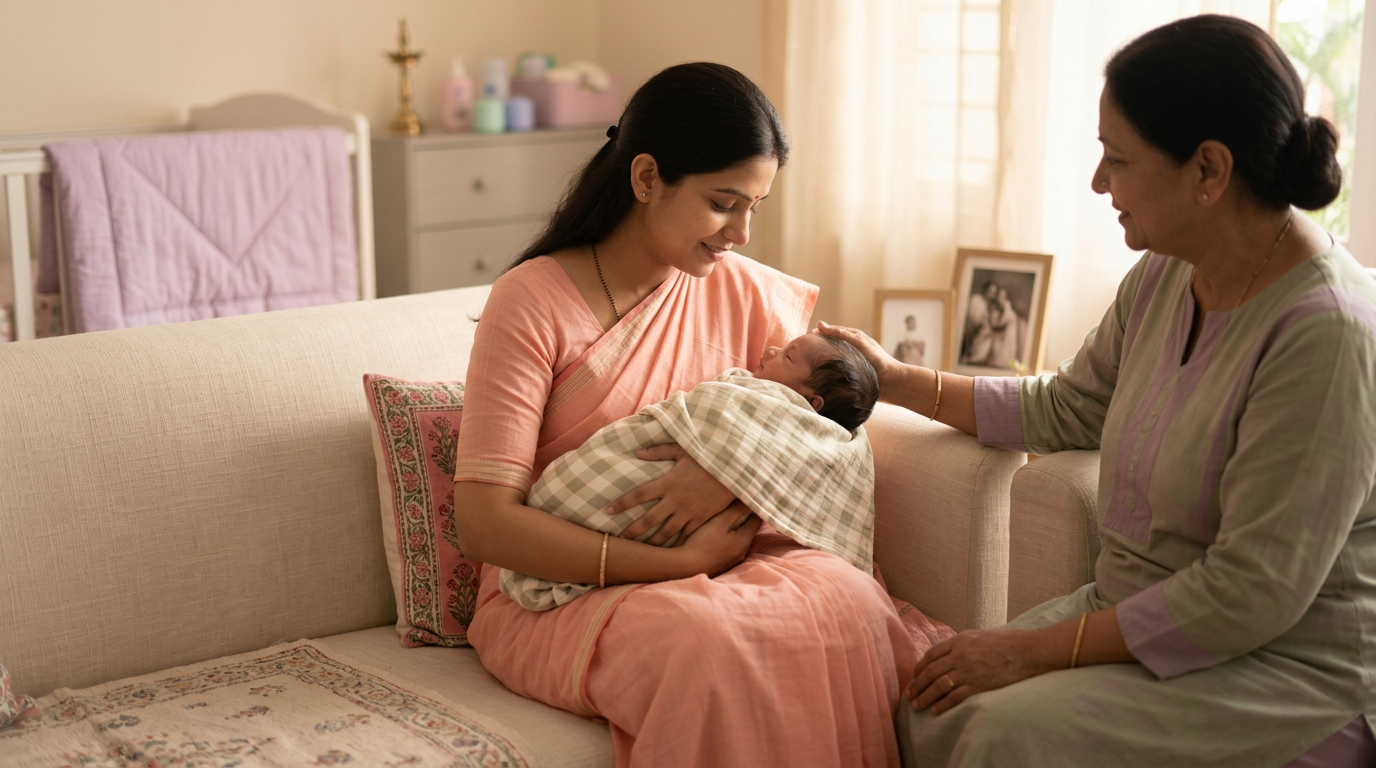
The postpartum meaning refers to the period immediately following childbirth, typically extending up to six weeks (the 42-day Jaappa or Sutak period), during which a mother’s body recovers from pregnancy and delivery. While many think it just means 'after birth,' it is a complex phase involve physical healing, hormonal shifts, and emotional adjustments. In medical terms, this is often called the puerperium, but for an Indian mom, it’s the time of maalish, gond ke ladoos, and finding her feet as a new parent.
What is the true postpartum meaning for Indian mothers?
In our culture, the postpartum meaning is deeply tied to the concept of confinement and rejuvenation. While Western medicine focuses on the six-week checkup, the Indian tradition of Sawa mahina (40 days) recognizes that the body takes time to return to its non-pregnant state.
During this time, your uterus (garbh) shrinks back to its original size, your hormones—which were at an all-time high—plummet, and your lactation journey begins. It is not just about the baby; it is about the "birth" of a mother.
The linguistics of recovery: Postpartum around India
Understanding this phase often depends on your linguistic roots. If you are searching for the postpartum meaning in hindi, you will likely come across terms like Prasav-pashchat (after delivery) or the more colloquial Sutak ka samay. If you are looking for the postpartum meaning in tamil, the focus is often on Prasava kaalam, a time dedicated to strict diet and rest.
The Three Stages of Postpartum Recovery
To truly grasp the postpartum meaning in english and medical science, we must break it down into three distinct phases as recognized by the Federation of Obstetric and Gynaecological Societies of India (FOGSI):
Physical Changes: What No One Tells You
The postpartum meaning isn't just about a "post-baby glow." It involves some gritty realities:
* Lochia: This is not a regular period. It’s the shedding of the uterine lining. It starts heavy (Stage 1) and tapers off. You’ll need heavy-duty maternity pads (brands like Nobel or Friends are popular in India) because traditional sanitary napkins may not suffice for the first week.
The "Pooping" Fear: If you had an episiotomy or a tear, your first bowel movement can feel terrifying. Indian diets rich in Khichdi* and clarified butter (ghee) help, but your doctor may prescribe a stool softener.
* Afterpains: As the uterus shrinks (involution), you might feel cramps that mimic early labour pains, especially while breastfeeding.
Engorgement: Around day 3 or 4, your milk "comes in." Your breasts may feel like two hard, hot stones. Proper latching, often guided by a Dai* or a lactation consultant, is key here.
The Indian Postpartum Diet: More than just Tradition
In India, the postpartum meaning is synonymous with specific foods designed to "warm" the body. The Indian Council of Medical Research (ICMR) notes that a lactating mother needs approximately 600 extra calories per day.
Galactagogues: Foods like Methi (fenugreek), Sauf (fennel), and Dalia* (broken wheat) are staples in Indian households to increase milk supply.
The Ghee Factor: While Sasu Maa might insist on putting ghee in everything, focus on healthy fats. A jar of homemade Gond ke Ladoo* can cost anywhere from ₹800 to ₹1,500 to make at home with quality dry fruits, and it provides the necessary energy for midnight feeds.
Hydration: Whether it’s Ajwain* water or plain warm water, staying hydrated is non-negotiable to prevent UTIs and constipation.
Real talk from Indian moms
> "I thought postpartum meaning just meant I'd be tired. I didn't realize I'd be crying over a dropped spoon because of the hormone crash. Once I accepted it was biological, I felt so much better." — Ananya, Mumbai, Mom to 4-month-old.
> "In my house, the postpartum meaning was the '40-day rule.' No kitchen work, lots of oil massages, and just bonding with my Ishaan. It felt restrictive but my body healed so fast." — Meenakshi, Chennai, Mom to 7-month-old.
When to call your paediatrician (and your OB-GYN)
While this is a natural phase, certain "Red Flags" require immediate medical intervention according to IAP (Indian Academy of Paediatrics) guidelines:
* For the Mother:
* Soaking more than one maternity pad in an hour (Haemorrhage).
* Fever over 100.4°F (Signs of infection or Mastitis).
* Severe headache or blurred vision (Postpartum Preeclampsia).
* Thoughts of harming yourself or the baby (Postpartum Psychosis).
* For the Baby:
* Yellowish skin or eyes (Jaundice).
* The umbilical cord stump looks red, swollen, or smells bad.
* Baby hasn't passed urine in 12-24 hours.
Frequently Asked Questions
What is the postpartum meaning in hindi?
In Hindi, the postpartum meaning is usually expressed as Prasavottar (प्रसवोत्तर), which literally translates to "after delivery." Families also refer to it as the Chilla or Sutak period, focusing on the 40 days of recovery and restricted movement for the mother.
What is the postpartum meaning in telugu?
The postpartum meaning in telugu is referred to as Purudu. This term encompasses the rituals, the specific diet (like Pathyam), and the period of seclusion meant to protect both the mother and the newborn from infections.
How long does the postpartum period actually last?
While the medical postpartum meaning focuses on the first 6 weeks, many health experts now refer to the "Fourth Trimester," which lasts 3 months. In reality, it takes about 9 to 12 months for a woman's nutrient stores and pelvic floor strength to fully recover.
Can men experience postpartum issues?
Yes. While they don't go through the physiological "postpartum meaning" of uterine healing, 1 in 10 Indian fathers experiences Paternal Postpartum Depression due to sleep deprivation and the pressure of new financial responsibilities.
Is postpartum the same as depression?
No. Postpartum is a time period. Postpartum Depression (PPD) is a medical condition that occurs during this period. Most women get the "Baby Blues" (short-term weepiness), but if the sadness lasts longer than two weeks, it is PPD.
You aren't just "recovering" from an event; you are rebuilding a whole new version of yourself. Take the maalish, eat the ladoos, and remember: a happy mother is the foundation of a happy baby.
I am doing my best, and my best is exactly what my baby needs.
Sources & further reading
- FOGSI: Postpartum Care Guidelines
- ICMR: Nutritional Requirements for Lactating Mothers
- IAP: Newborn and Maternal Health Red Flags
- NHP India: Postnatal Care
Written by Dr. Ritu Sharma, MD (Obstetrics & Gynaecology)
Reviewed by TheMamaCircle Editorial Team
Last updated: 13 July 2026
This article is for general information only and is not a substitute for personalised medical advice. Always consult your paediatrician or obstetrician for your specific situation.