When Do Babies Start Seeing and Hearing? India Parents Guide
When do babies start seeing and hearing? Learn the week-by-week timeline of newborn vision and hearing milestones, from blurry shapes to full-color HD sight.
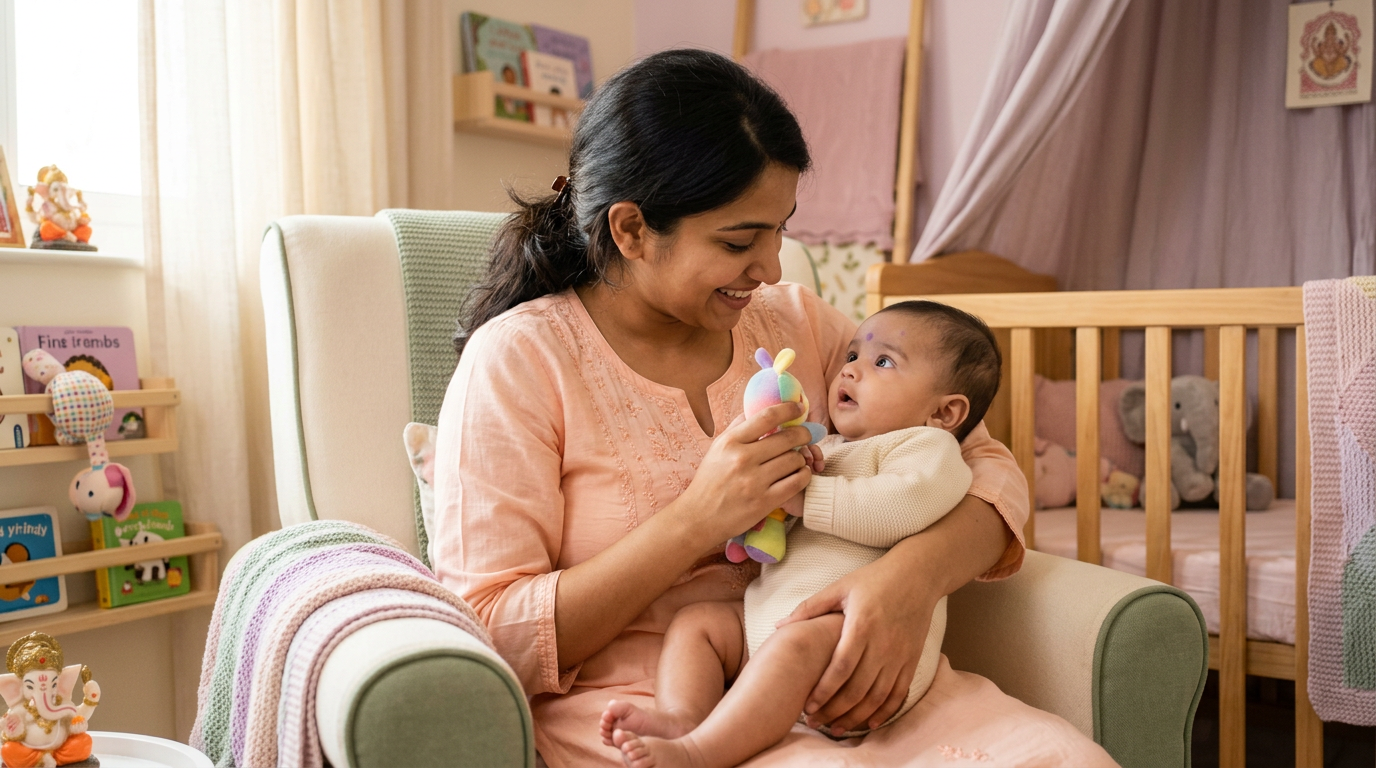
If you are staring at your bundle of joy and wondering if they can actually see your smile or hear your lullyabies, you aren't alone. When do babies start seeing and hearing? While their ears are fully functional at birth (having eavesdropped on your heartbeat for months), their vision is a work in progress. A newborn sees the world like a blurry, black-and-white Bollywood film from the 1950s, only being able to focus on things about 8 to 12 inches away—exactly the distance to your face during stanpaan (breastfeeding).
When do babies start seeing and hearing? The timeline of senses
The development of a baby’s senses is a rapid, fascinating process that begins long before you bring them home from the hospital. Understanding this timeline helps you engage with your little one in a way that supports their growing brain.
The Auditory Journey: Hearing from the Womb
Unlike sight, hearing is well-developed before birth. By the third trimester, your baby can hear the muffled sounds of your voice, the rhythmic thumping of your heart, and even loud noises outside the garbh (womb).
* At Birth: Your baby recognizes your voice immediately. They prefer high-pitched, melodic sounds—which is why "motherese" or baby talk comes so naturally to us.
0-2 Months: They will startle at loud noises (the dhak-dhak* of a pressure cooker whistle is a classic Indian household trigger).
4 Months: They begin looking for the source of a sound. If you shake a jhunjhuna* (rattle) to their side, they will turn their head.
* 6-7 Months: They start mimicking sounds and responding to their own name.
The Visual Journey: From Blur to HD
Can newborn babies see clearly? Not quite. At birth, their central vision is still developing, and their retinas aren't fully capable of distinguishing colours.* 0-1 Month: They see in shades of grey, black, and white. They love high-contrast patterns.
* 2-3 Months: This is a big leap. They start tracking moving objects and their eyes begin to work together.
* 5-8 Months: Depth perception kicks in. They start seeing the world in 3D and their newborn eye color might start to shift toward its permanent shade.
Understanding newborn vision: What they actually see
When we talk about newborn vision, we have to manage expectations. Your baby isn't ignoring the beautiful pastel nursery you decorated; they literally cannot see the light mint green walls yet.
Why High Contrast Matters
In the first few weeks, the nerve cells in their brain and eye aren't fully connected. This is why newborn vision examples often feature black-and-white cards. High-contrast images send the strongest visual signals to the baby’s brain, which helps stimulate optic nerve growth. You can see this in action using our baby vision simulator to understand how your baby perceives your face versus a toy.
The Face Preference
Babies are biologically hardwired to seek out human faces. The hairline, the eyes, and the mouth provide the exact type of high-contrast "map" their developing eyes can lock onto. When you are holding them, keep your face about 20-30 cm away. This is the "sweet spot" where their focus is sharpest during the early postnatal period.
Supporting sensory development at home
You don't need expensive imported gadgets to help your baby’s senses flourish. The Indian household is naturally sensory-rich.
* Visual Stimulation: Use black and white "flashcards." You can even draw simple shapes like a sun or a flower with a thick black marker on white paper. If you are looking for age-appropriate tools, many Montessori baby toys focus on these high-contrast basics.
Auditory Play: Singing traditional folk songs or loris* (lullabies) is excellent. The repetitive rhythms of Indian classical music or simple chants can be very soothing.
Tracking Exercises: Take a bright red pom-pom or a large, colorful bindi* on your forehead and move slowly from side to side to help them practice eye-tracking.
* Tummy Time: This isn't just for muscles. It changes their visual perspective of the floor and encourages them to look up and around. You can monitor their progress using a baby milestones tracker.
Cultural practices and eye health in India
In many Indian homes, there are long-standing traditions regarding a baby’s eyes. As a paediatrician, I often have to guide families on what is safe.
Kajal/Surma: While Dadi and Nani might insist that applying kajal makes the eyes larger or wards off the "evil eye," the Indian Academy of Paediatrics (IAP) strongly advises against it. Commercial kajal* can contain high levels of lead, and home-made versions can introduce bacteria, leading to conjunctivitis or blocked tear ducts.
* Sunlight (Piliya protection): While mild morning sunlight is often recommended for neonatal jaundice, ensure the baby’s eyes are shielded from direct, harsh glare.
* Maalish (Massage): During the body massage, be very gentle around the eye area. Avoid getting oil (like mustard or coconut oil) into the eyes, as it can cause irritation and redness.
Real talk from Indian moms
> "I spent so much money on a colorful mobile for the crib, but Ishaan only cared about the black-and-white newspaper my husband was reading! Once I realized he couldn't see the light blues and pinks yet, I switched to high-contrast cards and he was mesmerized."
> — Ananya S., Mumbai (Baby age: 3 months)
> "I was worried because Meera's eyes seemed to cross whenever she looked at me. My doctor told me it's normal for the first few weeks because their eye muscles are still learning to coordinate. By the time she was 4 months old, it straightened out perfectly."
> — Priya R., Bengaluru (Baby age: 6 months)
When to call your paediatrician: The Red Flags
While most babies follow a standard development path, keep an eye out for these signs that require a professional check-up with a paediatric ophthalmologist:
* Excessive Tearing: If the eyes are constantly watery or have a yellowish discharge (could be a blocked tear duct or infection).
* Extreme Light Sensitivity: If your baby seems in pain or closes their eyes tightly in normal indoor lighting.
* Persistent Squinting: While occasional eye-crossing is normal until 3-4 months, a constant inward or outward turn needs evaluation.
* White Pupil: If you notice a white, cloudy, or silvery glow in the pupil (the black part of the eye), especially in flash photography. This can be a sign of congenital cataracts or other serious conditions.
* No Tracking by 3 Months: If your baby does not follow a moving object or your face with their eyes by the end of the third month.
* Lack of Response to Sound: If your baby doesn't startle at loud noises or turn toward your voice by 4-5 months.
Frequently Asked Questions
Can newborn babies see their parents?
Yes, but not clearly. A newborn can see your face when you are holding them close, but the details are blurry. They recognize you more through your scent and the familiar sound of your voice than through clear visual identification in the first few weeks.
When do babies start seeing color?
Babies begin to distinguish colors around 2 to 3 months of age. Red is usually the first color they perceive, followed by green. Subtle shades like pastels (pinks and light blues) are the last to be recognized, usually closer to 5 months.
When does newborn eye color become permanent?
Most Indian babies are born with dark brown or greyish-black eyes. However, if a baby is born with lighter eyes, the permanent newborn eye color usually settles by 6 to 12 months as the melanin in the iris develops.
How can I tell if my newborn can hear me?
Most babies in India undergo a Universal Newborn Hearing Screening (UNHS) before leaving the hospital. At home, you can tell they hear you if they quiet down when you speak, startle at a door slamming, or eventually try to turn their head toward your voice.
Why do newborn babies have watery eyes?
Watery eyes are common in infants due to narrow or underdeveloped tear ducts. In India, we often see this exacerbated by dust or the application of kajal. If the watering is accompanied by pus or redness, consult your doctor.
What are some newborn vision examples of what they see?
At one week, a baby sees a world of blurred shapes and shadows. By two months, they can see your features but might not distinguish between a smile and a frown. By six months, they see with almost the same clarity and color depth as an adult.
The journey of sensory development is a marathon, not a sprint. Your baby is busy processing millions of new signals every day. While you wait for that first intentional "Mamma" or the first time they track a butterfly in the garden, remember that your presence—your voice, your face, and your touch—is the most important stimulus they have. Trust your instincts, avoid the kajal, and enjoy these blurry, beautiful early days.
You are exactly what your baby needs to see right now.
Sources & further reading
- Indian Academy of Paediatrics - Growth and Development
- National Health Portal India - Newborn Care
- AIIMS - Department of Pediatrics Sensory Guidelines
Written by Dr. Anjali Mehta, MBBS, DCH (Paediatrics)
Reviewed by TheMamaCircle Editorial Team
Last updated: 12 September 2026
This article is for general information only and is not a substitute for personalised medical advice. Always consult your paediatrician or obstetrician for your specific situation.