Baby Growth Chart India: WHO & IAP Weight Guide for Moms
Track your little one's milestones with our Indian baby growth chart. Learn about WHO percentiles, Indian baby weight chart in kg, and when to call your doctor.
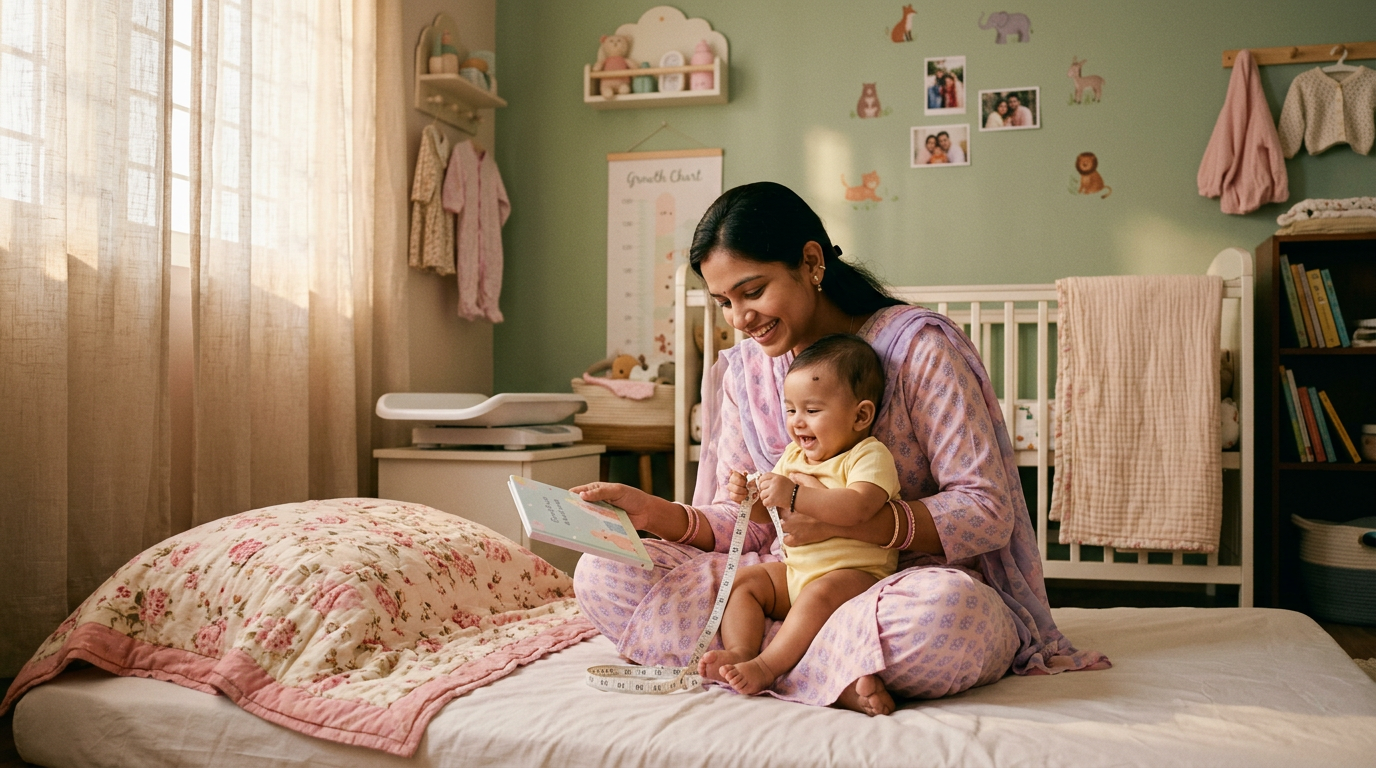
Is my baby growing well? It is the one question that keeps every Indian mama up at 3 AM. Whether you are wondering if your little one is getting enough malai from your milk or if that bowl of ragi porridge is doing its job, a baby growth chart is your best friend. In India, we use the WHO-standardised charts adapted by the Indian Academy of Paediatrics (IAP) to track weight, height, and head circumference. This guide helps you understand these numbers without the "neighbourhood aunty" pressure.
Understanding the WHO and IAP Baby Growth Chart for Indian Infants
In India, we don't just look at one number; we look at the trend. The baby growth chart ensures your baby is following their own unique curve. Unlike US-centric charts, the IAP charts account for the genetic diversity of Indian babies.
Most Indian paediatricians focus on three main metrics:
* Weight-for-age: To check for undernutrition or rapid gain.
* Height/Length-for-age: To ensure long-term linear growth.
* Head Circumference: Vital for monitoring brain development during the first 24 months.
The Role of Percentiles
When you see "50th percentile" on your baby growth chart, it doesn't mean your baby got a C-grade. It simply means that out of 100 healthy babies of the same age and gender, 50 weigh more and 50 weigh less. As long as your baby stays consistently near their 'line'—whether it’s the 15th or the 85th—they are thriving.
Month-by-Month Weight Milestones: What to Expect?
The first year is a whirlwind of growth. While fluctuations happen, especially during growth spurts or after a round of vaccinations, here is the general trajectory for an indian baby weight chart in kg.
The First Quarter (0-3 Months)
Newborns often lose about 7-10% of their birth weight in the first week. Don’t panic! This is just extra fluid. By day 10, they should be back to birth weight.
* Weight Gain: Expect a gain of about 800g to 1kg per month.
* The Milestones: By the 3 month baby weight check, most babies have filled out those initial skin folds and started developing a "double chin."
The Second Quarter (4-6 Months)
This is the era of the "rolling over" workout.
* Double the Weight: A standard rule of thumb in Indian paediatrics (per IAP guidelines) is that a baby should double their birth weight by 5-6 months.
Nutrition: Whether it’s stanpaan* (breastfeeding) or formula, growth remains rapid here.
Growth and Nutrition: Fueling the Chart
In India, the introduction of solids (Annaprashan) usually happens around 6 months. To keep that baby growth chart trending upwards, focus on energy-dense local foods.
* Ragi (Finger Millet): High in calcium and iron, essential for bone growth. A 500g pack of organic ragi flour usually costs ₹90–₹150.
Homemade Ghee: A teaspoon of shuddh desi ghee* in khichdi provides the healthy fats required for brain development.
* Moong Dal Khichdi: The gold standard for protein-first weaning.
The Importance of Maalish
Don't underestimate the power of the traditional maalish (massage). Studies cited by AIIMS suggest that daily oil massage using coconut or sesame oil not only improves skin barrier function but can also promote steady weight gain in infants through improved circulation and sleep patterns.
Why We Use the IAP Chart Instead of Western Versions
If you use a generic app from a US developer, you might see "red flags" that aren't actually there. Indian babies often have different growth velocities compared to Caucasian babies. The IAP (Indian Academy of Paediatrics) revised its growth charts in 2015 to better reflect the nutritional transition in India, helping identify both stunting and childhood obesity early.
Real Talk from Indian Moms
> "I spent the first four months crying because my MIL said my daughter looked 'kamzor' (weak). But my doctor showed me the baby growth chart and she was perfectly on the 50th percentile. The chart saved my sanity!"
> — Ridhima S., Mumbai, Mom to 8-month-old Navya
> "After our bout with teething, his weight dropped. I panicked, but checking the weight chart for kids helped me see that his height was still increasing. It’s about the whole picture, not just the fat rolls."
> — Ananya P., Bengaluru, Mom to 14-month-old Ishaan
When to Call Your Paediatrician: Red Flags
While we love a "chubby" baby in India, health isn't measured by the number of thigh rolls. You should contact your doctor if:
* Your baby crosses two major percentile lines (downward) on the chart.
* There is no weight gain for two consecutive months in the first year.
* The baby's head circumference stops growing or increases too suddenly.
* Your baby seems lethargic, has fewer than 6 wet nappies a day, or misses major motor milestones (like neck holding by 4 months).
* The baby consistently flags in the "Orange" or "Red" zones of the WHO/IAP chart provided in your vaccination booklet.
How to use a Digital Baby Growth Chart at Home
While your doctor takes precise measurements during vaccination visits, you can track trends at home.
Frequently Asked Questions
What is the normal baby growth chart for Indian babies?
The normal chart follows the WHO Multicentre Growth Reference Study (MGRS) standards, which have been adopted by the Ministry of Health and Family Welfare (MoHFW) and the IAP. It tracks weight, height, and BMI to ensure a child is not undernourished or overweight for their age.
How much should be a 3 month baby weight?
In general, the 3 month baby weight for an Indian boy is approximately 6.4 kg and for a girl is about 5.8 kg, according to WHO 50th percentile standards. However, a range of 5 kg to 8 kg can be normal depending on the birth weight.
Can I use a weight chart for kids to track my toddler?
Yes, the weight chart for kids extends up to age 18. For toddlers (1-3 years), the focus shifts slightly towards BMI (Body Mass Index) to ensure that the rapid introduction of family foods doesn't lead to early childhood obesity.
Why is my baby's weight gain slow after 6 months?
Growth often slows down once a baby becomes mobile. Once they start crawling—and eventually walking—they burn significantly more calories. As long as they are reaching milestones and staying on their baby growth chart curve, a slight dip is usually normal.
Does "Indian baby weight chart in kg" differ for breastfed vs formula-fed babies?
Breastfed babies often gain weight more rapidly in the first 2-3 months and then more slowly than formula-fed babies from 6-12 months. The indian baby weight chart in kg currently used is based on the "Gold Standard" of the breastfed infant.
What if my baby is below the 3rd percentile?
Being below the 3rd percentile is a signal for your paediatrician to investigate further. It may be perfectly normal due to genetics (small parents), or it could indicate a need for nutritional intervention or screening for underlying issues like reflux or malabsorption.
Remember, mama: your baby is a human being, not a data point. Use the baby growth chart as a compass, not a verdict. As long as they are active, peeing well, and reaching for your dupatta with a smile, you are doing a great job.
My baby is healthy, my baby is strong, and we are growing together.
Sources & further reading
- Indian Academy of Paediatrics (IAP) Growth Charts
- WHO Child Growth Standards
- All India Institute of Medical Sciences (AIIMS) - Newborn Care
- Indian Council of Medical Research (ICMR) - Nutrient Requirements
Written by Dr. Anjali Mehta, MBBS, DCH (Paediatrics)
Reviewed by TheMamaCircle Editorial Team
Last updated: 20 June 2026
This article is for general information only and is not a substitute for personalised medical advice. Always consult your paediatrician or obstetrician for your specific situation.