Baby Toys India Guide: Best Age-Wise Learning Toys & Safety
Looking for the best baby toys in India? Our guide covers age-wise learning toys, BIS safety marks, and traditional desi picks for your little one's growth.
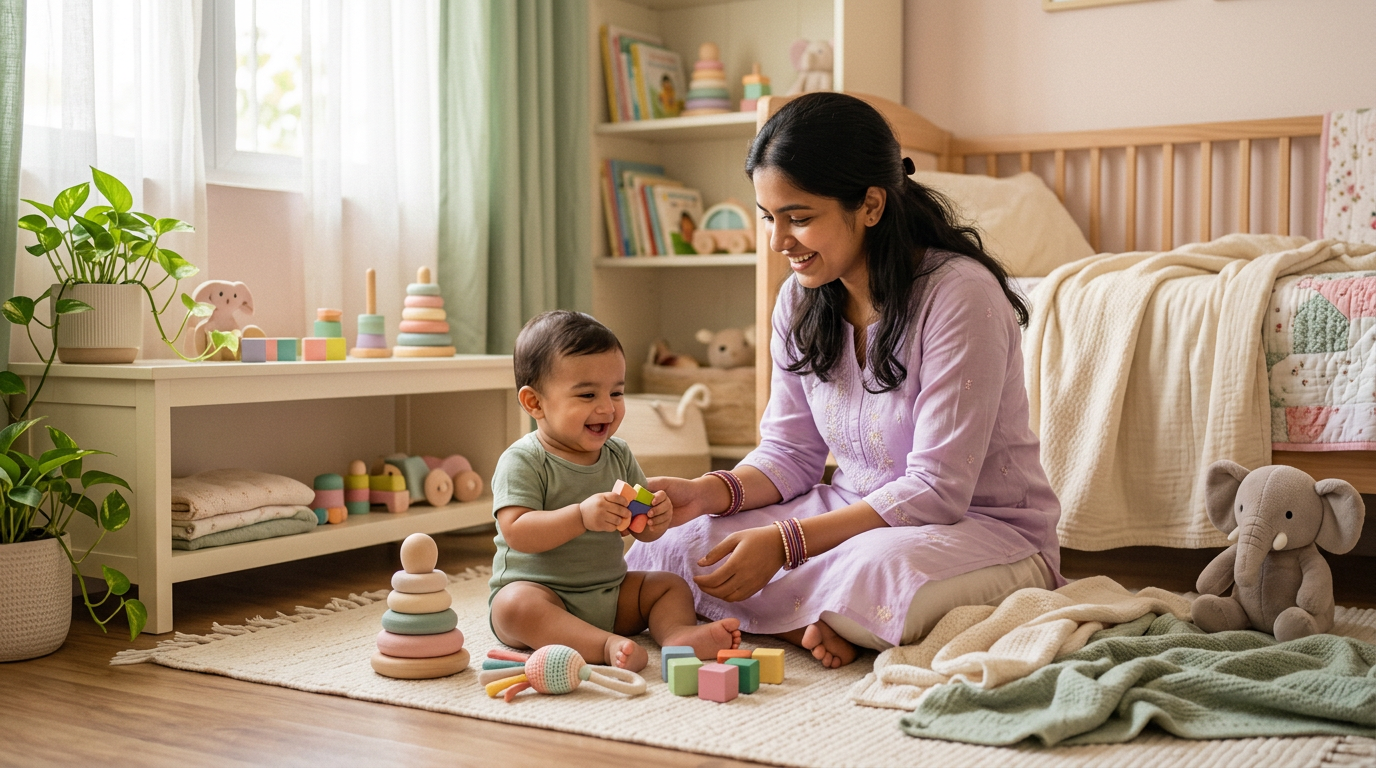
Choosing the right baby toys in India is no longer just about picking the brightest rattle from the local kirana store or the flashiest plastic piano online. It is about matching the toy to your baby’s rapidly developing brain and motor skills while ensuring every item meets Indian safety standards like the BIS (IS 9873) mark. From the jhunjhuna that captures a newborn's attention to the sophisticated wooden puzzles for toddlers, the right playthings act as the "work" of childhood, helping your little one reach crucial baby milestones tracker.
What are the safest baby toys for newborns (0-3 Months)?
During the first three months, your baby is transitioning from the garbh (womb) to the big, bright world. Their vision is still developing—initially, they can only see about 8 to 12 inches away, roughly the distance to your face during stanpaan (breastfeeding).
Essential Playthings for the First Quarter:
* High-Contrast Flashcards: Look for black, white, and red patterns. Because their retinas aren't fully developed, these high-contrast images are the only things they can truly focus on. You can even use a baby vision simulator to understand exactly how they perceive these patterns.
* Soft Wrist Rattles: Since newborns have little grip, velcro wrist rattles encourage them to move their arms and discover that their limbs belong to them!
* Unbreakable Mirrors: Babies are narcissistic in the cutest way possible. They love looking at "the other baby" in the mirror, which builds self-awareness.
The "Desi" DIY Special: A simple stainless steel katori* and spoon. While they won't hold it yet, the gentle "clink" sound helps with auditory tracking.
Why do you need specific toys for 6 month old baby stages?
Around the half-year mark, everything changes. Your baby is likely sitting up with support, rolling over, and—the biggest challenge for Indian moms—putting everything in their mouth. This is the peak of the oral exploration phase. When looking for toys for 6 month old baby, safety and "chew-ability" are your top priorities.
Best Picks for 6-12 Months:
Silicone Teethers: Move over local plastic rings; look for BPA-free, food-grade silicone teethers. Brands like Shumee or Ariro* offer great neem wood alternatives that are traditional and safe.
* Stacking Rings: These teach size differentiation and hand-eye coordination.
* Textured Ball Sets: Different textures (bumpy, smooth, squishy) stimulate the somatosensory cortex in the brain.
* Activity Cubes: These are excellent baby learning toys that keep them engaged during supervised floor time, helping them strengthen their core. If you are worried about your own core recovery after birth, checking for a free diastasis recti self-check can help you stay mobile enough to play on the floor with them.
The Shift to Baby Learning Toys for 12-18 Months
Once your baby crosses the one-year mark, they are no longer just observing; they are experimenting. They want to know "What happens if I drop this?" (Usually, it means Mummy picks it up!). This is the stage for baby learning toys that encourage problem-solving and cause-and-effect.
Cognitive and Motor Boosters:
* Shape Sorters: A classic for a reason. It builds spatial awareness and persistence.
Push Toys: Whether it’s a modern wooden walker or the traditional Gaadi* (wooden cart), these provide the stability needed for those first wobbly steps.
Kitchen Play Sets: Indian toddlers love mimicking their Dadi in the kitchen. Small, blunt wooden sets of belan (rolling pin) and tawa* are massive hits.
Musical Instruments: Small dholaks*, xylophones, or maracas help develop a sense of rhythm and auditory discrimination.
Choosing between baby girl toys and baby boy toys: Does it matter?
In many Indian households, there is a traditional tilt towards buying dolls for girls and cars for boys. However, from a paediatric perspective, baby girl toys and baby boy toys should be one and the same in the early years.
Both boys and girls need dolls to develop empathy and fine motor skills (buttoning doll clothes). Both need trucks and blocks to develop spatial reasoning and physics intuition. Instead of gender-coding, focus on Montessori baby toys that focus on natural materials and open-ended play. Whether you are shopping for baby boy toys or baby girl toys, the goal remains the same: cognitive stimulation without overstimulation.
Safety Standards and Maintenance in the Indian Climate
In India, we deal with high humidity and dust, which makes toy maintenance a health priority.
Real talk from Indian moms
"I spent 2000 Rupees on a fancy musical gym, but my 8-month-old preferred playing with my steel dabba and a plastic whisk. Now I focus on open-ended wooden blocks that actually grow with him." — Sneha, Mumbai, Mom to 10-month-old Kabir.
"We live in a joint family, so everyone buys toys. I had to make a rule: only BIS-certified toys or cotton soft toys. The cheap plastic ones from the local fair smell like chemicals and the edges are so sharp!" — Priyanka, Bengaluru, Mom to 14-month-old Ishani.
When to call your paediatrician
While play is fun, it is also a diagnostic tool. Contact your doctor if:
* Your 3-month-old does not track a moving toy with their eyes.
* Your 6-month-old does not reach for toys or bring them to their mouth.
* Your 9-month-old shows no interest in "social" toys (like Peek-a-boo).
* Your baby consistently ignores loud noises made by musical toys.
* Emergency: If your baby swallows a small toy part, a button battery, or a magnet, head to the ER immediately.
Frequently Asked Questions
What are the best baby learning toys for a 1-year-old?
The best learning toys at this age are those that encourage "open-ended" play. Wooden blocks, large peg puzzles, and stackable cups are excellent. These help with fine motor skills and spatial awareness. In India, look for brands that use vegetable dyes and sustainable wood to ensure they are non-toxic.
Are wooden baby toys better than plastic ones?
Generally, yes. High-quality wooden toys are more durable, eco-friendly, and lack the harmful phthalates often found in cheap plastic. They also provide a different sensory experience (weight and texture) compared to plastic. Ensure they are finished smoothly to avoid splinters.
How many baby toys does a child actually need?
Less is more! Overloading a child with too many toys can lead to "choice paralysis" and shorter attention spans. A good rule of thumb is the "Toy Rotation" method—keep only 4-5 toys out at a time and swap them every two weeks to keep the novelty alive.
What should I look for in toys for 6 month old baby safety?
Safety is paramount. Ensure the toy is larger than the inside of a toilet paper roll to prevent choking. Check for the BIS mark, ensure there are no long strings (longer than 7 inches) that could cause strangulation, and verify that the paint is lead-free.
Where can I find traditional Indian baby toys?
Traditional toys like Channapatna (from Karnataka) or Kondapalli (from Andhra Pradesh) are fantastic. They are usually made of wood, use natural dyes, and have been staples in Indian nurseries for generations. They are excellent for motor development and cultural connection.
Can I give my baby soft toys to sleep with?
No. According to safe sleep guidelines (AAP and IAP), soft toys, pillows, and heavy blankets should be kept out of the crib until the baby is at least 12 months old to prevent the risk of SIDS or suffocation. Keep the soft toys for supervised playtime only.
Play is the foundation of your baby's future. By choosing age-appropriate, safe, and stimulating items, you aren't just buying "things"—you are building their brain, one rattle at a time. Remember, the best toy your baby has is you. Enjoy these floor-time moments, Mama; they grow up faster than a blink.
I am doing my best, and my baby is thriving through play.
Sources & further reading
- Indian Academy of Pediatrics (IAP) Guidelines on Play
- Bureau of Indian Standards (BIS) Toy Safety Norms
- WHO: Towards a Healthier Future - Play and Development
Written by Dr. Anjali Mehta, MBBS, DCH (Paediatrics)
Reviewed by TheMamaCircle Editorial Team
Last updated: 6 September 2026
This article is for general information only and is not a substitute for personalised medical advice. Always consult your paediatrician or obstetrician for your specific situation.