Brain development activities for babies: An Indian Mom's
Boost your baby's IQ with simple brain development activities for babies. Use sensory play and tummy time at home to spark lifelong learning. Start today!
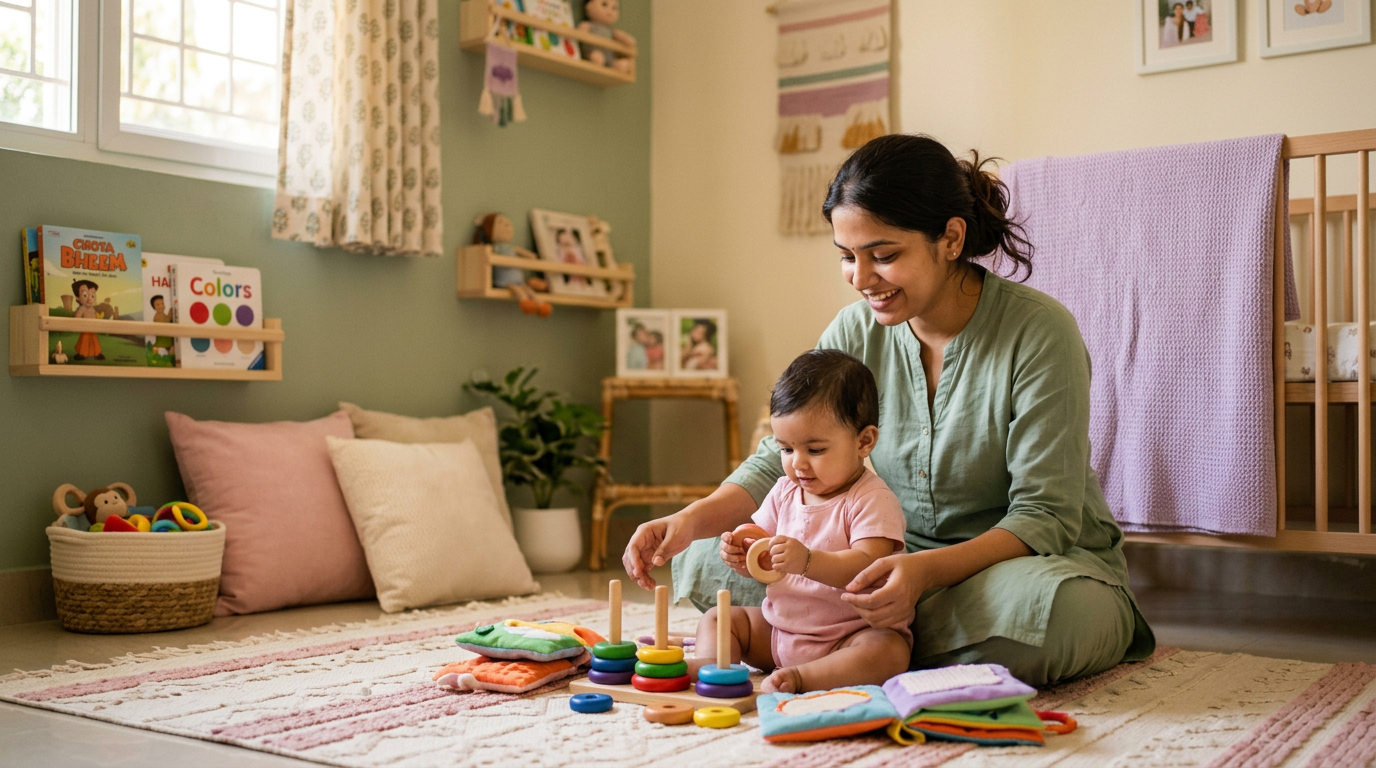
Brain development activities for babies aren't about buying expensive imported toys or subscribing to high-end flashcard apps. In fact, the most effective ways to boost your little one's cognitive growth happen right in your Indian kitchen or living room. By focusing on sensory stimulation, responsive interaction, and tummy time, you help build the neural pathways that form the foundation for lifelong learning.
During the postnatal period (also called postnatal), your baby's brain is like a sponge, doubling in size by their first birthday. You don’t need a PhD in child development to help them; you just need a few minutes of intentional play every day.
Why Brain Development Activities for Babies Start at Home
The Indian Academy of Paediatrics (IAP) emphasizes that the first 1,000 days are critical for neurodevelopment. While many parents feel pressured to buy "educational" battery-operated gadgets, the truth is that your face, your voice, and simple household objects provide better stimulation.
When you engage in brain development activities for babies, you are encouraging "synaptogenesis"—the formation of connections between neurons. In a typical Indian 2BHK, you have everything you need to spark this growth. Whether it’s the sound of a steel katori clinking or the texture of a cotton dupatta, these everyday sensations are high-octane fuel for a developing mind.
0–3 Months: The Power of Sight and Sound
At this stage, your baby’s world is a bit blurry, but their hearing is acute. They are hardwired to seek out human faces, especially yours.
Visual Tracking with High Contrast
Newborns see best in high contrast. You don't need fancy cards; just take a white piece of paper and draw thick black circles or triangles with a marker.
* The Activity: Move the paper slowly from left to right about 10-12 inches from their face.
* Skill Built: Strengthening eye muscles and visual tracking.
* Mama Tip: Use a baby vision simulator to understand exactly what your little one sees during these early months.
The "Steel Vessel" Symphony
Traditional Indian kitchens are a goldmine for sensory play for babies.
* The Activity: Gently clink a steel spoon against a steel glass behind the baby (out of sight) to see if they turn their head toward the sound.
* Skill Built: Auditory localization and cause-and-effect.
* Caution: Ensure the sound isn't too loud to startle them into crying. If they do cry, check our AI cry analyzer to see if it's fear or just overstimulation.
3–6 Months: Reaching and Rolling
This is the golden age of tummy time activities. As their neck grows stronger, their perspective of the world shifts.
Dupatta Peek-a-Boo
Forget the expensive "silk play scarves" you see on Instagram. Use a soft, breathable malmal dupatta or a cotton saree pallu.
* The Activity: Drape the cloth over your head and say "Kahaan hai Mumma?" then reveal yourself with a cheerful "Peek-a-boo!" or "Bhooo!"
* Skill Built: Object permanence—understanding that things (and people) exist even when they can't be seen.
The Mirror Gaze
Babies are fascinated by other babies, even if that baby is just their own reflection.
* The Activity: Place a floor-safe mirror in front of them during tummy time. Watch them try to "talk" to or touch the "other" baby.
* Skill Built: Self-awareness and social-emotional development.
6–12 Months: Tactile Exploration and Fine Motor Skills
Once your baby starts sitting up and eating solids, the world of activities for babies expands significantly.
The Atta Dough Discovery
Instead of store-bought playdough that might contain chemicals, use edible atta (whole wheat dough).
* The Activity: Give them a small ball of soft, non-sticky dough. Let them squish, poke, and pull it.
* Skill Built: Fine motor skills and hand-eye coordination.
* India-Specific Detail: Ensure the dough is fresh and you supervise closely to avoid a choking hazard if they decide to take a massive bite!
Sticky Note Peel
If you have a cupboard or a low wall, stick 5-6 colorful sticky notes just within their reach.
* The Activity: Encourage them to reach out and peel the notes off.
* Skill Built: Pincer grasp (using thumb and forefinger) and shoulder stability.
Setting Up a Sensory Bin the Indian Way
Sensory bins are a staple of indoor activities for toddlers, but they can start earlier with supervision.
Note: This activity requires 100% eyes-on supervision to prevent choking.
Real talk from Indian moms
"I used to feel guilty that I didn't have a Montessori playroom. Then I realized my 8-month-old spent 20 minutes just trying to put a plastic lid on a Dahi container. That was his 'work' for the day!" — Pooja R., Bengaluru, Mom to 9-month-old Kabir.
"We do 'Kitchen Disco' every evening. I put on some old Bollywood hits, hold Advait, and dance. He loves the rhythm and the change in my voice when I sing along. It's our favorite brain-boosting ritual." — Meera S., Delhi, Mom to 5-month-old Advait.
"Don't underestimate the power of a cardboard box from your latest BigBasket or Amazon delivery. My daughter spent three days just crawling in and out of a box. Best 0-rupee toy ever." — Ananya K., Mumbai, Mom to 11-month-old Zoya.
When to call your paediatrician
While every baby develops at their own pace, keep an eye out for these red flags regarding brain development and milestones:
* Does not track moving objects with eyes by 3-4 months.
* Does not respond to loud sounds or the mother’s voice.
* Does not reach for or grasp toys by 6 months.
* Shows a significant loss of skills they previously had.
* Seems unusually stiff or unusually "floppy."
If you notice any of these, consult your paediatrician. You can also monitor physical growth using a baby growth chart and document milestones in a baby milestones tracker.
Frequently Asked Questions
What are the best brain development activities for babies under 6 months?
For infants, the best activities involve "serve and return" interactions. This means responding to their coos, making eye contact, and narrating your day. Visual stimulation with high-contrast images and daily tummy time activities are also vital for building the physical strength needed for cognitive exploration.
How often should I do sensory play for babies?
Sensory play doesn't need to be a scheduled "class." You can integrate sensory play for babies into daily routines—like letting them feel the water during a bath or touching the cool skin of a cucumber while you prep salad. 10-15 minutes of focused sensory exploration twice a day is plenty.
Are there specific indoor activities for toddlers that help with speech?
Yes! Reading aloud from picture books, singing nursery rhymes (like "Machhli Jal Ki Rani Hai"), and describing everything you are doing ("Now Mumma is putting on your blue socks") are excellent indoor activities for toddlers to boost vocabulary and language processing.
Can activities for babies help with colic or fussiness?
While play won't cure colic, gentle rhythmic activities like swaying or "bicycle legs" can help with gas. If your baby is crying excessively, use an AI cry analyzer to help distinguish between a hunger cry and a sensory overload cry.
Do I need to buy expensive toys for brain development?
Absolutely not. The Bureau of Indian Standards (BIS) regulates toy safety, but the best "toys" aren't toys at all. A bunch of safe steel keys, a plastic bottle filled with colorful lentils (sealed shut!), and your own smiling face are the most effective tools for activities for babies.
Spending time on brain development activities for babies is the best investment you can make in their future. It doesn't require a huge budget or a sprawling bungalow—just your presence, a bit of atta, and a lot of love. You are doing a great job, Mama.
Repeat after me: "My presence is my baby's favorite toy."
Sources & further reading
- Indian Academy of Pediatrics - Early Childhood Development
- WHO Guidelines on Physical Activity, Sedentary Behaviour and Sleep for Children under 5 Years of Age
- ICMR-NIN Dietary Guidelines and Child Care
Written by Dr. Anjali Mehta, MBBS, DCH (Paediatrics)
Reviewed by TheMamaCircle Editorial Team
Last updated: 12 September 2026
This article is for general information only and is not a substitute for personalised medical advice. Always consult your paediatrician or obstetrician for your specific situation.