Life Skills for Children: 22+ Fun Games & Chores (India
Teach life skills for children through fun Indian games! From folding dupattas to kirana shop math, learn age-appropriate chores for kids to build confidence.
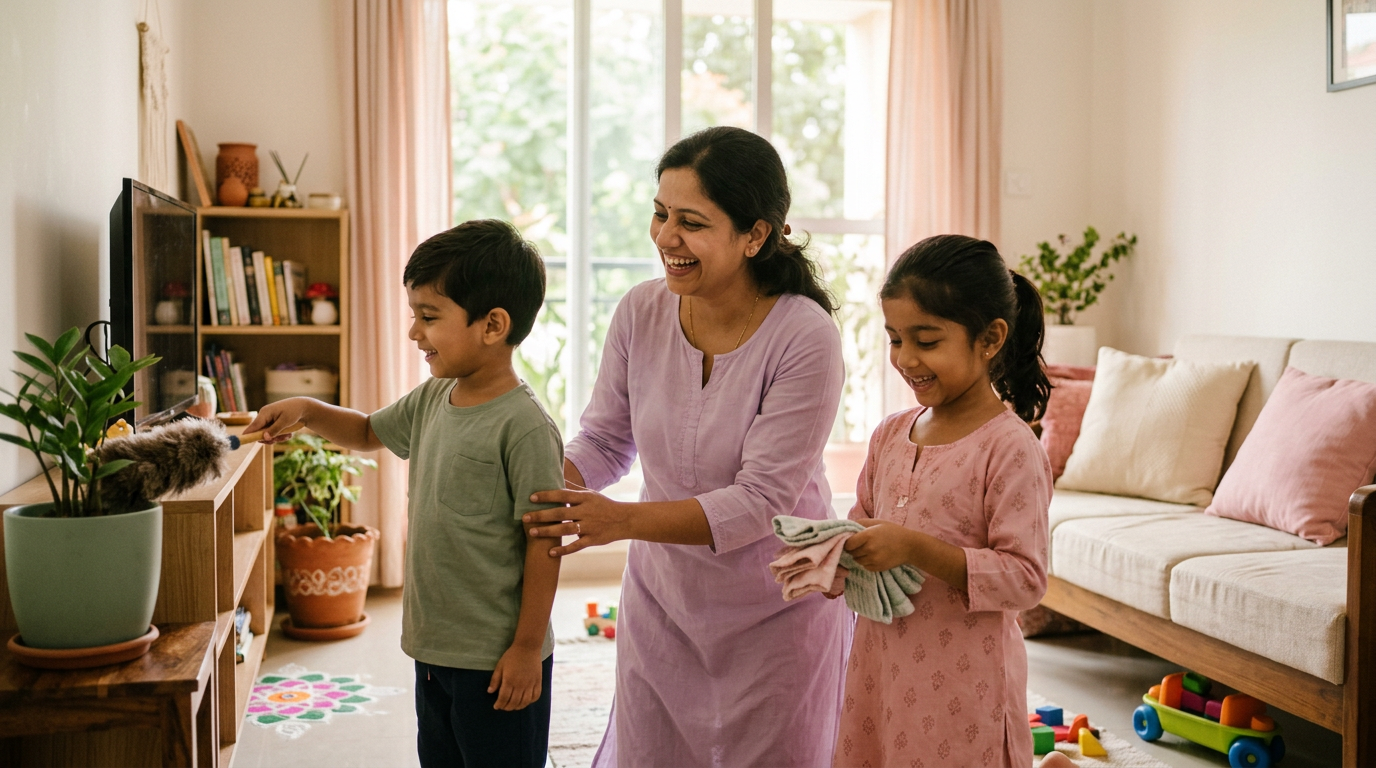
Teaching life skills for children isn’t about preparing them for adulthood in twenty years; it is about empowering them to feel capable in their own home today. In the Indian context, we often over-function for our kids—peeling their oranges and packing their bags until they are in college—but true confidence comes from "doing." By integrating age-appropriate tasks into daily play, you help your child develop independence, executive function, and the "can-do" spirit that defines a resilient human being.
Why Life Skills for Children Matter in the Indian Household
In many Indian homes, we have the luxury of help or the presence of grandparents who love to dote. While this is a blessing, it can inadvertently delay the development of life skills for children. According to the Indian Academy of Paediatrics (IAP), fostering autonomy early on is linked to higher self-esteem and better problem-solving skills in the primary school years.
When a child learns to pour their own glass of water or help set the dastarkhwan (dining mat), they aren't just doing a chore; they are learning physics, motor control, and social responsibility. It turns the home from a service center into a learning lab.
The Montessori Connection: Practical Life Skills
If you’ve explored montessori practical life activities, you know that the "Practical Life" corner is the heart of the classroom. These activities are designed to help children gain control in the coordination of their movement and gain independence.
For an Indian mom, this doesn't require expensive wooden toys. It looks like:
Transferring grains: Giving your toddler two bowls and a spoon to move sabut moong dal or chana* from one to the other.
* Care of the environment: Handing them a damp cloth to wipe the dust off the lower shelves of the TV unit.
Self-care: Teaching them to pull up their own pyjamas* or put their slippers on the right feet.
Age-Wise Life Skills for Kids: The Roadmap
Teaching life skills for kids works best when the task matches their developmental stage. Pushing a 2-year-old to fold a heavy cotton bedsheet will only lead to frustration, but letting them "wash" their plastic toys in a bucket of soapy water is pure magic.
Ages 2 to 3: The "I Do It" Phase
* Pouring Dal: Use a small jug to pour dry grains into a bowl. This builds the wrist stability needed for writing later.
* The Slipper Match: Putting slippers in the shoe rack. Bonus points for identifying which one is 'left' and 'right.'
Vegetable Sorting: After a trip to the sabzi mandi, let them sort the bhindi (okra) from the tamatar* (tomatoes).
* Wiping Spills: When they drop their milk, give them a small rag. No scolding, just "Let's clean it up together."
Ages 4 to 5: The Eager Assistant
Folding Small Clothes: Start with handkerchiefs and small dupattas*. This is one of the most effective life skills activities for hand-eye coordination.
* Setting the Table: Placing steel plates and spoons for dinner.
Watering Plants: Using a small mug or watering can to hydrate the Tulsi* or aloe vera on the balcony.
* Basic Hygiene: Brushing teeth independently (with a quick "quality check" by you) and washing hands with soap for 20 seconds. You can track their growth and physical development using our baby growth chart to see how their motor skills align with their age.
Ages 6 to 7: The Independent Navigator
* Kirana Shop Math: Give them ₹50 and ask them to buy a packet of Marie biscuits. Let them handle the exchange and check the change.
* Packing the School Bag: Checking their timetable and ensuring the right notebooks and pencil box are inside.
Basic Food Prep: Tearing lettuce for a salad, peeling a boiled egg, or spreading butter on pav*.
* Personal Information: Knowing their full name, parents’ phone numbers, and their home landmark (e.g., "Near the Mother Dairy booth").
Turning Chores into Games
Kids hate the word "work," but they love a challenge. To get them involved in age appropriate chores for kids, you need to gamify the process.
Indian Safety Scripts Every Child Needs
In India, "stranger danger" is a bit complex because we are a social culture where talking to "uncles" and "aunties" is expected. Instead of fear, teach scripts:
* The Secret Code: Have a family password. If someone says, "Mummy sent me to pick you up," the child asks for the password.
* Body Boundaries: Use the correct names for body parts. If your child is younger, you can use our baby milestones tracker to see when they should be able to identify these parts.
* Emergency Contact: Teach them how to dial '100' or your number on a locked phone (using the emergency call feature).
Real Talk from Indian Moms
"My 4-year-old daughter, Ananya, used to scream when I tried to brush her hair. I started a 'Beauty Parlour' game where she 'charges' me ₹10 (pretend play) to brush my hair, and then it's my turn. Now she does it herself!" — Sunita, Mumbai, Mom to 4yo
"In our house in Bengaluru, we have a 'Dal Sorting' station. Whenever I'm cooking, Ishaan (3) sits on his high chair and separates the green moong from the yellow moong. It keeps him busy for 20 minutes and he feels like he's 'helping Mamma make dinner'." — Deepa, Bengaluru, Mom to 3yo
When to Call Your Paediatrician
While every child develops at their own pace, there are times when a delay in learning life skills might point to a developmental need. Contact your doctor if:
* Your child is 3 and cannot hold a spoon or small cup without significant spilling.
* They show extreme distress or sensory meltdown when their hands get "dirty" (with flour, water, or sand).
* They are 4 and cannot follow a simple two-step instruction (e.g., "Pick up the toy and put it in the box").
* You notice a sudden loss of skills they previously mastered (regression).
* They lack interest in imitating adult actions by age 2.
Frequently Asked Questions
What are the most important life skills for children to learn first?
The most critical early skills are self-care (feeding, dressing) and safety (knowing their name, avoiding hot surfaces). In the Indian context, learning to eat with hands or a spoon independently is a major milestone that builds confidence.
How do I introduce life skills for kids without making it feel like work?
Integration is key. Don't set a "chore time." Instead, invite them into your world. Say, "I need help sorting these onions," rather than "Go do your chores." Use praise that focuses on the effort: "You worked so hard to get all the water into the bucket!"
What are some simple life skills activities for a 3-year-old?
Start with "Transferring" (moving objects from one container to another), "Wiping" (cleaning their own table space), and "Self-dressing" (pulling up pants). You can also involve them in puja prep, like picking petals for a rangoli.
What are considered age appropriate chores for kids in a typical Indian home?
Typical chores include putting away steel utensils, folding dupattas or small towels, filling water bottles (using a funnel), and keeping their shoes in the rack. For older kids (6+), clearing their plate after a meal is a non-negotiable skill.
How do montessori practical life activities help with school readiness?
These activities build "Executive Function." When a child follows the steps to wash a dish—soaping, scrubbing, rinsing, drying—they are training their brain to sequence tasks, focus, and complete a cycle, which is exactly what they need for academic learning.
Teaching your child to navigate life is the greatest gift you can give them. It takes patience—yes, it is faster to just tie their laces yourself—but the look of pride on their face when they say, "Mamma, look! I did it!" is worth every extra minute. You are raising a capable human, one small task at a time.
Mera bachcha khud kar lega. (My child will do it themselves.)
Sources & further reading
- Indian Academy of Pediatrics - Growth and Development
- NIN - Nutrition and Lifestyle for Children
- WHO - Child development and early learning
Written by Dr. Anjali Mehta, MBBS, DCH (Paediatrics)
Reviewed by TheMamaCircle Editorial Team
Last updated: 11 September 2026
This article is for general information only and is not a substitute for personalised medical advice. Always consult your paediatrician or obstetrician for your specific situation.