Life Skills for Kids: The Ultimate Indian Guide & Games
Teach essential life skills for kids through fun Indian games like 'Kirana Shop.' From Montessori tasks to age-appropriate chores, empower your child today!
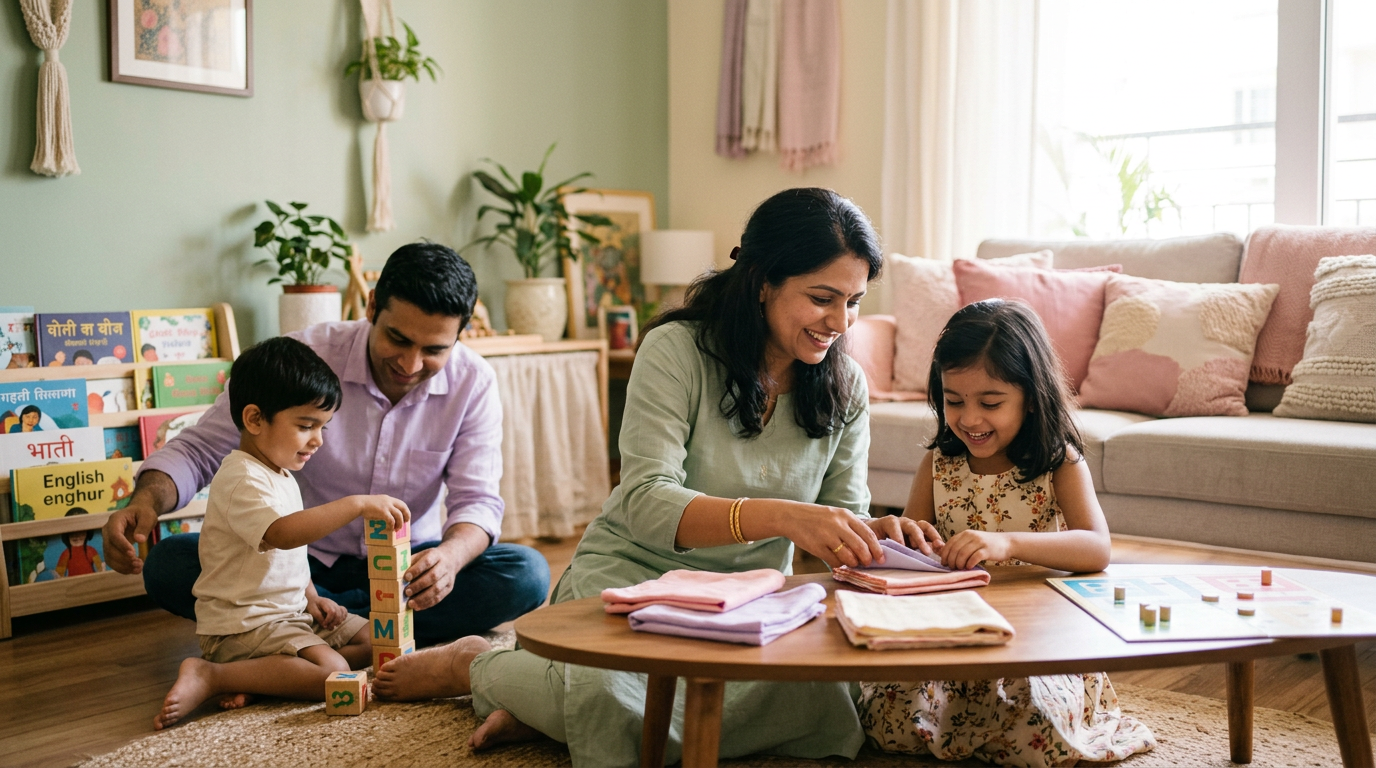
In an era where we often focus on coding classes and Abacus, the real magic of childhood lies in a child’s ability to pour their own glass of water without a spill or help Dadi fold the laundry. Developing life skills for kids isn't about preparing them for a job; it is about building their confidence to handle the world. By integrating these skills into daily play, we move beyond textbook learning to functional independence that stays with them forever.
Why focus on life skills for kids early on?
In Indian households, we have a beautiful tradition of 'helping out,' but we often wait until children are 'old enough' to let them touch anything in the kitchen or handle money. However, the Indian Academy of Pediatrics (IAP) emphasizes that early childhood is the prime window for developing executive functions. When we teach life skills for kids, we are essentially training their brains to plan, organize, and execute tasks.
Early exposure to these tasks reduces the "dependency trap" where an eight-year-old still waits for someone to mix their curd rice. It fosters a sense of belonging. A child who helps shell peas (matar) for dinner feels like a contributing member of the family, not just a bystander.
Practical Montessori life skills activities for the Indian home
The Montessori method emphasizes 'Practical Life' as the foundation of all learning. In our context, this doesn't require expensive wooden kits. You can use what is already in your kitchen. These montessori practical life activities focus on fine motor skills and concentration.
1. The 'Dal Transfer' Challenge
* Skill: Fine motor control and focus.
Activity: Give your child two small steel katoris. Fill one with raw moong dal or chana* and show them how to pour it into the other without dropping a grain.
* Evolution: Once they master dry pouring, move to liquids like water or buttermilk.
2. The Dupatta Fold
* Skill: Visual-spatial awareness and order.
* Activity: Instead of complicated origami, use your cotton dupattas or small hand towels. Show them how to match the corners. It is the perfect entry point for age appropriate chores for kids.
3. Kitchen Helper (Sabzi Cleaning)
* Skill: Sensory exploration and hygiene.
* Activity: Let them wash the bhindi or curry leaves in a large bowl of water. Sorting the 'good' leaves from the 'yellow' ones is a great cognitive exercise.
How do you teach life skills for children through games?
Traditional Indian games are goldmines for life skills. We don't need a formal curriculum; we just need a little jugaad to make learning fun.
The Kirana Shop Game
Take a few empty biscuit packets, a milk carton, and some plastic fruits. Assign prices (keep them simple, like ₹5 or ₹10). Give your child a few coins or notes and play 'Customer and Shopkeeper.'
* Learning: Basic math, the value of money, and social interaction.
* Pro-tip: Next time you go to the local Mother Dairy or kirana store, let them hand over the ₹20 note themselves.
The 'Safety Script' Roleplay
In a crowded country like ours, safety is a non-negotiable life skill. Play a game called "Lost in the Mela."
* The Game: Practice what to do if they can’t see Mummy. Teach them to look for a 'Uniform Auntie' (police) or a mother with other kids.
* The Script: Help them memorize your phone number by turning it into a catchy song or a jingle.
Age-appropriate chores for kids: A simple Indian guide
We often underestimate what our little ones can do. Here is a breakdown of tasks that fit into a typical Indian daily routine:
* Ages 2–3: Putting toys back in the basket, bringing their own steel glass to the sink, helping put 'dirty clothes' in the bucket.
* Ages 4–5: Setting the mat (aasan) for dinner, watering the Tulsi plant, pairing socks after the laundry is dry, clearing their own plate after a meal.
* Ages 6–7: Making their own bed, helping peel boiled potatoes or bananas, packing their school bag based on a timetable, using a broom to sweep a small area.
If you are tracking your child's growth and noticing they are physically ready for more tasks but seem to tire easily, checking a baby growth chart (which covers older children too) can help ensure they are meeting their physical milestones.
Building emotional resilience and social skills
Life skills activities aren't just physical. They include emotional intelligence. In our large families, navigating relationships with Dada-Dadi, Bua, and Chacha is a skill in itself.Gratitude: Make it a habit to say "Thank you" to the bhaiya* who delivers the milk or the person who cleans the society.
* Conflict Resolution: When siblings fight over a toy, don't just intervene. Ask, "How can we make this fair?" Let them propose a timer or a trade.
* Self-Care: Teach them the 'Bubble Breath'—inhaling deeply as if smelling a flower and exhaling slowly as if blowing a bubble—to manage anger.
Real talk from Indian moms
"I started letting my 4-year-old, Advik, help me with the 'dry' laundry. He calls himself the 'Sock Master' because his job is to find the matching pairs. It’s one less thing for me to do, and he feels so proud!"
— Megha R., Bengaluru, Mom to 4-year-old
"We play 'Restaurant' every Sunday. My daughter writes a tiny menu (mostly just 'Poha' and 'Chai'), sets the table, and serves us water. It’s the best way I’ve found to teach her table manners without nagging."
— Pooja S., Lucknow, Mom to 6-year-old
When to call your paediatrician
While learning life skills is a journey, certain delays in motor or social skills might require a professional look. Consult your doctor if:
* Your child is 3 years old and cannot hold a spoon or small object (fine motor delay).
* They show no interest in imitating household tasks or 'pretend play' by age 3.
* They struggle significantly with balance or frequently drop objects that are age-appropriate to carry.
* They exhibit extreme distress or 'meltdowns' when asked to perform simple, age-appropriate transitions or tasks.
* If you have concerns about their physical development, you can use our baby milestones tracker to see if they are hitting the expected benchmarks for their age group.
Frequently Asked Questions
What are the most important life skills for kids to learn first?
The most fundamental skills are self-care (brushing, dressing) and safety (knowing their name/parents' names). Once these are in place, focus on 'contribution skills' like clearing their plate and 'emotional skills' like expressing their needs clearly.
How can I incorporate life skills activities into a busy schedule?
Don't make it an 'extra' task. Instead of doing things for them, do things with them. If you are making rotis, give them a small piece of dough (atta) to roll. It’s a sensory life skill activity that happens while you are already working in the kitchen.
Are there specific life skills for children that help with school readiness?
Yes! Independence in the bathroom, being able to open their own lunchbox (tiffin), and the ability to follow two-step instructions (e.g., "Take your shoes off and put them in the rack") are crucial for a smooth transition to nursery or KG.
What are some age appropriate chores for kids that are safe in a kitchen?
Safe chores include washing vegetables, tearing lettuce or coriander, stirring cool liquids with a whisk, and mashing soft foods like boiled potatoes or bananas. Always supervise and keep them away from hot stoves and sharp knives.
Can montessori practical life activities help with a child’s focus?
Absolutely. Activities like threading large beads, pouring water, or even slow-folding clothes require 'maximum effort' and concentration. This helps lengthen their attention span, which is a vital skill for later academic learning.
Teaching your child how to navigate the world is the greatest gift you can give them. It starts with a spilled bucket of water and a cloth to wipe it up. Start small, stay patient, and remember—every time they try, they are learning.
I am capable, I am helpful, and I am learning every day.
Sources & further reading
- Indian Academy of Pediatrics (IAP) - Growth and Development
- WHO: Early Childhood Development
- National Health Portal of India: Child Health
Written by Dr. Anjali Mehta, MBBS, DCH (Paediatrics)
Reviewed by TheMamaCircle Editorial Team
Last updated: 13 September 2026
This article is for general information only and is not a substitute for personalised medical advice. Always consult your paediatrician or obstetrician for your specific situation.