Montessori Play Toys India: Age-Wise Guide for 0-24 Months
Discover the best montessori play toys for Indian babies. Learn why wooden baby toys beat plastic and how to curate a Montessori home on a budget. Guide inside!
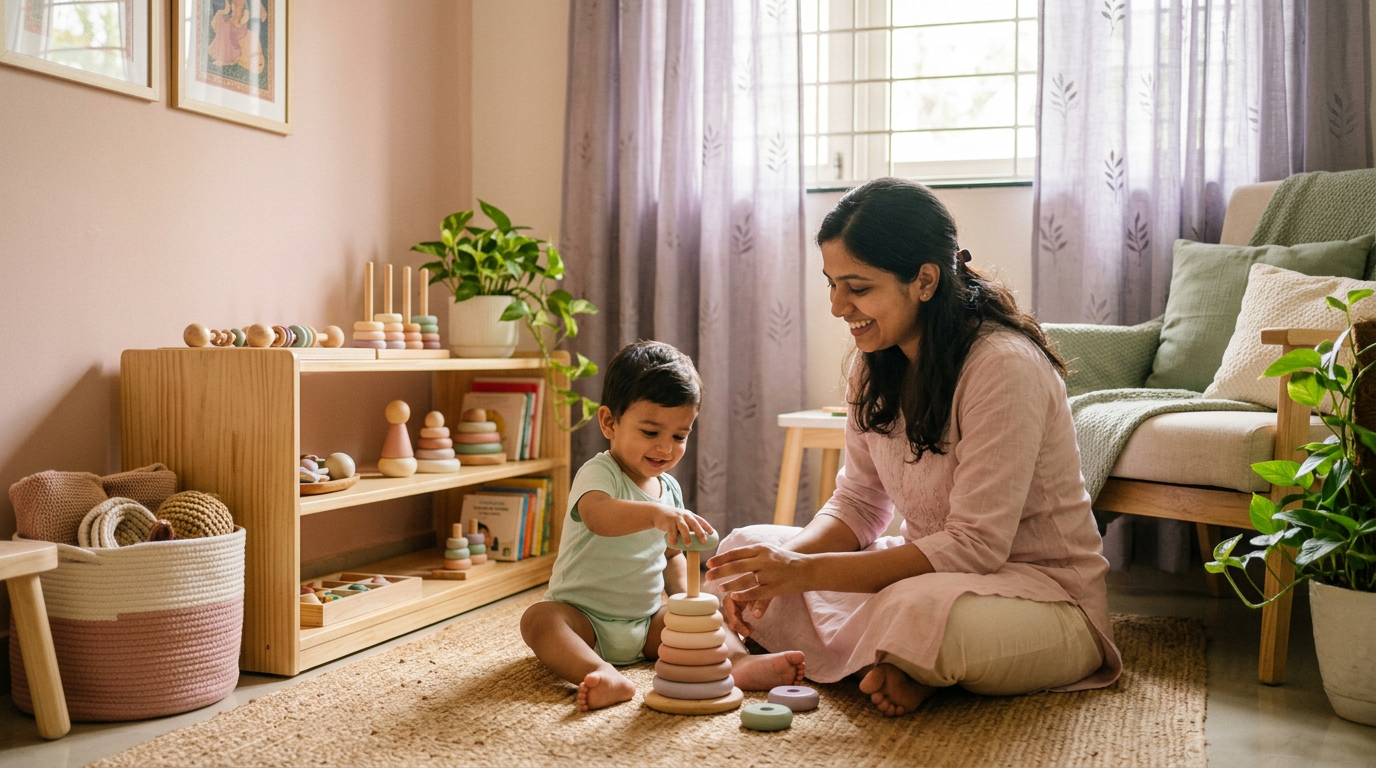
Choosing the right montessori play toys in India doesn't mean you need a fancy Pinterest-perfect nursery or an international bank account. It simply means selecting purposeful objects that respect your baby's innate drive to learn through movement and senses. In the Indian context, where our homes are often buzzing with nanis, dadis, and cousins, Montessori is about creating a "Yes Space" amidst the chaos, focusing on quality over a mountain of plastic battery-operated noise-makers.
What Are Montessori Play Toys?
At its core, Dr. Maria Montessori’s philosophy suggests that "play is the work of the child." Therefore, montessori play toys (often called 'materials') are tools designed to help a child master one specific skill at a time—like grasping, nesting, or pulling—without the distraction of flashing lights or loud electronic music.
In India, we have a long tradition of using natural materials. Think of the old-school Channapatna wooden rattles or the coconut shell spoons your grandmother might have given you to bang on a steel thali. Modern montessori toys india take this wisdom and refine it into developmentally appropriate stages that meet BIS (Bureau of Indian Standards) safety norms.
Age-Wise Guide to Montessori Play Toys (0-24 Months)
0 to 6 Months: The Sensorial Awakening
In these early months, your baby is transitioning from the garbh (womb) to the world. They dont need much, but what they have should be high-quality.
* The Munari & Octahedron Mobiles: Visual tracking is the first "work."
* Interlocking Discs: These help babies practice transferring an object from one hand to the other.
* Silver or Wooden Rattles: Unlike plastic ones, these provide "temperature feedback." A silver rattle feels cool; wood feels warm. This is vital for sensorial development.
* The Crochet Ball: Easy for tiny fingers to hook into, unlike a smooth plastic ball that rolls away too fast, causing frustration.
6 to 12 Months: Developing Fine Motor Precision
This is the stage of sitting up and the dreaded "object permanence" (where they cry because they think you've vanished when you go to the kitchen to make chai).
* Object Permanence Box: A classic among montessori educational toys. The baby drops a ball into a hole, it disappears, and then reappears. This builds trust and cognitive logic.
* Egg in Cup: A simple exercise in fitting shapes together.
* Palmar & Pincer Grasp Blocks: Identifying that different grips are needed for different sizes.
12 to 18 Months: The Explorer Phase
Now that your toddler is likely cruising or walking (and trying to climb the sofa), they need montessori developmental toys that challenge their coordination.
The Steiner/Montessori Rocking Arch: Brands like Ariro or Kinder Castle* make beautiful Neem-wood versions.
* Vertical Ring Stackers: Moving away from the "graded" rainbows to simple poles where they can practice hand-eye coordination.
Imitation "Real Life" Tools: A small steel lota for pouring water or a tiny wooden belan* (rolling pin) to use while you make rotis.
18 to 24 Months: Practical Life and Logic
This is where "Practical Life" starts. In an Indian household, this is the best time to involve them in daily chores—what we call chota kaam.
* Cleaning Sets: A small broom and dustpan (child-sized).
Matching Cards: Cards featuring common Indian fruits like Aam, Cheeku, and Papaya*.
* Coin Box: Excellent for the pincer grip.
Why Wooden Baby Toys Trump Plastic in the Indian Climate
If you’ve lived through a Mumbai monsoon or a Delhi summer, you know that cheap plastic can get sticky, warp, or even emit a chemical smell. wooden baby toys are a superior investment for several reasons:
Budgeting for Montessori in India
You don't need to spend 50,000 Rupees on a full kit. Montessori is a mindset, not just a shopping list.
* The Luxe Route (₹3000 - ₹7000): Investing in a Pikler Triangle or a large wooden Activity Cube.
The Mid-Range Route (₹800 - ₹2500): Curated boxes from brands like Ariro or Flintobox*.
The Budget/DIY Route (₹0 - ₹500): Using a steel katori and rajma* beans (supervised!) for scooping and pouring.
Real Talk from Indian Moms
> "I used to buy every musical toy I saw at Hamleys. My daughter was overstimulated and cranky. We switched to basic montessori play toys—just some wooden blocks and a silk scarf—and her focus went from 2 minutes to 15. It saved my sanity during her afternoon nap window!"
> — Sunita R., Bengaluru (Mom to 14-month-old)
> "In our joint family, everyone kept gifting plastic cars. I started asking for montessori toys specifically for birthdays. Now, even my Sasu Maa enjoys watching the baby concentrate on the wooden stacker rather than staring at a screen."
> — Megha W., Pune (Mom to 10-month-old)
When to call your paediatrician
While toys are for development, they can also highlight when a child might need a little extra help. Monitor these red flags:
* Your baby is 6 months old and does not reach for or grasp toys.
* Your child consistently uses only one hand to play while the other remains limp.
* At 12 months, your child shows no interest in "cause and effect" (like dropping a ball to see it fall).
* Your child has an extreme adverse reaction to the texture of wooden or fabric toys (potential sensory processing concern).
* Presence of "mouthing" (putting everything in the mouth) beyond the age of 2, which might indicate a pica-related deficiency or sensory need.
Frequently Asked Questions
What are the best montessori toys india has to offer for newborns?
For newborns in India, focus on high-contrast black and white cards and lightweight wooden rattles. Brands like Ariro specialize in Neem-wood rattles that are safe for gums and perfectly sized for Indian infants.
Where can I buy montessori educational toys that are BIS certified?
You should look for reputable Indian brands like Shumee, Skola, and Kinder Castle. These brands manufacture locally and ensure their montessori educational toys meet the IS 9873 safety standards for toys.
Are montessori developmental toys better than electronic toys?
Yes, from a paediatric perspective. montessori developmental toys require the child to be the "active" participant. Electronic toys make the child a "passive" observer. Active play builds stronger neural pathways and better problem-solving skills.
How do I clean wooden baby toys in humid Indian weather?
Never soak wooden toys in water. Simply wipe them with a damp cloth dipped in a mild vinegar-water solution. Dry them immediately under a fan. Avoid direct harsh sunlight for long periods as it can crack the wood, but a quick 10-minute "sunbath" can help kill germs.
Can I use traditional Indian kitchen items as montessori play toys?
Absolutely! A whisk, a wooden spatula, or various sizes of stainless steel bowls make excellent toys. They teach "Practical Life" skills and weight differentiation without costing a paisa. Just ensure there are no sharp edges.
Why are wooden baby toys more expensive than plastic?
Wooden baby toys are usually handcrafted, made from sustainable timber, and dyed with non-toxic, food-grade pigments. The cost reflects the safety of the material and its longevity compared to "use-and-throw" plastic.
As you begin this journey, remember that your presence is the most important "toy" your baby has. Sit on the floor, observe more, and intervene less. You are doing a great job, Ma.
I am a capable mother, and I provide my child with exactly what they need to thrive.
Sources & further reading
- Indian Academy of Paediatrics (IAP) - Toy Safety Guidelines
- Bureau of Indian Standards (BIS) - IS 9873 Safety of Toys
- WHO - Physical activity, sedentary behaviour and sleep for children under 5 years of age
Written by Dr. Anjali Mehta, MBBS, DCH (Paediatrics)
Reviewed by TheMamaCircle Editorial Team
Last updated: 15 July 2026
This article is for general information only and is not a substitute for personalised medical advice. Always consult your paediatrician or obstetrician for your specific situation.