Newborn Eye Color: When Does It Change? (India Guide)
Wondering when newborn eye color settles? Learn why Indian babies' eyes change, see vision examples, and know when to call a paediatrician. Ready to see?
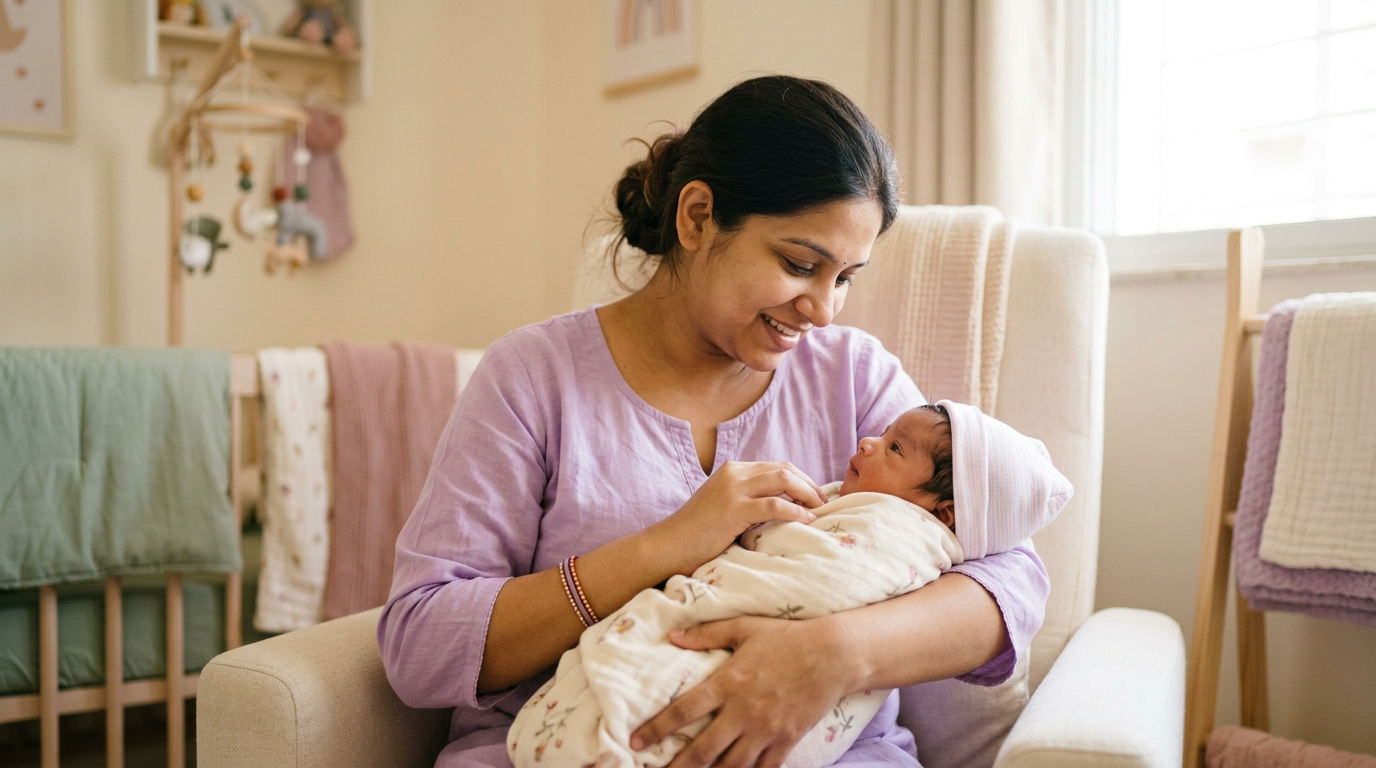
You’ve spent nine months imagining your little one’s face. Now that they are finally here, you are likely staring into those tiny, squinty eyes wondering if they will stay that mysterious slate-grey or turn into a deep kohl-brown like their Dadi’s. The truth is, newborn eye color is rarely permanent at birth. Most Indian babies are born with dark grey or brownish-black eyes, and the final shade takes months to reveal itself as the melanin in the iris reacts to light.
Why Does Newborn Eye Color Change?
The iris is the muscular part of the eye that controls how much light gets in. Its color is determined by a protein called melanin—the same pigment that gives our skin and hair their shade. Think of it like a tan; melanin production often ramps up once the baby is exposed to the bright lights of the world outside the garbh (womb).
If your baby has low amounts of melanin at birth, their eyes might look blue or grey. As the cells (melanocytes) start producing more pigment over the first year, the eyes may darken to hazel, green, or the most common Indian shade, deep brown. Since most Indian parents have high levels of melanin, the majority of our babies will eventually have brown eyes, even if they start out looking a bit "cloudy" or blueish-grey in the first few weeks of postnatal life.
The Timeline: When Does the Final Color Set In?
While you might be analyzing every photo for a hint of green or gold, patience is key. The newborn eye color transition isn't an overnight switch; it is a slow burn.
* 0 to 3 Months: Most changes happen in this window. You might notice the "haze" clearing.
* 6 to 9 Months: The color usually stabilizes significantly. This is a great time to check their progress against a baby growth chart to ensure overall development is on track.
* 1 Year: By the first birthday, most children have their permanent eye color.
* 3 Years: In rare cases, subtle shifts in shading can continue until the toddler years.
Can Newborn Babies See the Color of Your Eyes?
It is a common myth that babies can see everything clearly from day one. If you are wondering can newborn babies see the specific shade of your eyes during stanpaan (breastfeeding), the answer is: not quite yet.
At birth, their vision is roughly 20/600. They see the world in shades of grey and are extremely nearsighted. They can only focus on objects about 8 to 10 inches away—which, coincidentally, is the exact distance between your face and theirs while feeding. While they can't distinguish between subtle eye colors, they are hardwired to love the high-contrast "target" of your dark pupil against the white of your eye. To see what your little one is actually perceiving right now, check out our baby vision simulator.
Visual Milestones in the First 6 Months
Genetics: Will They Have My Eyes or Their Father’s?
We used to think eye color was a simple case of "Brown beats Blue" (Dominant vs. Recessive). However, modern science shows it’s more complex, involving up to 16 different genes.
* Two Brown-Eyed Parents: Most likely a brown-eyed baby, but if both parents carry a "recessive" light-eye gene from a grandparent, a hazel-eyed surprise is possible!
* One Brown, One Blue: It’s a toss-up, though brown remains the statistical favorite in the Indian context.
* Two Blue-Eyed Parents: Highly likely to have a blue-eyed baby, but not a 100% guarantee.
During your 1:1 postnatal care sessions, many moms ask if diet affects eye color. While a good postnatal diet rich in Vitamin A (like carrots and papaya) is vital for the health of the retina, it won't change the genetic blueprint of the iris.
Decoding Newborn Vision: What is Normal?
It is easy to get obsessed with the shade of their eyes, but their visual function is far more important. If you look at newborn vision examples, you will see that "wandering eyes" are quite common in the early weeks.
Because their brain is still learning how to coordinate the eye muscles, one eye might occasionally drift inward or outward (pseudo-strabismus). As long as this is intermittent and disappears by 4 months, it is usually just a part of normal newborn vision development.
The Role of Melanin and Sun Protection
In India, we have intense UV radiation. Even though your baby’s newborn eye color is still developing, their eyes are very sensitive. Avoid the traditional practice of applying kajal or surma to the eyes. The Indian Academy of Paediatrics (IAP) strongly advises against this as it can lead to lead poisoning, chemical irritation, or blocked tear ducts. Instead, protect those developing eyes with a wide-brimmed hat or by keeping the stroller canopy down during peak sunlight hours (10 AM to 4 PM).
Real Talk From Indian Moms
"I was convinced my son had his Portuguese great-grandfather’s green eyes. They looked so light for the first four months! By his first birthday, they turned into a beautiful honey-hazel. I still love them, but the suspense was real!"
— Ananya R., Bengaluru (Baby aged 14 months)
"In my community, everyone kept saying 'Iska aankhon ka rang toh bilkul alag hai' (His eye color is totally different). But my paediatrician told me to wait. Sure enough, by 8 months, the 'grey' became a deep, dark brown, just like his Papa's."
— Meera V., Chennai (Baby aged 10 months)
"I spent way too much time searching for 'newborn eye color' changes on Google. My advice? Don't buy the fancy outfits to match their eyes until they are at least six months old!"
— Sunita K., Delhi (Baby aged 2 years)
When to Call Your Paediatrician
While color changes are normal, certain signs require a visit to a paediatric ophthalmologist. Keep an eye out for:
* White Pupil (Leukocoria): If you see a white reflex in a photo (instead of red-eye) or a white cloudy appearance in the pupil.
* Excessive Tearing: Persistent watery eyes could indicate a blocked tear duct, common in infants but needs monitoring.
* Extreme Light Sensitivity: If your baby screams or turns away in normal indoor lighting.
* Persistent Squint: If the eyes remain crossed or turned out after the age of 4 months.
* Yellow Sclera: If the white part of the eye looks yellow, this is a sign of neonatal jaundice and needs an immediate bilirubin check.
Frequently Asked Questions
When do babies start seeing and hearing?
Babies can hear even before birth (around 23 weeks in the womb). When do babies start seeing and hearing together as a coordinated sense? This begins at birth, but their hearing is much more developed than their vision initially. They will recognize your voice instantly, but they won't clearly see your face for a few weeks.
Can newborn babies see color?
Not fully. At birth, they see mostly high-contrast black, white, and grey. By 2-3 months, they start to distinguish red and green. Blue and yellow take a little longer because the receptors for those colors are less developed at birth.
What is the most common newborn eye color in India?
Most Indian babies are born with dark brown or slate-grey eyes. The slate-grey usually transitions into a darker brown or black within the first six months.
How do I know if my baby's eyes will stay light?
There is no definitive way to tell, but look at the iris from the side. If you see gold or brown flecks in a grey eye, it is very likely to turn brown. If the eye stays a clear, solid blue or grey past 6 months, there is a higher chance it will remain light.
Is it true that breast milk can cure eye infections?
This is a common "Nani maa ke nuskhe" (grandmother’s remedy) in India, but doctors advise against putting breast milk in the eyes. While it has antibodies, the sugars in the milk can actually encourage bacterial growth. Stick to sterile saline wipes and consult your doctor for antibiotic drops if needed.
Does newborn eye color affect their vision?
No. Whether your baby has light grey or dark brown eyes, their visual acuity (how well they see) develops at the same rate. Eye color is purely cosmetic and related to pigment, not the "hardware" of the eye itself.
Watching your baby’s features unfold is one of the most magical parts of the first year. Whether those eyes turn out to be the color of dark chocolate or forest green, they will soon be the eyes that light up the moment you walk into the room. Enjoy the "grey phase" while it lasts—it’s just one of the many ways your baby is growing and changing every single day.
You are doing a great job, Mama; trust your instincts and your baby's unique timeline.
Sources & further reading
- Indian Academy of Pediatrics (IAP) - Eye Care in Newborns
- AIIMS - Department of Ophthalmic Sciences
- World Health Organization (WHO) - Newborn Health
Written by Dr. Anjali Mehta, MBBS, DCH (Paediatrics)
Reviewed by TheMamaCircle Editorial Team
Last updated: 16 September 2026
This article is for general information only and is not a substitute for personalised medical advice. Always consult your paediatrician or obstetrician for your specific situation.