Indian Baby Weight Chart in Kg: WHO & IAP Monthly Guide
Check the official indian baby weight chart in kg for boys & girls. See IAP/WHO percentiles, 3 month baby weight norms, and growth red flags. Growth isn't a race!
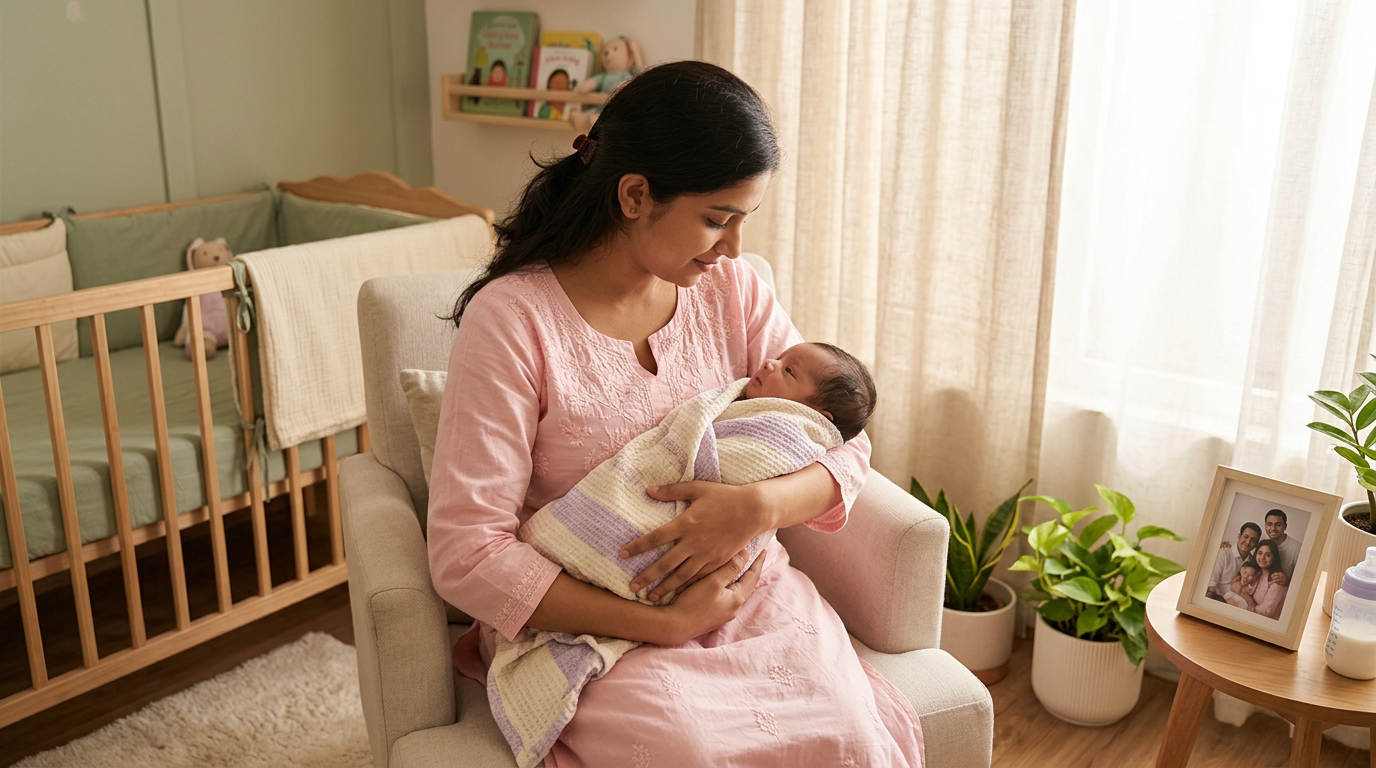
If you are squinting at a blurry printout from your last clinic visit, let’s simplify things: an indian baby weight chart in kg is the roadmap to your baby’s nutrition, not a report card of your parenting. Whether you’re worried about dadi saying the baby looks "weak" or sasu maa insisting on extra ghee, the gold standard we use in India is based on the WHO Multi-centre Growth Reference Study, adapted by the Indian Academy of Pediatrics (IAP). For a quick check of where your little one stands, you can also use our digital baby growth chart to track progress over time.
Indian Baby Weight Chart in Kg: Month-by-Month Guide
In India, we track growth using "percentiles." If your baby is in the 50th percentile, it simply means they weigh more than 50% of healthy babies their age. It does not mean they are "average" in a bad way—it means they are exactly where they should be. Most Indian babies born full-term weigh between 2.5 kg to 3.5 kg at birth.
Here is the standard baby weight chart india for the first year, combining IAP and WHO data:
| Age (Months) | Boys (Average kg) | Girls (Average kg) | Healthy Range (kg) |
| :--- | :--- | :--- | :--- |
| Birth | 3.3 | 3.2 | 2.5 – 4.3 |
| 1 Month | 4.5 | 4.2 | 3.4 – 5.8 |
| 2 Months | 5.6 | 5.1 | 4.3 – 7.1 |
| 3 Months | 6.4 | 5.8 | 5.0 – 8.0 |
| 6 Months | 7.9 | 7.3 | 6.4 – 9.8 |
| 9 Months | 8.9 | 8.2 | 7.1 – 11.5 |
| 12 Months | 9.6 | 8.9 | 7.7 – 12.4 |
Note: These are medians. If your baby was born prematurely or had a low birth weight (LBW), their trajectory will look different.
Is my baby growing correctly? Understanding the Percentiles
When you look at an indian baby weight chart in kg, don’t obsess over a single point. We look for a "growth curve." If your baby stays on the 15th percentile consistently, that is perfect. We only worry if they suddenly drop from the 50th to the 5th, or if they jump from the 50th to the 95th too rapidly.
Factors influencing the Indian baby weight chart:
* Birth Weight: A baby born at 2.6 kg (typical in many Indian households) will naturally weigh less at 3 month baby weight checks than a baby born at 4 kg.
* Breastfeeding vs. Formula: Breastfed babies often gain weight rapidly in the first 3 months and then taper off, whereas formula-fed babies may show more linear growth. If you are struggling with feeding, our AI cry analyzer can sometimes help decode if those "hunger cries" are actually about something else.
* Genetics: If both parents are lean and petite, the baby is unlikely to be a "Michelin Man" baby—and that is okay!
Why Indian Growth Charts Differ from Western Ones
Many apps use the US CDC charts, which include data from non-breastfed infants and different ethnic backgrounds. The indian baby weight chart in kg used by IAP (Indian Academy of Pediatrics) accounts for the fact that Indian children have different body compositions.
Using a generic baby weight chart meant for American babies can lead to "growth chart anxiety," where Indian mothers feel their children are underweight when they are actually perfectly healthy by ICMR (Indian Council of Medical Research) standards.
Feeding for healthy weight gain in India
What is a normal 3 month baby weight?
By three months, most Indian parents expect the baby to look "chubby." On the indian baby weight chart in kg, a 3-month-old boy typically weighs around 6.4 kg and a girl around 5.8 kg.
However, at this stage, we also look at the baby growth chart for length and head circumference. If your baby is meeting milestones—like holding their head up or social smiling—the number on the scale is secondary. If you are tracking your own recovery alongside the baby's growth, our postpartum wellness assessment can help you check if your energy levels are where they should be to keep up with a growing infant.
How to use a weight chart for kids as they grow
Once your baby crosses the one-year mark, the weight chart for kids changes. The "toddler slump" is real. Between ages 1 and 2, weight gain slows down significantly because they are too busy running around to sit and eat.
Pro-tip for Indian Moms: Stop comparing your child to the neighbor’s kid who eats four parathas. Every child’s metabolic rate and activity level are unique. As long as they are active and reaching milestones, you are doing great.
Real talk from Indian moms
> "I spent three months crying because my daughter was 'lean' compared to my niece. My paediatrician finally showed me her curve on the indian baby weight chart in kg and she was perfectly on the 25th percentile. I wish I hadn't wasted that time worrying."
— Ananya S., Bengaluru (Mom to 8-month-old)
> "In our family, everyone wants a 'gol-mol' baby. My son was active but thin. I focused on calorie-dense foods like ragi and ghee instead of just forcing more milk. The growth chart helped me stay sane when my mother-in-law commented on his weight."
— Megha R., Pune (Mom to 14-month-old)
When to call your paediatrician
While variations are normal, keep an eye out for these "Red Flags" that require a visit to the clinic:
* Weight Loss: Any actual drop in weight (not just a slow-down in gain).
* Crossing Percentiles: If the baby drops across two major percentile lines (e.g., from 75th to 25th).
* Lethargy: If the baby is too tired to feed or seems unusually floppy.
* Persistent Illness: Frequent diarrhea or respiratory infections that stall growth.
* Output Issues: Fewer than 6 wet nappies a day (for babies under 6 months).
Frequently Asked Questions
What is the ideal indian baby weight chart in kg for a newborn?
A healthy Indian newborn typically weighs between 2.5 kg and 3.5 kg. Anything below 2.5 kg is classified as Low Birth Weight (LBW) and requires closer monitoring, though many of these babies catch up by age two.
Where can I find a reliable baby growth chart for Indian infants?
The most reliable charts are the IAP (Indian Academy of Pediatrics) growth curves, which are based on the WHO standards but calibrated for the Indian population. Most Indian vaccination cards include these charts in the back.
What should be the average 3 month baby weight?
At 3 months, the average weight for an Indian baby boy is approximately 6.4 kg, and for a girl, it is around 5.8 kg. However, a range of 5.0 kg to 8.0 kg is considered normal depending on birth weight.
How often should I check a weight chart for kids?
For the first 6 months, weight is usually checked at every vaccination visit (monthly). For toddlers, a check-up every 3 to 6 months is sufficient, unless there are underlying health concerns.
Is the baby weight chart india different for breastfed and formula-fed babies?
Yes, the WHO/IAP charts are based on the "gold standard" of breastfed babies. Breastfed babies often grow faster in the first 3-4 months and then slow down, while formula-fed babies may gain weight more steadily but have a higher risk of childhood obesity.
Why is my baby not gaining weight according to the baby weight chart?
Common reasons include "distracted feeding," recent illness (like a common cold or teething), or simply a high activity level. If the baby is meeting developmental milestones like rolling over or sitting up, they are usually fine.
Monitoring your baby’s growth is a marathon, not a sprint. Use the indian baby weight chart in kg as a helpful guide to ensure they are on their own unique track. You are the expert on your baby; trust your gut and the data, not the aunties.
Your baby’s worth is not measured in grams, and your worth is not measured in how much they eat.
Sources & further reading
- Indian Academy of Pediatrics (IAP) Growth Charts
- WHO Child Growth Standards
- AIIMS Paediatrics - Growth Monitoring Guidelines
Written by Dr. Anjali Mehta, MBBS, DCH (Paediatrics)
Reviewed by TheMamaCircle Editorial Team
Last updated: 25 July 2026
This article is for general information only and is not a substitute for personalised medical advice. Always consult your paediatrician or obstetrician for your specific situation.