Infant Vision Development: A Week-by-Week Guide for Moms
Curious about infant vision development? Learn what your baby sees week-by-week, from blurry newborn vision to full colour, plus red flags for Indian moms.
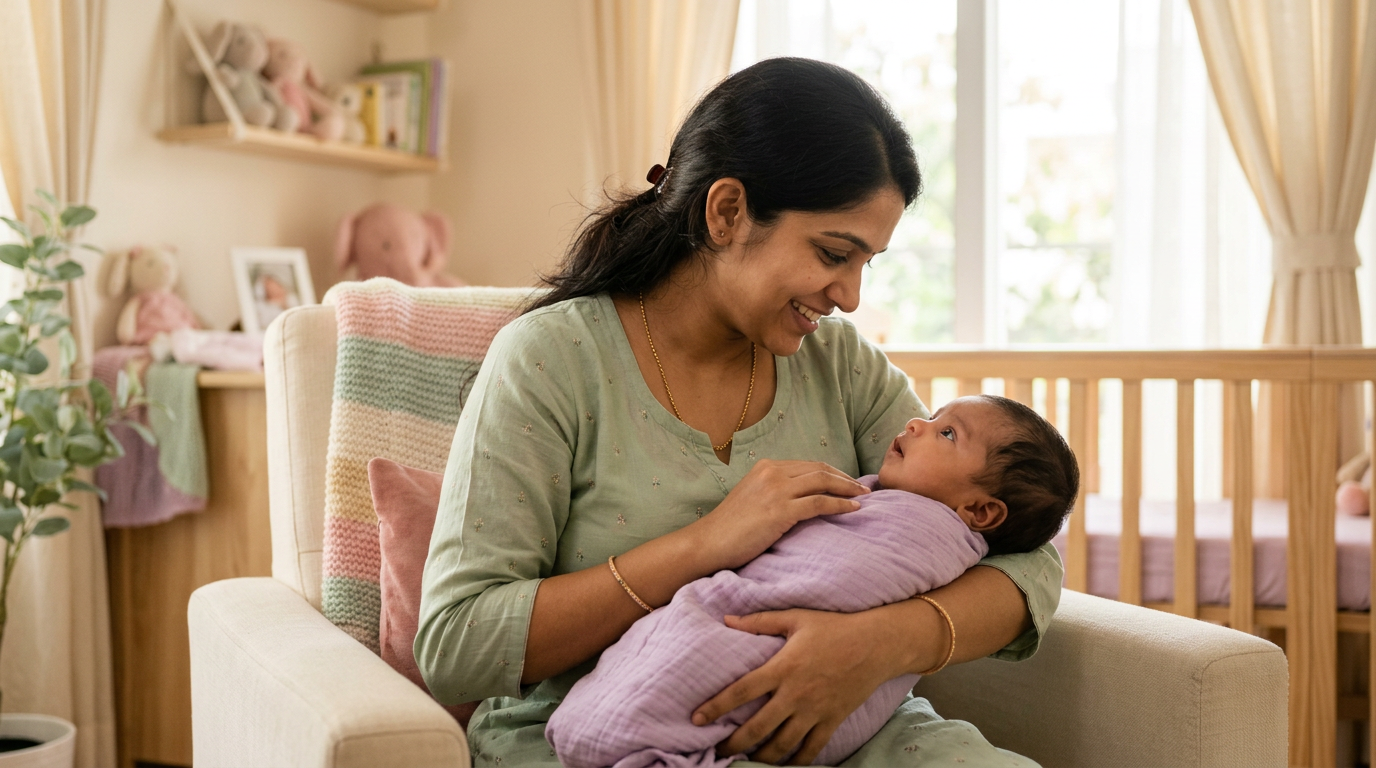
When you first hold your little one in the hospital, you might wonder if they are actually looking at you or just the tubelight behind you. Infant vision development is a gradual process; at birth, a baby’s eyesight is the least developed of all their senses. They can only see about 20 to 30 cm away—essentially the distance between your face and theirs during stanpaan (breastfeeding). Everything else is a beautiful, blurry smudge of light and shadow.
The Week-by-Week Roadmap of Infant Vision Development
Understanding how your baby begins to see the world helps you engage with them more effectively. During the early postnatal period (also called postnatal), your baby’s brain is working overtime to wire the visual cortex.
Birth to 1 Month: The High-Contrast Phase
At this stage, your baby’s eyes are not yet coordinated. You might see them cross occasionally, which is usually normal as they learn to focus.
* Visual Range: 8–12 inches.
* Color Perception: They see mostly in black, white, and shades of grey.
* Preference: They love bold, geometric patterns and the human face—specifically the hairline and eyes.
* What you can do: Use black-and-white high-contrast flashcards. You don’t need expensive kits; even a hand-drawn black circle on white paper works wonders.
2 to 4 Months: The World in Technicolor
This is a major leap in infant vision development. By two months, babies begin to track moving objects with their eyes and start to perceive primary colours, starting with red.
Tracking: They can follow a slow-moving rattle (like a traditional silver jhunjhuna*) from side to side.
* Hand-Eye Coordination: They start reaching for things, though they usually miss by a few inches.
* Depth Perception: By month four, they begin to develop binocular vision, meaning their eyes work together to perceive depth.
5 to 8 Months: Reaching and Grabbing
By now, your baby is likely sitting up and seeing the room from a new perspective. Their colour vision is almost as sharp as an adult's.
* Recognition: They can recognize your face from across the room and might smile before you even say a word.
Fine Motor Skills: They start noticing smaller objects, like a stray moong dal* on the floor (watch out for choking hazards!).
* Eye Colour: If your baby was born with blue or grey eyes, you might notice the permanent pigment settling in now, though it can change up until age one.
9 to 12 Months: The Final Polish
By their first birthday, most babies have vision that is close to 20/20. They are excellent at judging distances, which helps them as they transition from crawling to cruising around the sofa.
Can newborn babies see clearly at birth?
The short answer is no. While many parents ask, can newborn babies see right away, the reality is quite blurry. At birth, their retina is not fully developed, and the lens can't change shape easily to focus. You can see what this looks like using our baby vision simulator.
In the first few weeks, your baby is biologically programmed to focus on your face. This is a survival mechanism that encourages bonding. If you notice your baby staring intently at your forehead or ears instead of your eyes, don't worry—they are simply looking at the high-contrast border where your hair meets your skin.
Stimulating Your Baby’s Sight: The Indian Way
You don't need fancy apps to help with vision milestones. Our traditional Indian practices often align perfectly with developmental needs.
The Black Bindi/Kajal Myth: While many nanis suggest applying kajal to "brighten" or "enlarge" the eyes, the Indian Academy of Paediatrics (IAP) strongly advises against it. Commercial and even home-made kajal can contain lead and cause infections or block tear ducts. Instead, use a small kaala teeka* on the forehead or behind the ear for 'nazar' if you wish.
Traditional Toys: Hang a bright red or multicoloured cloth (a soft dupatta or saree* scrap) near their cradle, but out of reach. The gentle movement in the wind helps with tracking.
* Mirror Play: Place a shatterproof mirror in their play area. Babies are fascinated by reflections, which helps them practice focusing.
* Sunlight Exposure: Short stints of indirect sunlight (not harsh midday sun) help regulate their circadian rhythm, helping them distinguish between day and night, which is linked to when do babies start seeing and hearing patterns in their environment.
Visual Milestones and Play Tools
As you track your baby's progress using a baby milestones tracker, look for these specific visual markers:
For parents looking to support this growth, Montessori baby toys like the 'Munari Mobile' (black and white) are excellent. In India, you can find high-quality wooden high-contrast toys on sites like Shumee or Skillmatics, typically ranging from ₹500 to ₹1,500.
Real Talk from Indian Moms
"I was so worried because my daughter, Aisha, kept squinting one eye whenever we went near the balcony. My sasu maa said it was just 'weak eyesight' from my side of the family, but the paediatrician said it was just her learning to handle bright light. By 4 months, it stopped!"
— Priya S., Bengaluru, Mom to 6-month-old Aisha
"We bought all these pastel-coloured nursery items, but Advait didn't care about them at all. Then I wore a bright red Kanjeevaram for a puja, and he wouldn't stop staring. That’s when I realized he really couldn't see the light blues and pinks yet!"
— Meenakshi R., Chennai, Mom to 3-month-old Advait
"I used to think he was ignoring me because he wouldn't look at me when I called from the door. Later I read about newborn vision examples and realized he literally couldn't see that far yet. Now at 10 months, he spots a biscuit from a mile away."
— Gurpreet K., Chandigarh, Mom to 10-month-old Zorawar
When to Call Your Paediatrician
While every baby develops at their own pace, some signs require a professional check-up by a paediatric ophthalmologist. Keep an eye out for:
* Excessive Tearing: If the eyes are always watery, it could indicate a blocked tear duct (dacryostenosis).
* Red or Crusted Eyelids: This might be a sign of an infection like conjunctivitis.
* Constant Eye Crossing: While occasional crossing is normal before 4 months, eyes that stay turned in or out constantly need evaluation.
* Extreme Light Sensitivity: If your baby screams or seems in pain in normal indoor lighting.
* White Pupil: If you notice a white, cloudy, or silvery reflection in the pupil (especially in flash photos), this is an emergency and requires immediate consultation to rule out cataracts or retinoblastoma.
* Lack of Tracking: If your baby is not following objects or making eye contact by 3 months.
Frequently Asked Questions
When do babies start seeing and hearing clearly?
Babies can hear quite well even before birth, but their vision takes longer to sharpen. Hearing is functional at birth, whereas vision reaches adult-like clarity only around 8 to 12 months of age. You will notice them turning toward sharp sounds (like a pressure cooker whistle) long before they can spot a small toy across the room.
What are some newborn vision examples of what they see?
Imagine looking through a very thick, frosted glass window while wearing someone else's glasses. A newborn vision example would be seeing your face as a blurry oval with dark spots for eyes and hair. They see high-contrast edges clearly but lose all detail in the middle.
Can newborn babies see colours?
At birth, babies primarily see in black, white, and shades of grey. By 2 months, they begin to see red and orange. By 5 months, they can distinguish between subtle shades of blues and yellows, and their colour vision is mostly complete by the time they start crawling.
Why do my baby's eyes look crossed?
This is very common in the first few months of infant vision development. The muscles that control the eyes are still strengthening. As long as the eyes don't stay locked in a crossed position 24/7, it usually resolves as their brain learns to coordinate both eyes into a single image.
Should I be worried if my baby has watery eyes?
In India, the dusty environment can sometimes irritate a baby’s eyes. However, persistent watering usually means a blocked tear duct. Gently massaging the corner of the eye (the nasolacrimal duct) with a clean finger—as shown by your doctor—often helps. If the discharge turns yellow or green, consult your paediatrician.
Watching your baby truly "see" you for the first time is one of the most heart-melting moments of the postnatal period. Their eyes are their primary windows to learning, so keep engaging, keep smiling, and don't worry if they seem a bit lost in the blur for now.
Your face is the most beautiful thing your baby will ever see.
Sources & further reading
- Indian Academy of Pediatrics (IAP) - Tips on Eye Care
- AIIMS - Paediatric Ophthalmology Guidelines
- WHO - Visual Impairment in Children
- National Health Portal India - Eye Care for Newborns
Written by Dr. Anjali Mehta, MBBS, DCH (Paediatrics)
Reviewed by TheMamaCircle Editorial Team
Last updated: 20 September 2026
This article is for general information only and is not a substitute for personalised medical advice. Always consult your paediatrician or obstetrician for your specific situation.