Newborn Vision Examples: What Babies See Week by Week
See the world through your baby's eyes with these newborn vision examples. Learn about high-contrast play, eye colour shifts, and when to call the doctor.
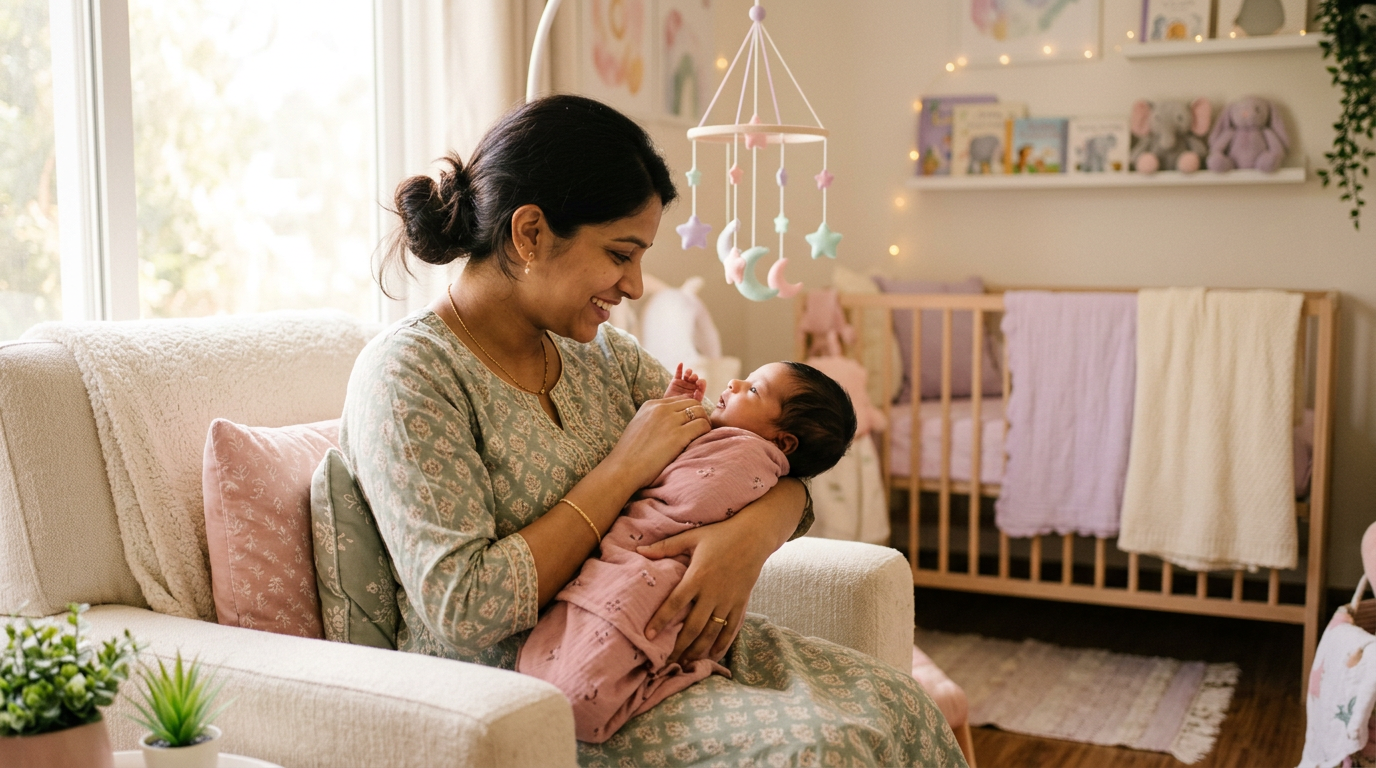
At birth, your baby isn't seeing the world in 4K resolution; it’s more like looking through a foggy car windshield during a Mumbai monsoon. Understanding newborn vision examples helps you realise that while your little one can’t see the jhumar on the ceiling yet, they are biologically programmed to find your face. In those first few days, a newborn’s visual range is limited to about 8 to 12 inches—exactly the distance from your breast to your eyes during stanpaan (breastfeeding).
What can newborn babies see in the first week?
If you were to look through a baby vision simulator, the world would look like a blurry, grey-scale painting. At birth, the nerve cells in the retina and the brain that control vision aren't fully developed. Their eyes are physically capable of seeing, but the brain isn't quite sure how to process the data yet.
Key visual milestones in week one:
* High Contrast is King: Because their cones (colour-detecting cells) are still waking up, babies respond best to black-and-white patterns. This is why those expensive pastel nurseries are actually quite boring for a baby!
* Light Sensitivity: You might notice your baby squinting in bright sunlight or under heavy LED lights. Their pupils are small to limit the amount of light entering the eye.
* Peripheral Focus: Surprisingly, newborns often see things better out of the corners of their eyes rather than looking directly at an object.
Newborn vision examples: A week-by-week visual guide
To help you understand your baby's perspective during your postnatal recovery, let's break down the clarity levels.
0 to 4 Weeks: The "Blurry Nani" Phase
In this stage, your baby sees the world in shades of grey, black, and white. If you hold a bright red dupatta near them, they might notice a dark shape, but the "redness" won't register. They can track a slow-moving light or a large object, but their eyes may occasionally cross. Don’t panic—their eye muscles are just learning to work in tandem.
5 to 8 Weeks: The First Pop of Colour
By now, the ability to see colours begins to kick in. Red is usually the first colour they perceive, followed by green. You’ll notice them staring intently at a bright bindi on your forehead or a colourful toy. This is a great time to introduce high-contrast flashcards or Montessori baby toys that feature bold patterns.
9 to 12 Weeks: Depth and Focus
During this period, your baby begins to develop depth perception. They start to understand that the rattle is closer than the ceiling fan. You’ll see them trying to reach out and swat at things. This is also when you can answer the question, when do babies start seeing and hearing in a coordinated way? They will now turn their eyes toward a sound, like the jingle of your payal (anklets).
When do babies get their permanent eye colour?
Many Indian babies are born with dark brown or deep slate-grey eyes. However, the question of newborn eye color is one of the most common ones I get in my clinic. The pigment in the iris, called melanin, needs exposure to light to darken.
* The Timeline: While you might see changes by 3 to 6 months, the permanent eye colour often isn't set until the first birthday.
* The Genetics: If both parents have dark brown eyes, the baby likely will too. However, if there’s a stray light-eyed relative in the family tree, you might be in for a surprise!
How to support vision during postnatal care
Visual stimulation is just as important as physical maalish (massage). During your 1:1 postnatal care sessions, we often discuss how to incorporate "eye play" into your daily routine.
Real talk from Indian moms
> "I thought my son was ignoring me because he wouldn't look at me when I sat at the foot of the bed. Then my doctor told me he literally couldn't see that far! Once I moved to about 10 inches away, his eyes locked onto mine and he gave me his first gummy smile."
> — Sunita R., Bengaluru (Baby Arjun, 6 weeks)
> "We bought all these soft, light pink toys, but Aavya didn't care for them at all. My mother-in-law gave her a black-and-white checked cushion cover, and she stared at it for 20 minutes straight! Now I know about newborn vision examples and why contrast matters."
> — Meher V., Delhi (Baby Aavya, 2 months)
When to call your paediatrician
While "wandering eyes" are normal in the first few weeks, some signs require a professional check-up with an ophthalmologist or your regular paediatrician. The Indian Academy of Paediatrics (IAP) recommends screening for:
* Excessive Tearing: If the eyes are always watery, it could be a blocked tear duct (very common in Indian infants but needs monitoring).
* White Pupil: If you notice a white, cloudy, or yellowish glow in the pupil (especially in photos with a flash), this is an emergency.
* Extreme Light Sensitivity: If your baby screams or seems in pain when exposed to normal indoor light.
Constant Crossing: If the eyes are crossed all* the time or one eye always turns in or out, rather than just occasionally when tired.
* Redness or Pus: Any discharge that looks like "yellow goop" should be checked to rule out conjunctivitis.
Frequently Asked Questions
Can newborn babies see faces immediately?
Yes, can newborn babies see faces? Absolutely. They are hard-wired to recognise the human face shape from birth, even if it looks like a blurry oval to them initially. They focus on the hairline and the eyes because of the high contrast.
Why do newborns have crossed eyes?
Newborn vision is a work in progress. The muscles that control the eyes are weak at birth. It takes time for the brain to coordinate these muscles. Occasional crossing is normal until about 4 months of age.When should I worry about my baby's vision?
If your baby is not tracking a large object or making eye contact by 3 months, it’s worth a chat with your doctor. Also, look for physical signs like crusty lids or persistent redness.
What do babies see at 1 month?
At one month, a baby can focus on objects about 8-10 inches away. They prefer high-contrast patterns and are starting to spend more time studying your face during feeds.
Do Indian babies' eyes change colour?
Yes, even though most Indian babies are born with dark eyes, the newborn eye color can shift from a dark grey or blue-grey to a permanent deep brown or hazel over the first 6 to 12 months as melanin develops.
How far can a 2-week-old see?
A 2-week-old sees best at a distance of 20 to 30 cm (8 to 12 inches). Anything further away is a blurry haze of light and shadow.
Understanding your baby's visual world helps you bond better. Whether you are showing them a bright red tomato in the kitchen or letting them stare at your dark kajal-lined eyes, you are helping their brain build the connections it needs to eventually see the world in all its vibrant glory. Remember, mama, you are the most beautiful thing your baby will ever see.
Sources & further reading
- Indian Academy of Paediatrics (IAP) - Visual Development
- AIIMS - Paediatric Ophthalmology Guidelines
- World Health Organization - Child Development Milestones
Written by Dr. Anjali Mehta, MBBS, DCH (Paediatrics)
Reviewed by TheMamaCircle Editorial Team
Last updated: 19 September 2026
This article is for general information only and is not a substitute for personalised medical advice. Always consult your paediatrician or obstetrician for your specific situation.