Sensory Play for Babies: Easy Indian Home Activities Guide
Discover easy sensory play for babies using Indian household items. Boost brain development with tummy time activities and DIY ideas for 2BHK living. Start playing!
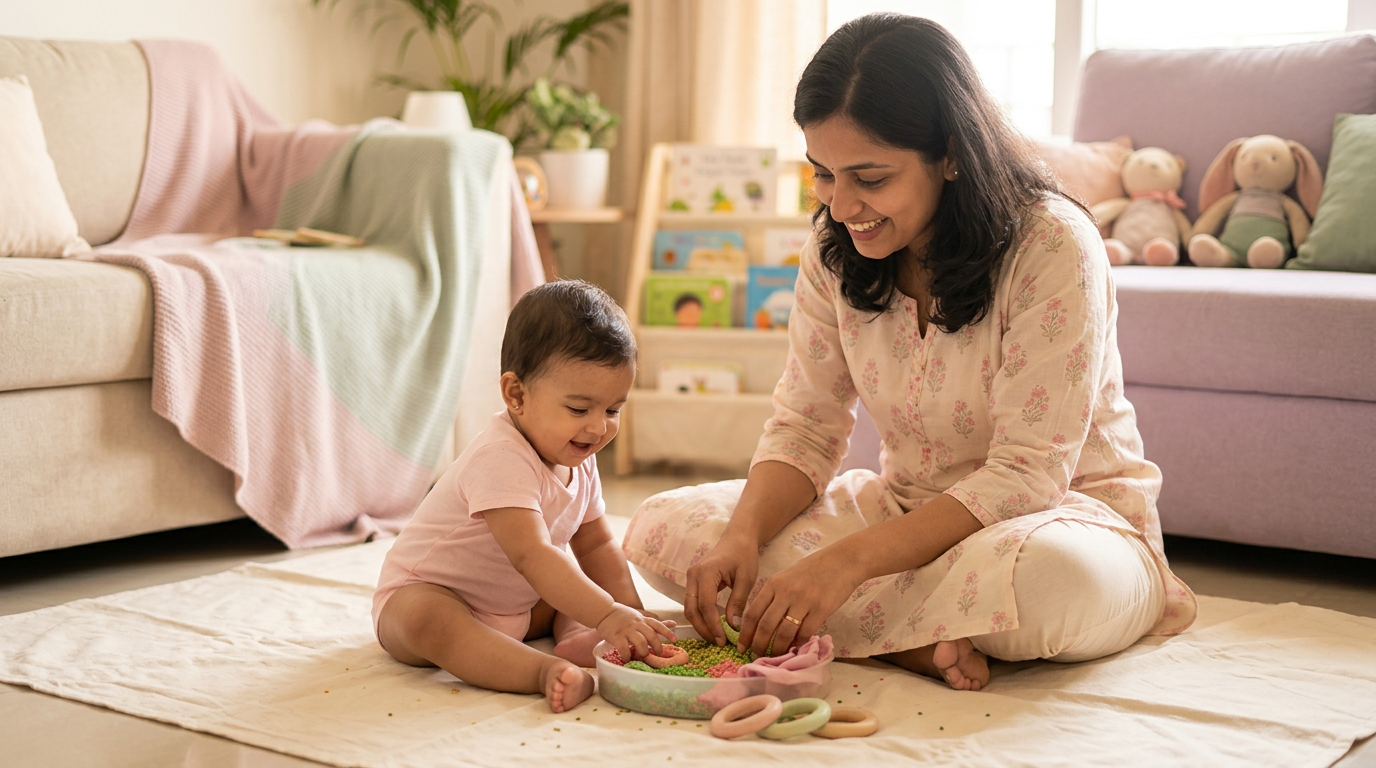
Sensory play for babies isn’t about buying expensive imported kits or aesthetic wooden toys you see on Instagram. In simple terms, it is any activity that stimulates your baby’s senses—touch, smell, taste, sight, and hearing—to build neural pathways in the brain. Whether it is feeling the texture of a cold steel katori or hearing the crinkle of a dried peepal leaf, these everyday experiences are the foundation of cognitive development. In India, we have been doing this for generations through maalish and kitchen-play without even realizing it had a fancy name.
Why Sensory Play for Babies Matters for Brain Development
During the first two years of life, a baby’s brain is like a sponge, absorbing millions of inputs every second. Sensory play for babies is the "gym" for these developing neurons. When your little one squishes a piece of boiled dal or watches the sunlight filter through a dupatta, their brain is learning about cause and effect, spatial awareness, and fine motor skills.
According to the Indian Academy of Pediatrics (IAP), play is essential to development because it contributes to the cognitive, physical, social, and emotional well-being of children. It isn't just "fun"—it is their primary job. By engaging multiple senses, you are helping them build a "sensory map" of the world, which eventually leads to better language skills and problem-solving abilities later in life.
5 Easy Indian Kitchen-Based Sensory Activities
You don't need a Montessori shelf to start. Most Indian households are already goldmines for sensory exploration. Here are five ways to use what you have in a 2BHK:
1. The Steel Uartensil Symphony (Sound & Touch)
Grab a few stainless steel thalis, katoris, and a wooden belan (rolling pin). Let your baby bang them together.
* Skill: Understanding acoustics and hand-eye coordination.
Pro-tip: Put a few dry rajma* beans inside a closed steel container to make a DIY shaker.
2. Atta Dough Exploration (Touch & Smell)
Take a small ball of fresh atta (wheat dough). Let your baby poke it, squeeze it, and pull it apart. The smell of fresh flour and the cool, squishy texture are incredibly grounding.
* Safety: Ensure they don't swallow large chunks, though a tiny taste won't hurt.
3. The Rangoli Rice Bin (Sight & Touch)
Take some leftover rice and color it with a drop of food grade organic turmeric (haldi) or beetroot juice. Put it in a large tray.
* Activity: Hide small Montessori baby toys or spoons inside the rice for them to find.
India Context: This mimics the tactile joy of playing with rangoli* powder but is much safer for babies.
4. Spice Smell Test (Smell)
Hold open containers of saunf (fennel), elaichi (cardamom), or kadipatta (curry leaves) under your baby's nose.
* Benefit: Olfactory stimulation is directly linked to memory centers in the brain.
5. Dupatta Peek-a-Boo (Sight & Movement)
Use a light, sheer chiffon or mulmul dupatta. Drape it over your baby’s face gently and pull it away. The way the light changes through the fabric helps with baby vision simulator concepts like object permanence.
What are the best activities for babies at different stages?
Developmental needs change every three months. What works for a newborn won't engage a 9-month-old crawler.
0 to 3 Months: High Contrast & Touch
At this stage, your baby is adjusting to life outside the womb. During your postnatal recovery (also called postnatal), keep things low-key.
* High-Contrast Cards: Black and white patterns are easiest for their developing eyes to see.
* Maalish: A traditional Indian oil massage is the ultimate sensory experience. Use warm coconut or sesame oil. It builds the bond between mother and child while stimulating the nervous system.
4 to 7 Months: Tummy Time & Texture
This is the peak age for tummy time activities.
* Water Play: Fill a shallow tray with a little water and let them splash while on their belly.
* Mirror Play: Place a safe acrylic mirror in front of them. Seeing their own reflection is a massive cognitive milestone.
8 to 12 Months: Cause and Effect
Now that they are sitting up or crawling, they want to interact more with the world.
* Sticky Tape: Stick some colorful painter's tape to the floor and let them try to peel it off. This is one of the best brain development activities for babies for fine motor precision.
Edible Sand: Crush some biscuits or rusks* into a powder. It looks like sand but is 100% safe if it ends up in their mouth.
Real talk from Indian moms
"We live in a small flat in Mumbai, and I used to feel guilty about not having a 'playroom.' Then my mother told me to just give my daughter a whisk and a bowl of soap suds while I cooked. She spent 20 minutes just watching the bubbles!" — Ria, Mumbai (Mom to 9-month-old Kabir)
"I started using my old silk sarees for sensory play. The different textures—raw silk, soft cotton, scratchy zari—are so much better than plastic toys." — Ananya, Bengaluru (Mom to 6-month-old Ishani)
How to Set Up a Safe Sensory Environment
While sensory play is about exploration, safety in an Indian household is paramount.
If you are tracking your baby's progress, you can use a baby milestones tracker to see how these activities correlate with their growth.
When to call your paediatrician
While every baby develops at their own pace, keep an eye out for these red flags during play:
* Baby does not make eye contact or follow moving objects by 4 months.
* Baby does not respond to loud noises or sudden sounds.
* Baby seems excessively stiff or excessively floppy.
* Baby consistently ignores one side of their body during play.
* Extreme sensitivity to textures (e.g., screaming every time their hands touch something wet or fuzzy) that doesn't improve with exposure.
If you notice your baby is unusually fussy during these sessions, they might be overstimulated. You can use an AI cry analyzer to help distinguish between a "tired" cry and an "overwhelmed" cry.
Frequently Asked Questions
What are the best activities for babies to boost IQ?
There is no single "IQ-boosting" activity, but brain development activities for babies that involve talking, singing, and tactile exploration are the most effective. Reading books together, even if they just chew on the corners, is excellent for future literacy.
Are there specific tummy time activities I should try?
Yes! To make tummy time less frustrating, place a musical toy just out of reach, or lie down face-to-face with your baby. You can also place a water mat or a tray of colorful water in front of them to keep them engaged while they strengthen their neck muscles.
What are some good indoor activities for toddlers who get bored easily?
For older babies and toddlers, indoor activities for toddlers like "obstacle courses" made of pillows, sorting large pasta shapes into different bowls, or finger painting with yogurt and food coloring are great ways to burn energy inside a flat.
Is sensory play for babies messy?
It can be! But you can manage the mess by using a large plastic mat or an old bedsheet. The "mess" is actually a sign of deep learning—your baby is figuring out how solids and liquids behave.
Can I do sensory play during my postnatal recovery?
Absolutely. Sensory play doesn't have to be active for the mother. You can lie in bed and let your baby feel the different textures of your clothes or listen to you hum a bhajan. If you're feeling overwhelmed, checking in with a postnatal wellness assessment can help you balance your own needs with your baby's play.
How long should a sensory session last?
For infants, even 5–10 minutes is plenty. Watch for signs of tiredness like rubbing eyes, turning away, or crying. Quality of interaction matters more than duration.
Sensory play for babies isn't a chore to tick off a list; it’s a way to see the world again through your child's eyes. You don't need a Pinterest-perfect home or expensive imports—your kitchen and your presence are enough. Today, just let them touch the cold water or smell the fresh dhaniya, and know that you are building a brilliant brain, one small sensation at a time.
You are providing exactly what your baby needs to thrive.
Sources & further reading
- Indian Academy of Pediatrics (IAP) - Guidelines on Play
- WHO - Early Childhood Development
- Ministry of Health and Family Welfare - Child Health Care
Written by Dr. Anjali Mehta, MBBS, DCH (Paediatrics)
Reviewed by TheMamaCircle Editorial Team
Last updated: 17 September 2026
This article is for general information only and is not a substitute for personalised medical advice. Always consult your paediatrician or obstetrician for your specific situation.