Developmental Milestones 0-12 Months: Indian Baby Guide
Track your baby's growth with our guide on developmental milestones 0-12 months. Learn when babies roll over & download our expert-backed milestone chart.
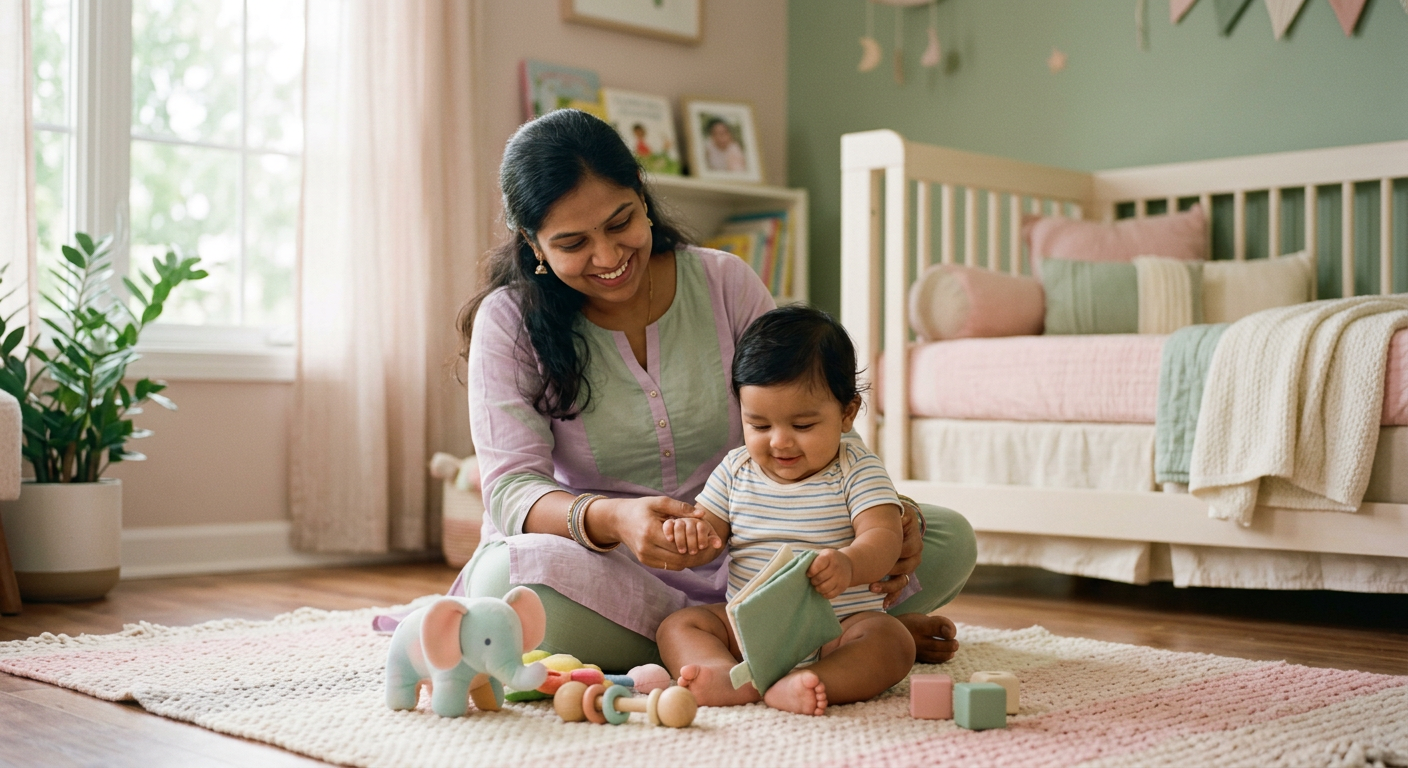
Watching your little one grow from a sleepy newborn into a curious toddler is a whirlwind. Most Indian parents obsess over weight (the first thing Dadi asks is "vazan kitna hai?"), but tracking developmental milestones 0-12 months is actually the best way to ensure your baby’s brain and nervous system are firing on all cylinders. Based on Indian Academy of Pediatrics (IAP) and WHO standards, this guide cuts through the "Sharma ji ka beta" comparisons and gives you the hard facts on what to expect during your postnatal journey.
The First Quarter: 0 to 3 Months (The "Fourth Trimester")
In this early postnatal phase, your baby is adjusting to the world outside the garbh. While they seem to only sleep and eat, their brain is growing at a staggering rate. During these months, you’ll notice the transition from random reflexes to intentional movements.
Key Milestones to Watch:
* Social Smile: By 6 to 8 weeks, your baby should give you a real, gummy smile in response to your voice. This is a major social milestone.
* Head Control: When held against your shoulder, they start to hold their head up briefly. By 3 months, they should lift their head and chest during supervised tummy time.
* Vision: They begin to track moving objects with their eyes. You can test this using high-contrast black and white cards or a brightly coloured rattle. (Check out our baby vision simulator to see how your baby views the world right now).
* Cooing: You’ll hear those sweet "oooh" and "aah" sounds. This is the foundation for future speech.
Pro-Tip: Don't skip the maalish. Daily oil massage (using cold-pressed coconut or sesame oil) is not just a tradition; it’s a great way to improve muscle tone and bond with your baby.
The Second Quarter: 4 to 6 Months (Rolling and Reaching)
This is when life gets active! You might find your baby suddenly on the other side of the bed. This is usually the window for when do babies roll over, starting from tummy to back first.
Key Milestones to Watch:
* Rolling: Most babies roll from front to back by 4-5 months, and back to front by 6 months.
Reaching and Grabbing: They will start grabbing your dupatta* or their own feet. They can hold a rattle and shake it.
Introduction to Solids: Around 6 months, as per WHO and IAP guidelines, you’ll start Annaprashan* or the introduction of solids. Look for signs of readiness like sitting with support and the disappearance of the tongue-thrust reflex.
* Babbles: They start adding consonants to their sounds, like "ba-ba" or "da-da."
If you are worried about their growth trajectory as you start solids, use our baby growth chart to track their weight and height against Indian standards.
The Third Quarter: 7 to 9 Months (The Great Exploration)
Your baby is no longer a "stationary" object. This stage is dominated by the development of the "Pincer Grasp" (using thumb and forefinger) and the beginning of independent mobility.
Key Milestones to Watch:
* Sitting Independently: By 7-8 months, most babies can sit without leaning on their hands (tripod sit).
* Crawling: While some babies skip crawling and go straight to standing, most start to scoot or crawl between 8 and 10 months.
Object Permanence: They start to understand that if you hide a toy under a godhadi (quilt), it hasn't disappeared forever. This is why they love Peek-a-boo (Jhappa*)!
* Stranger Anxiety: Your baby might start crying when held by a distant relative they don't see often. This is actually a positive sign of healthy emotional attachment.
The Fourth Quarter: 10 to 12 Months (Walking and Talking)
The countdown to the first birthday is filled with big physical leaps. The most common question I get in the clinic is when do babies start walking. While the average is 12 months, the normal range is anywhere from 9 to 16 months.
Key Milestones to Watch:
* Pulling to Stand: They will use the sofa or your leg to pull themselves up to a standing position.
* Cruising: Walking while holding onto furniture. Make sure your coffee tables don't have sharp edges!
* First Words: They might say 1-2 words with meaning (like "Mama" or "Pani").
Fine Motor Skills: They can drop a block into a container and feed themselves small bits of roti* or soft fruit using their fingers.
For a full breakdown of every tiny shift, you can refer to our comprehensive baby development month by month guide or download our baby milestones tracker.
Real talk from Indian moms
"Everyone told me my son should be walking by 10 months because his cousin did. I was so stressed! But he took his first steps at 14 months, right on his own schedule. Every baby really is different." — Sunita R., Bengaluru, Mom to 18-month-old Arjun.
"I used to think tummy time was a Western concept, but my Nani reminded me that putting the baby on their stomach across your lap while massaging is basically the same thing. It helped my daughter find her balance much faster." — Priya M., Delhi, Mom to 7-month-old Kyra.
"We live in a joint family, so there’s constant noise. I was worried about my baby's speech, but the constant 'chatter' from his aunts and cousins actually helped him pick up words like 'Didi' and 'Khao' by 11 months!" — Ananya S., Pune, Mom to 1-year-old Ishaan.
When to call your paediatrician
As a doctor, I tell parents: trust your gut, but watch for these clinical "Red Flags." If your baby isn't hitting these developmental milestones 0-12 months, it doesn't always mean a "disorder," but it does require an evaluation.
* By 3 Months: Does not follow moving objects with eyes; does not respond to loud sounds; does not smile at people.
* By 6 Months: Feels very stiff or very floppy; does not reach for objects; shows no affection for caregivers.
* By 9 Months: Does not sit with help; does not babble ("ba-ba", "da-da"); does not recognize familiar faces.
* By 12 Months: Does not crawl; cannot stand when supported; does not search for objects that are hidden while they watch; does not say single words.
* Any Age: A "loss of milestones"—if they could sit and now they can't, or they were babbling and now they are silent, call your doctor immediately.
Frequently Asked Questions
When do babies roll over?
Most babies begin attempting to roll from their stomach to their back around 4 months. By 6 months, they usually master rolling in both directions. Ensure they have plenty of floor time on a firm mat (like a traditional chatai or a foam play mat) to practice these muscles.
When do babies start walking?
The typical window for a baby's first independent steps is between 9 and 15 months. Do not worry if your 12-month-old is only "cruising" (walking while holding furniture). Avoid using circular baby walkers, as the IAP discourages them due to safety risks and potential delays in natural muscle development.
What are the developmental milestones 0-12 months?
These milestones are a set of functional skills or age-specific tasks that most children can do by a certain age range. They cover four main areas: Gross Motor (sitting/walking), Fine Motor (grabbing/picking up items), Language (cooing/words), and Social/Emotional (smiling/playing).
How can I use a baby milestone chart effectively?
A baby milestone chart should be used as a general road map, not a rigid exam schedule. Mark the dates your baby achieves a skill, and if you notice a delay of more than 2 months past the "average" age, discuss it with your paediatrician during your next vaccination visit.
Does "baby development month by month" vary for premature babies?
Yes. For babies born before 37 weeks, we use "corrected age." If your baby was born 2 months early, at 6 months chronological age, we look for milestones expected of a 4-month-old.
My baby isn't crawling yet at 9 months, is this a problem?
Not necessarily. Some babies "army crawl," some "bottom shuffle," and some skip crawling entirely to go straight to standing. As long as they are moving their limbs symmetrically and trying to navigate their environment, it is usually not a cause for concern.
Every child is a unique individual who will bloom in their own time. While trackers and charts are helpful tools, your love, presence, and engagement are the best fuels for your baby's growth.
I am doing a great job, and my baby is growing exactly as they need to.
Sources & further reading
- Indian Academy of Pediatrics (IAP) Growth Charts
- WHO Infant Development Milestones
- AIIMS Paediatrics Milestone Guidelines
- National Health Portal (NHP) India - Child Health
Written by Dr. Anjali Mehta, MBBS, DCH (Paediatrics)
Reviewed by TheMamaCircle Editorial Team
Last updated: 9 September 2026
This article is for general information only and is not a substitute for personalised medical advice. Always consult your paediatrician or obstetrician for your specific situation.