Newborn Vision Guide: What Your Baby Sees Week-by-Week
Newborn vision is a blurry world of high contrast. Learn what your baby sees week-by-week, when eye color settles, and red flags for Indian moms to watch.
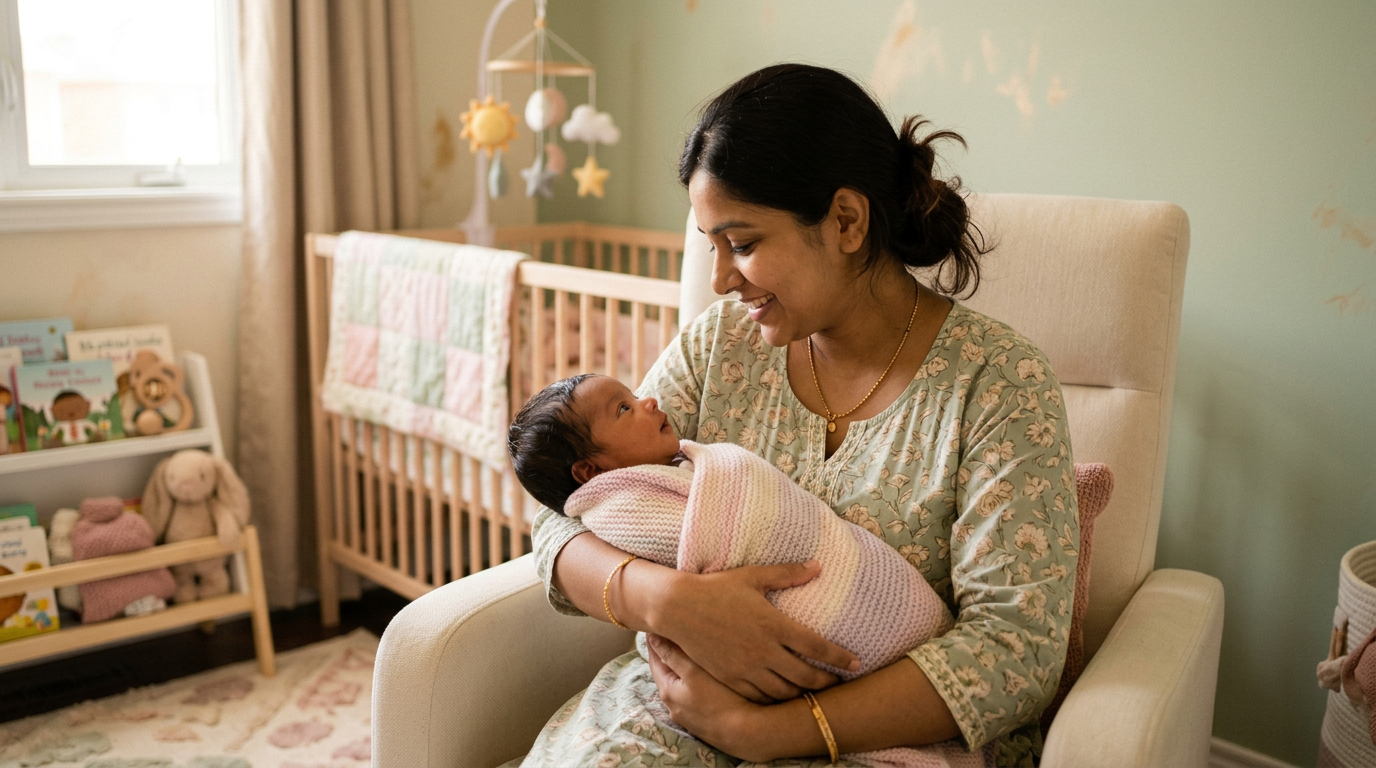
A newborn vision is a blurry, black-and-white world where your baby can only see things clearly between 8 to 12 inches away—conveniently, the exact distance from your face to theirs during stanpaan (breastfeeding). While their eyes are physically formed at birth, the brain isn't yet ready to process complex visual data, meaning they see the world like a fuzzy, low-resolution photograph. Over the first few months of the postnatal period (also called postnatal), their vision will sharpen, colours will emerge, and they will eventually track your movement across the room.
What Can Newborn Babies See Right Now?
If you are wondering can newborn babies see the beautiful nursery decals you spent weeks choosing, the honest answer is: not really. A neonate's visual acuity is roughly 20/600. In simple terms, what you can see clearly from 600 feet, they need to be 20 feet away from to see with the same clarity.
The 20-Centimetre Rule
In these early postnatal weeks, your baby’s world is small. They focus best on objects 20 to 30 centimetres (8–12 inches) from their face. This isn't an evolutionary accident; it’s the distance to your face when you are cradling them. They are biologically programmed to find your eyes and bond with you.
Contrast is Queen
Forget pastel pinks and soft mint greens for now. A newborn’s retina can only distinguish between high-contrast boundaries. This is why black-and-white patterns or high-contrast flashcards are so effective. If you place a black-and-white panda toy next to a light blue teddy bear, your baby will stare at the panda every single time.
Newborn Vision Week-by-Week Guide
Understanding newborn vision examples helps you set realistic expectations for playtime. You can even use our baby vision simulator to get a glimpse of their fuzzy perspective.
Weeks 0–4: The Blur Phase
Light Sensitivity: You’ll notice your baby blinking at bright lights. In India, we often use heavy curtains or parda during the sutak* or initial postnatal confinement period; this actually helps the baby adjust to light levels gradually.
* Peripheral Vision: They can see things to their side better than things directly in front of them initially.
* Eye Crossing: It is very common for a newborn's eyes to occasionally cross or drift outward. Their eye muscles are still learning to work in tandem.
Months 1–2: The Colour Awakening
Tracking: Around the 5-week mark, they might start following a slow-moving jhunjhuna* (rattle) or your face.
Primary Colours: Red is usually the first colour they see, followed by green. If you want to engage them, wear a bright red bindi* or a vibrant dupatta—they’ll be mesmerised.
Months 3–4: Depth and Focus
* Hand-Eye Coordination: You’ll see them batting at toys on their play gym.
* Depth Perception: They begin to understand how far away objects are, which is a massive leap in brain development. This is a great time to start using a baby milestones tracker to log these visual wins.
When Do Babies Start Seeing and Hearing Clearly?
Parents often ask when do babies start seeing and hearing as a combined milestone. While hearing is quite well-developed at birth (they’ve been eavesdropping on your conversations in the garbh for months!), vision takes much longer to mature. By month four, these two senses start working together perfectly. Your baby will hear your voice from across the room and turn their head to visually locate you.
The Mystery of Newborn Eye Colour
One of the most common questions in Indian households is whether the baby will inherit Dadi's light eyes or Nana's dark ones. The truth about newborn eye color is that it is rarely permanent at birth.
Most Indian babies are born with dark grey or deep brown eyes. However, the amount of melanin (pigment) in the iris changes with exposure to light. You typically won't know the final, permanent eye colour until the baby is 6 to 9 months old, and in some cases, it can keep shifting until their third birthday. If your baby is born with lighter eyes, don't buy the matching lehenga just yet—they might darken significantly by the time they start solids!
Real Talk from Indian Moms
"I spent ₹3,000 on a fancy musical mobile with tiny pastel birds. My daughter didn't even look at it. Then my mother-in-law hung a simple black and white newspaper cutout near her cot, and she wouldn't stop staring at it for twenty minutes!"
— Ananya S., Bengaluru (Mom to 2-month-old Ishaan)
"During my postnatal recovery, I was worried because Meera's eyes kept crossing whenever I held her close. My paediatrician laughed and said she was just 'learning to drive' her eye muscles. By week 8, she was tracking my red dupatta perfectly."
— Priya V., Lucknow (Mom to 5-month-old Meera)
Helping Your Baby’s Vision Develop
When to Call Your Paediatrician
While most visual quirks in the postnatal period are normal, the Indian Academy of Paediatrics (IAP) recommends keeping an eye out for these red flags:
* White Pupil: If you notice a white or yellowish glow in the pupil (the black part of the eye) in photos or under light, this requires an immediate check-up to rule out retinoblastoma.
* Excessive Watering: While "sticky eyes" are common due to blocked tear ducts, constant tearing or pus-like discharge needs a doctor’s look.
* Extreme Light Sensitivity: If your baby screams or seems in pain in normal indoor lighting.
* Constant Eye Crossing: It’s normal for eyes to drift occasionally until 3 months, but if they are fixed in a crossed position or drift constantly after month 4, consult a paediatric ophthalmologist.
* Redness or Swelling: Any signs of infection (conjunctivitis) which is common in crowded Indian urban environments.
Monitoring your baby's newborn vision is one of the most rewarding parts of early parenthood. Seeing that first moment of recognition when they lock eyes with you makes all those sleepless nights feel worth it. Be patient with their blurry world; they are working hard to see you clearly.
You are the most beautiful thing your baby will ever see.
Sources & further reading
- Indian Academy of Pediatrics - Visual Development Guidelines
- AIIMS - Pediatric Ophthalmology Care
- WHO - Visual Health in Neonates
Written by Dr. Anjali Mehta, MBBS, DCH (Paediatrics)
Reviewed by TheMamaCircle Editorial Team
Last updated: 24 September 2026
This article is for general information only and is not a substitute for personalised medical advice. Always consult your paediatrician or obstetrician for your specific situation.