When Do Babies Start Walking? India Guide & Milestone Chart
When do babies start walking? Most Indian babies take their first steps between 9-15 months. Track milestones and learn the red flags to watch for.
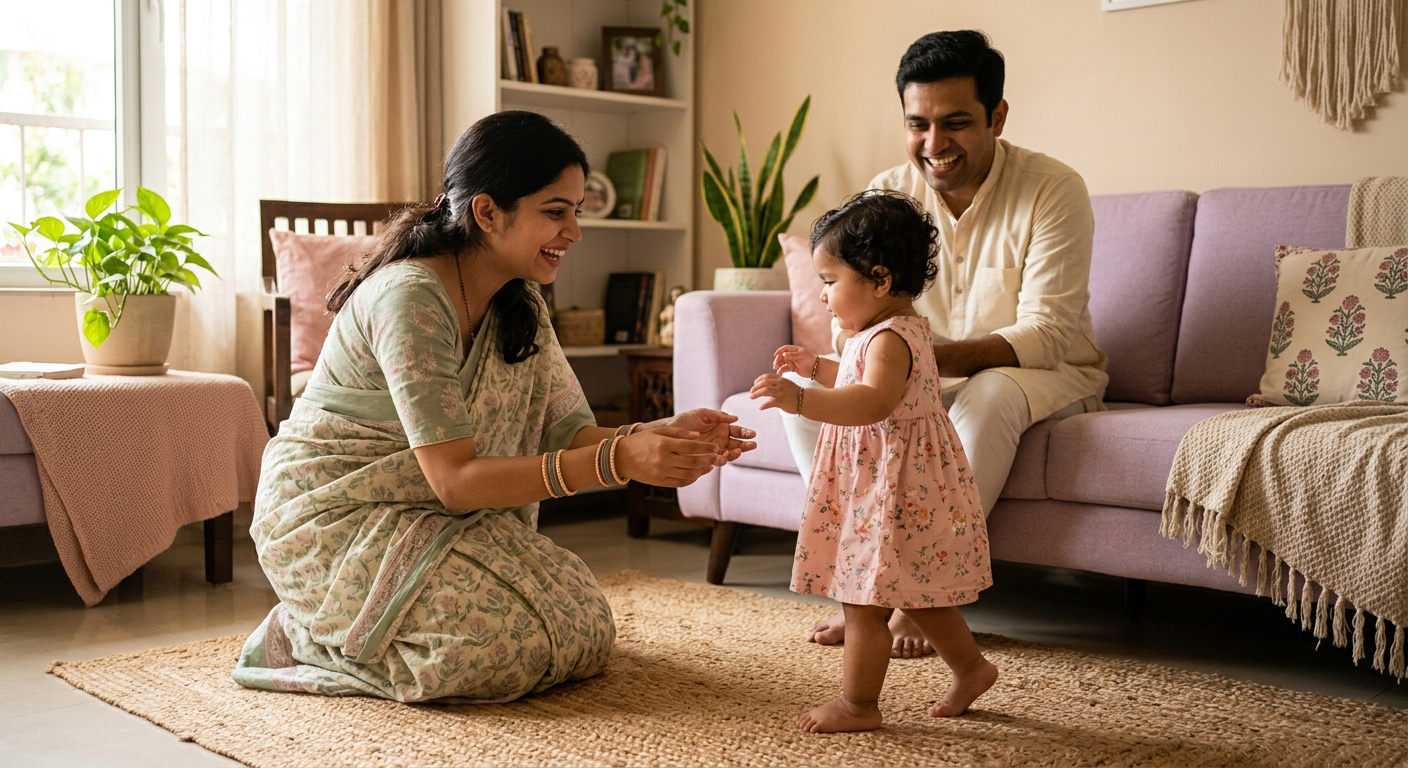
Most Indian parents will see the "magic moment" happen between 9 and 15 months of age. While the average age for when do babies start walking is around the 12-month mark, the Indian Academy of Pediatrics (IAP) reminds us that every child follows their own biological clock. Some "early birds" might cruise at 8 months, while others wait until 16 or 17 months to take those first independent steps without a finger to hold.
The Stages of Learning to Walk
Walking isn't a switch that flips overnight; it is the grand finale of a long series of motor developments. If you’ve been tracking your baby development month by month, you know that walking requires core strength, balance, and a healthy dose of courage.
1. Rolling and Sitting (4-7 Months)
Before a baby can stand, they must master the art of the roll. Knowing when do babies roll over is the first indicator of the trunk strength needed for later mobility. By 6-7 months, most Indian babies sit without support, often entertained by a simple jhunjhuna (rattle) or a soft cloth book.
2. Pulling Up to Stand (8-10 Months)
This is the stage where your furniture starts getting a workout. Your little one will grab the edge of the diwan or the bars of their cot to pull themselves up. At this stage, they haven't quite figured out how to get back down, often leading to a "plop" and a few tears.
3. Cruising (9-11 Months)
Cruising is when a baby moves around the room by holding onto furniture. They are testing their weight distribution. This is a great time to ensure your home is child-proofed. Sharp edges of teak wood coffee tables should be padded. You can use our baby milestones tracker to log these mini-wins as they happen.
Factors That Influence When Do Babies Start Walking
In India, cultural practices and home environments play a massive role in motor development. While genetics are the primary driver, these factors also matter:
Maalish (Massage) Habits: Traditional Indian oil massage, often done by a dai* or the mother herself using mustard oil or coconut oil, helps in improving blood circulation and muscle tone. While it doesn't "make" a baby walk faster, the physical stimulation is excellent for sensory-motor development.
Floor Time vs. Gadgets: Babies who spend more time on a clean dhurrie* or play mat develop stronger muscles than those kept in bouncers or walkers. The WHO and IAP strictly advise against the use of circular baby walkers, as they can cause toe-walking and are a major source of head injuries.
Temperament: Some babies are "cautious observers" who won't let go of your hand until they are 100% sure they won't fall. Others are "risk-takers" who don't mind a few bumps on the aangan* (courtyard) floor.
* Weight: If a baby is on the higher end of the baby growth chart, they might take a little longer to find their center of gravity compared to a leaner baby.
Real Talk from Indian Moms
"My elder son walked at 10 months, but my daughter didn't even try until she was 14 months. I was so stressed because my sasu maa kept comparing them! Finally, she just stood up one day at a wedding and walked toward the gulab jamun stall. Food is a great motivator!" — Pooja R., Delhi (Mom to a 3-year-old and 18-month-old)
"We live in a joint family, so someone was always carrying my baby. My paediatrician told me, 'Put her down! If she's always in a lap, why would she bother walking?' As soon as we gave her more floor time, she started cruising within two weeks." — Meenakshi S., Bengaluru (Mom to a 14-month-old)
Encouraging Those First Steps Safely
You don't need expensive battery-operated toys to help your baby walk. Simple, traditional methods work wonders.
* The Barefoot Advantage: Let your baby be barefoot at home. The soles of the feet provide vital sensory feedback from the floor (whether it's cool marble or warm wood). Grippy socks are fine for winter, but bare feet are best for balance.
Push Toys: Instead of a sit-in walker, give them a sturdy wooden push-cart (often called a Gaadi* in some regions). Ensure it complies with BIS (IS 9873) safety standards so it doesn't tip over.
Strategic Toy Placement: Place their favorite toy (or a piece of roti*) just out of reach on a low table to encourage them to cruise or take a step.
* Postnatal Care for Mom: Remember, as your baby gets mobile, you will be bending and lifting more. If you are experiencing back pain or "mummy tummy," check our free diastasis recti self-check to ensure your core is recovering properly during your postnatal phase (also called postnatal).
When to Call Your Paediatrician (Red Flags)
While there is a wide range of "normal," the IAP suggests a developmental screening if you notice the following:
* The baby is 18 months old and still not walking independently.
* The baby walks only on their tiptoes for more than a few months.
* There is a noticeable limp or the baby seems to favor one leg significantly over the other.
* The baby had started walking but suddenly loses the ability or regresses significantly.
* The baby seems excessively "floppy" or has very stiff legs that are hard to bend.
* The baby isn't reaching other developmental milestones 0-12 months like sitting or crawling.
Frequently Asked Questions
When do babies start walking on average?
Most babies take their first steps between 11 and 13 months, but the window of 9 to 15 months is considered perfectly normal. In India, we often see a slight delay if the baby is frequently carried by family members or kept in a "jhula" for long periods.
What should be in a 0-12 month baby milestone chart?
A comprehensive baby milestone chart should include gross motor skills (rolling, sitting, crawling), fine motor skills (pincer grasp), language (babbling "da-da"), and social milestones (smiling, stranger anxiety). Walking is usually the final entry in the 0-12 month category.
Is it true that boys walk later than girls?
There is no significant scientific evidence from the WHO or IAP to suggest a gender divide in when babies start walking. It depends more on the individual child’s physical strength and temperament than whether they are a boy or a girl.
My baby is 14 months and only crawls. Is this a delay in baby development month by month?
Not necessarily. Many "bottom shufflers" or efficient crawlers delay walking because they can get where they want to go very quickly by crawling. As long as they are pulling up to stand and cruising, they are likely on track.
Should I buy expensive shoes for my baby's first steps?
No. In fact, shoes with hard soles can make it harder for a baby to learn balance. Inside the house, barefoot is best. For outside, choose a soft, flexible sole that allows the foot to move naturally. You can find good quality first-walker shoes in India for ₹500–₹1200.
Does late walking mean my baby is less intelligent?
Absolutely not. There is no correlation between the age a child walks and their future IQ or academic success. Some of the world’s most brilliant minds were late walkers!
Your baby will find their feet when they are ready, and no amount of worrying will speed up their biology. For now, keep your floors clear, your camera charged for that first wobbly video, and trust the process. You are doing a great job, Mumma.
Sources & further reading
- IAP Growth Charts and Milestones
- WHO Motor Development Milestones
- National Health Portal India - Child Development
Written by Dr. Anjali Mehta, MBBS, DCH (Paediatrics)
Reviewed by TheMamaCircle Editorial Team
Last updated: 15 September 2026
This article is for general information only and is not a substitute for personalised medical advice. Always consult your paediatrician or obstetrician for your specific situation.